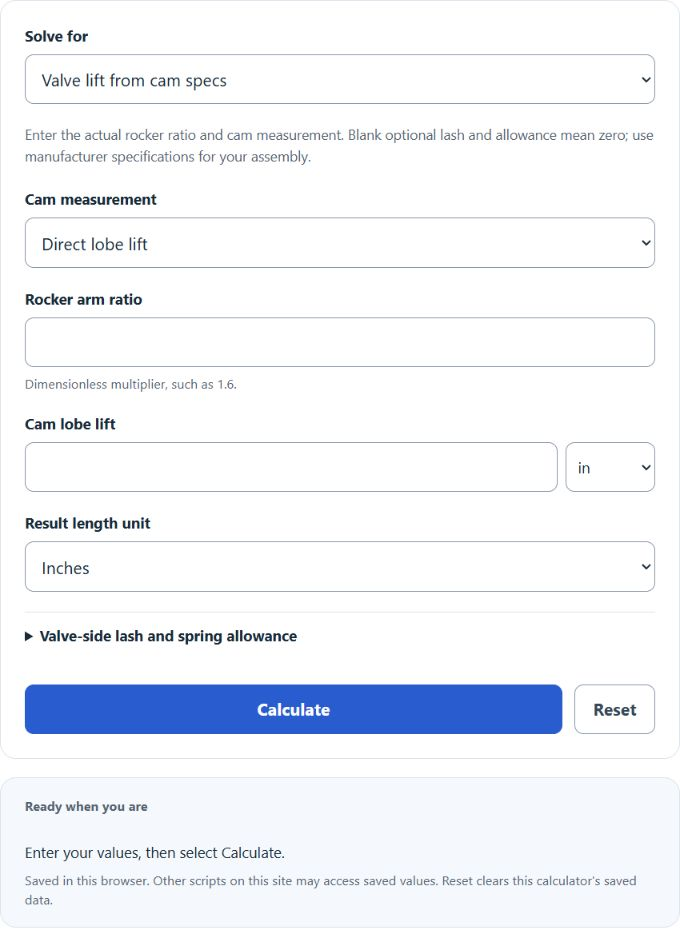
Calculate gross and net valve lift from cam lobe lift, rocker ratio, and lash, or reverse-solve the cam lift required for a target net lift in inches or millimeters.
- All Automotive Calculators
- Rocker Arm Ratio Calculator
- PTO Ratio Calculator
- Ring Gap Calculator
- Valve Spring Pressure Calculator
Valve Lift Formula
Valve lift is the total distance the valve opens from its seat. In a rocker-arm valvetrain, valve lift is determined by the cam lobe lift and the rocker ratio. This calculator returns net valve lift from cam measurements and rocker ratio, or required cam lobe lift from a target net lift. The formula below describes gross valve lift before lash.
- VL = valve lift
- LL = maximum lobe lift
- RR = rocker ratio
The gross-lift relationship can be rearranged as follows. For a net-lift target, add valve-side lash to the target before dividing by rocker ratio. The rocker-ratio formula below is a related algebraic relationship.
How to Use the Valve Lift Calculator
- Enter the maximum lobe lift from the camshaft specification.
- Enter the rocker ratio.
- The calculator returns the valve lift in the selected unit.
- For the inverse calculation, choose cam lobe lift from target and enter target net lift plus the rocker ratio. Enter valve-side lash in the optional section if needed.
Each length field supports inches or millimeters and converts its entered quantity when its unit changes. Rocker ratio is unitless. Blank optional valve-side lash and spring allowance mean zero.
For measured cam dimensions, lobe lift is overall lobe height minus base-circle diameter, without dividing by two. Overall height runs from the lobe nose to the opposite base-circle surface through the cam center. Measure the true base circle carefully; ramps can affect a caliper reading. See Cat Cams’ measurement instructions.
What Each Input Means
| Term | Description | Unit |
|---|---|---|
| Maximum Lobe Lift | The lift produced directly by the cam lobe before rocker multiplication. | in or mm |
| Rocker Ratio | The multiplication factor created by the rocker arm geometry. | Unitless |
| Valve Lift | The actual valve opening distance predicted from lobe lift and rocker ratio. | Same unit as lobe lift |
Examples
These ideal examples use zero valve-side lash and zero optional spring allowance. With nonzero lash, net valve lift is gross lift minus that valve-side lash.
Example 1: A camshaft has a maximum lobe lift of 0.320 in and the engine uses a 1.60 rocker ratio.
The predicted valve lift is 0.512 in.
Example 2: You want 12.0 mm of valve lift and have a 1.50 rocker ratio.
The required lobe lift is 8.0 mm.
Example 3: Measured valve lift is 0.525 in and lobe lift is 0.350 in.
The rocker ratio is 1.50.
Why Valve Lift Matters
Valve lift affects how far the intake or exhaust valve opens, which directly influences airflow through the cylinder head. In general, lift is an important part of overall valvetrain behavior because it impacts:
- Airflow potential through the ports and valve curtain area
- Engine breathing at different RPM ranges
- Camshaft and rocker matching during engine builds
- Valvetrain stress as lift and effective motion increase
- Component clearance throughout the full lift cycle
Practical Notes
The calculator gives the theoretical valve lift based on the published lobe lift and rocker ratio. Actual measured lift at the valve can vary slightly because of lash, rocker geometry, flex, wear, and manufacturing tolerances.
- Do not confuse cam lobe lift with valve lift.
- A higher rocker ratio increases valve lift for the same cam lobe.
- If units do not match, the result will be incorrect.
- Very small changes in rocker ratio can produce meaningful changes in final valve lift.
Before Increasing Valve Lift
If you are changing rocker ratio or cam profile, verify that the rest of the valvetrain can safely support the added lift.
- Valve spring coil bind clearance
- Retainer-to-seal or retainer-to-guide clearance
- Piston-to-valve clearance
- Pushrod length and rocker geometry
- Manufacturer lift limits for heads, springs, and rockers
Common Mistakes
- Entering valve lift where lobe lift is required
- Using an advertised rocker ratio without checking the actual setup
- Mixing inches and millimeters in the same calculation
- Assuming more lift always produces more usable power
- Ignoring clearance checks after changing rocker ratio
Frequently Asked Questions
Is rocker ratio a measurement unit?
No. Rocker ratio is a dimensionless multiplier, such as 1.5, 1.6, or 1.7.
Can I use inches or millimeters?
Yes. Just keep lobe lift and valve lift in the same unit.
Does this calculator account for lash or deflection?
It subtracts the valve-side lash you enter from gross lift. It does not model deflection or changing rocker geometry, so measured lift can differ.
Why is valve lift larger than lobe lift?
Because the rocker arm multiplies the cam lobe movement by the rocker ratio.