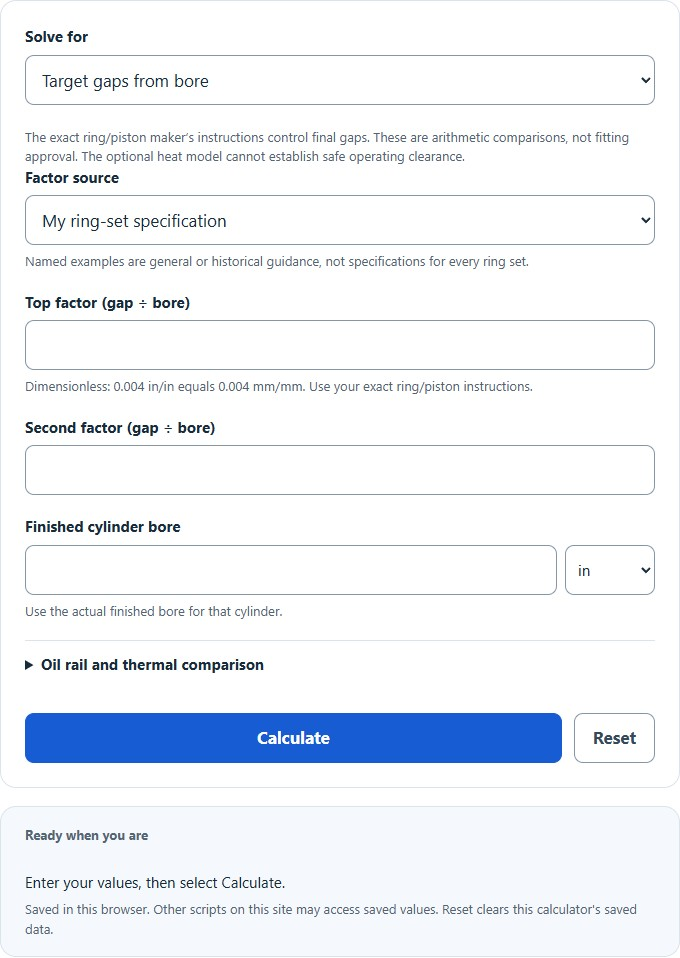
Calculate top and second piston ring gaps from bore and stated gap factors, compare measured gaps, or reverse the ratio for an equivalent bore. Enter the specification for the exact ring set and operating conditions; optional thermal arithmetic does not approve fitting.
- All Automotive Calculators
- Bore X Stroke Calculator
- Bore to Stroke Ratio Calculator
- Piston Valve Clearance Calculator
- Compression Height Calculator
- Engine Intake Diameter Calculator
- Intake Runner Length Calculator
- Piston Speed Calculator
Ring Gap Rule-of-Thumb Formula
The calculator multiplies bore by independent top and second ring factors, or reverses that ratio. Custom factors from the exact ring instructions are the starting choice. Named general examples are comparisons, not universal application specifications. The 0.004 formula below is an illustrative ratio; final targets and allowable ranges come from the ring manufacturer.
In this rule, the gap is approximately four thousandths of the bore for every one unit of bore diameter. The multiplier is a ratio, so it stays the same as long as the bore and ring gap use the same unit.
- RG = ring end gap
- BS = cylinder bore size
- 0.004 = illustrative top-ring multiplier, not a universal minimum
How to Use the Ring Gap Calculator
- Choose a task and enter the ring manufacturer’s factors for the actual ring set and operating conditions, or explicitly select a named general example.
- Enter the finished honed bore, measured gap or known gap required by that task. Select the unit matching each measurement.
- Select Calculate. A measured-gap difference is an arithmetic comparison with the entered minimum; a larger gap is not automatically within the manufacturer’s full specification.
- Use the result as a starting point, then compare it to the specification for your exact ring set and application.
Why Ring Gap Matters
Piston rings expand as engine temperature rises. If the end gap is too small, the ring ends can touch when hot, which can damage the ring, piston, or cylinder wall. If the gap is too large, sealing efficiency may drop and blow-by can increase. The correct target is enough clearance for thermal expansion while still maintaining effective sealing.
Unit Notes
This rule works in inches, millimeters, centimeters, or any other unit, provided both measurements use the same unit system.
That means a 90 mm bore and a 3.543 in bore produce the same physical gap; only the displayed unit changes.
Example
If the bore size is 3.50 inches, the estimated ring gap is:
Converted to millimeters:
If you already know the desired ring gap and want the equivalent bore estimate, you can reverse the formula:
Quick Reference Table
| Bore Size (in) | Estimated Gap (in) | Estimated Gap (mm) |
|---|---|---|
| 3.000 | 0.0120 | 0.305 |
| 3.250 | 0.0130 | 0.330 |
| 3.500 | 0.0140 | 0.356 |
| 3.750 | 0.0150 | 0.381 |
| 4.000 | 0.0160 | 0.406 |
| 4.250 | 0.0170 | 0.432 |
| 4.500 | 0.0180 | 0.457 |
What Can Change the Final Target Gap?
The 0.004 multiplier is a general estimate, not a universal final specification. The actual gap you use may change based on:
- Ring position: top and second compression rings are not always set to the same gap.
- Operating heat: hotter running combinations usually need more clearance.
- Application type: mild street use, heavy load, racing, boost, and nitrous setups do not all use the same target.
- Ring material and design: different ring packages can call for different end gaps.
- Manufacturer instructions: the ring maker’s specification should take priority over a rule-of-thumb estimate.
Optional Thermal Comparison
The thermal comparison requires separate ring and cylinder temperature rises from the same cold reference, plus appropriate expansion coefficients. It expands the bore circumference and the ring’s free arc length independently: hot model gap = cold gap + π × bore × bore coefficient × bore temperature rise − (π × bore − cold gap) × ring coefficient × ring temperature rise. This simplified free-expansion model omits restraint, gradients and operating deformation. A positive result is not a safety verdict; a zero or negative result reaches the limit of the open-gap model. No application-based temperature is assumed, and the result must not replace ring instructions.
Practical Tips Before Final Assembly
- Measure the actual finished bore, not only the nominal advertised bore size.
- Check each ring in the exact cylinder where it will be installed.
- Keep the ring square in the bore when measuring end gap.
- Follow the exact ring maker’s filing and measurement instructions. Oil rails and expanders have separate requirements; do not infer permission to file them from a generic minimum gap.
- Record each cylinder and ring measurement so nothing gets mixed up during assembly.
Common Questions
Does the 0.004 value change in metric units?
No. Because it is a ratio, the same multiplier works in any unit system as long as the bore and gap use the same unit.
Can this calculator replace the ring manufacturer’s spec sheet?
No. It provides a quick estimate for planning and checking, but final ring end gap should be set from the specification for the exact ring set and operating conditions.
Is a larger gap always safer?
A gap that is too small is risky because thermal expansion can close it up, but an excessively large gap can reduce sealing performance. The goal is not simply a larger gap; it is the correct gap for the build.