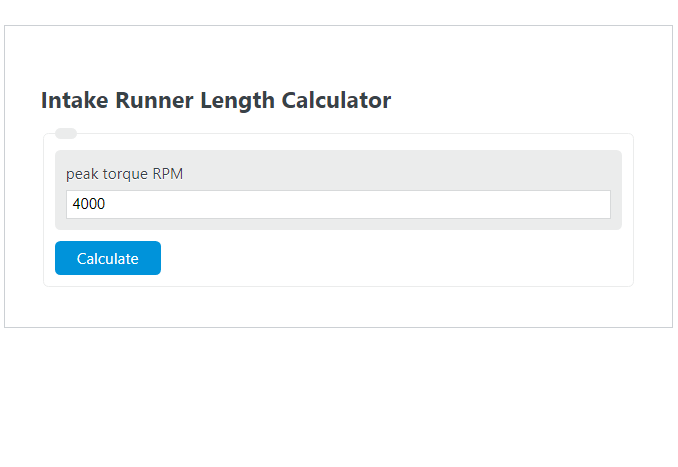
Calculate intake runner length or peak torque RPM with this rule-of-thumb calculator for intake tuning in engines using cm, m, in, or ft.
- All Automotive Calculators
- Intake Length Calculator
- Engine Intake Diameter Calculator
- Velocity Stack Length Calculator
- Lobe Separation Angle Calculator
- RPM to Torque Calculator
- J-Pipe Resonator Calculator
Intake Runner Length (Rule-of-Thumb) Formula Used by This Calculator
This calculator estimates a starting intake runner length from the engine speed where you want peak torque to occur. It is best used for early manifold planning, comparing design directions, or checking whether a proposed runner is likely to favor lower-RPM or higher-RPM torque.
- IRL = estimated intake runner length in centimeters
- PT = target peak torque engine speed in RPM
If you already know the runner length and want to estimate the torque peak RPM implied by this same rule-of-thumb, rearrange the equation as follows:
How to Calculate Intake Runner Length
- Choose the engine speed where you want peak torque to occur.
- Divide that RPM value by 1000.
- Subtract the result from 10.
- Multiply by 4.3.
- Add 17.8 to get the estimated runner length in centimeters.
The relationship is simple: lower target torque RPM gives a longer runner, while higher target torque RPM gives a shorter runner.
Example 1: Target Peak Torque at 4,000 RPM
For a 4,000 RPM torque target, the estimated intake runner length is 43.6 cm.
Example 2: Known Runner Length of 35 cm
A runner length of 35 cm corresponds to an estimated peak torque point of about 6,000 RPM in this simplified model.
Quick Reference Table
| Target Peak Torque RPM | Estimated Runner Length |
|---|---|
| 3,000 RPM | 47.9 cm |
| 4,000 RPM | 43.6 cm |
| 5,000 RPM | 39.3 cm |
| 6,000 RPM | 35.0 cm |
| 7,000 RPM | 30.7 cm |
| 8,000 RPM | 26.4 cm |
How to Interpret the Result
- Longer runners generally support stronger low-speed and mid-range cylinder filling.
- Shorter runners generally move the tuning effect higher in the RPM range.
- The calculator gives a starting length, not a final specification for every engine combination.
What Counts as Runner Length?
In practice, “runner length” is not always measured the same way. Some builders reference the length from the intake valve area through the port and manifold path, while others measure only the external manifold section. For the best comparison between designs, measure the actual airflow path as consistently as possible.
- Use the runner centerline rather than a straight end-to-end distance.
- Be consistent about whether the cylinder head port is included.
- If the runner has a bellmouth or tapered entry, keep that reference point consistent across designs.
Why This Formula Is Only a Starting Estimate
Real intake tuning is affected by more than runner length alone. The final torque curve can shift based on pressure-wave behavior, intake temperature, and the rest of the induction system.
- Wave timing and harmonic selection can change the ideal effective length.
- Cam timing and intake valve closing influence where the engine responds best.
- Runner diameter, taper, plenum volume, and entry shape also affect performance.
- Fabrication constraints may require a compromise between packaging and tuning.
Common Length Conversions
These conversions are useful when the design estimate is generated in centimeters but the manifold is being built or packaged using inches or feet.
Practical Use Tips
- Use the calculated value as a first-pass design target.
- Compare multiple lengths if your engine operates across a wide RPM band.
- Recheck the estimate whenever major camshaft, plenum, or throttle-body changes are made.
- Validate the final design with testing whenever possible.