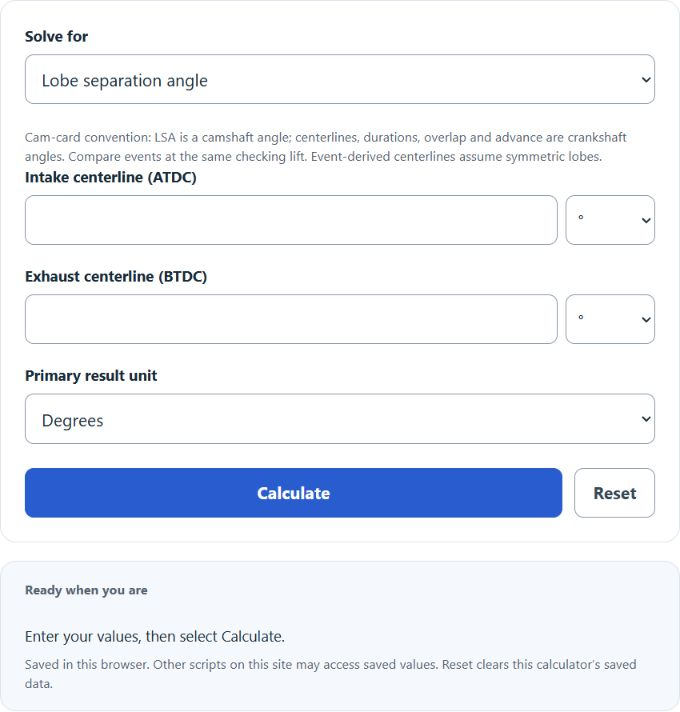
Calculate lobe separation angle, valve overlap, and intake/exhaust centerlines from cam durations, events, and advance in degrees or radians.
- All Automotive Calculators
- Air to Fuel Ratio (AFR) Calculator
- Exhaust Diameter Calculator
- Intake Length Calculator
- Valve Spring Pressure Calculator
- Valve Lift Calculator
- Intake Runner Length Calculator
- Exhaust Length Calculator
Lobe Separation Angle Formula
Variables:
- LSA is the lobe separation angle (camshaft degrees)
- IC is the intake centerline (degrees ATDC, crankshaft degrees)
- EC is the exhaust centerline (degrees BTDC, crankshaft degrees)
To calculate LSA, use the formula above with intake centerline in crankshaft degrees ATDC and exhaust centerline in crankshaft degrees BTDC. Event-derived centerlines use duration midpoints and assume symmetric lobes; use the same checking lift for all events and durations.
How to Calculate Lobe Separation Angle?
The following steps outline how to calculate the Lobe Separation Angle.
- First, choose the value to solve for and determine the intake centerline in crankshaft degrees ATDC.
- Next, determine the exhaust centerline (deg).
- Next, gather the formula from above = LSA = (IC + EC) / 2.
- Finally, calculate the Lobe Separation Angle.
- After inserting the variables and calculating the result, check your answer with the calculator above.
Example Problem :
Use the following variables as an example problem to test your knowledge.
intake centerline (deg) = 108
exhaust centerline (deg) = 112
Frequently Asked Questions (FAQ)
What is the significance of the Lobe Separation Angle in an engine?
The Lobe Separation Angle (LSA), together with duration and other engine factors, affects several aspects of an engine's performance, including idle characteristics, vacuum, torque curve shape, and where the engine tends to make its best power. At fixed durations, a smaller (tighter) LSA generally increases valve overlap, which usually reduces idle quality/low-speed vacuum and can make the power band narrower and “peakier.” A larger (wider) LSA generally reduces overlap, improving idle quality/vacuum and often broadening the torque curve.
How does changing the intake or exhaust centerline affect the LSA?
On a typical single-cam engine (one camshaft controlling both intake and exhaust lobes), advancing or retarding the cam moves the intake and exhaust centerlines together relative to the crankshaft, so the cam’s ground LSA does not change. On DOHC engines where the intake and exhaust cams can be adjusted independently (for example, with independent VVT phasers or adjustable sprockets), changing the relative phasing between the two cams changes the effective separation between the intake and exhaust events (and overlap) at the crank.
Can the Lobe Separation Angle be adjusted on all engines?
True (ground) LSA is set by the camshaft design and is not adjustable on most engines without changing camshafts (or using hardware that changes the relationship between the intake and exhaust cams/lobes). Many engines do allow changing installed cam timing (ICL/ECL) via cam phasing or adjustable cam gears, which changes valve timing and overlap, but does not change the cam’s ground LSA.
What are the typical values for Lobe Separation Angles in performance engines?
Many performance cams fall roughly in the 104–116° range (camshaft degrees), depending on engine type and goals. Tighter LSAs are common in aggressive naturally aspirated combinations where more overlap is desired, while wider LSAs are often chosen for smoother idle characteristics and are common in many boosted applications.