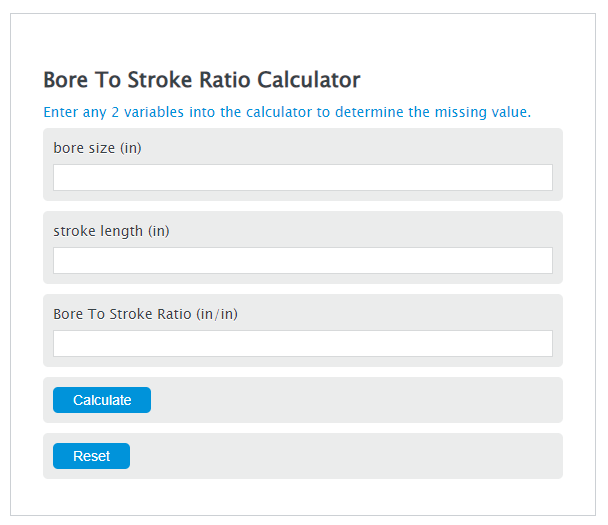
Calculate bore-to-stroke ratio, bore size, or stroke length with automatic unit conversion, engine geometry classification, and optional displacement results.
- Head Gasket Volume Calculator
- HP Per Liter Calculator
- Bore X Stroke Calculator
- Compression Height Calculator
- Engine Intake Diameter Calculator
- Ring Gap Calculator
- All Automotive Calculators
Bore To Stroke Ratio Formula
The bore to stroke ratio compares the cylinder bore diameter to the piston stroke length. The ratio is unitless, but the bore and stroke must be in the same length unit before dividing.
- R = bore to stroke ratio
- B = bore size
- S = stroke length
The calculator uses these formulas depending on which value you leave blank:
- To calculate ratio: it divides bore size by stroke length.
- To calculate bore size: it multiplies the ratio by the stroke length.
- To calculate stroke length: it divides the bore size by the ratio.
If you enter bore and stroke in different units, the calculator converts them to a common unit before applying the formula.
Common Bore To Stroke Ratio Meanings
| Ratio Type | Ratio | What It Means |
|---|---|---|
| Undersquare | Less than 1.00 | Stroke is longer than bore. |
| Square | 1.00 | Bore and stroke are equal. |
| Oversquare | Greater than 1.00 | Bore is larger than stroke. |
Length Unit Conversions Used
| Unit | Equivalent in Inches |
|---|---|
| 1 inch | 1 in |
| 1 millimeter | 0.0393701 in |
| 1 centimeter | 0.393701 in |
| 1 foot | 12 in |
Example Calculations
Example 1: Calculate bore to stroke ratio
You have a bore size of 86 mm and a stroke length of 86 mm.
The bore to stroke ratio is 1.0000, which is a square engine layout.
Example 2: Calculate stroke length
You have a bore size of 4.000 in and a bore to stroke ratio of 1.25.
The stroke length is 3.2000 in.
FAQs
What is a good bore to stroke ratio?
There is no single good ratio for every engine. A ratio above 1.00 is called oversquare, a ratio of 1.00 is square, and a ratio below 1.00 is undersquare. The best value depends on the engine design, intended RPM range, displacement, valve size, and torque requirements.
Does the bore to stroke ratio have units?
No. The ratio is unitless because it divides one length by another length. You can use inches, millimeters, centimeters, or feet, but bore and stroke must be converted to the same unit before calculating the ratio.
What happens if bore and stroke are equal?
If bore and stroke are equal, the bore to stroke ratio is 1.00. This is called a square bore and stroke layout.