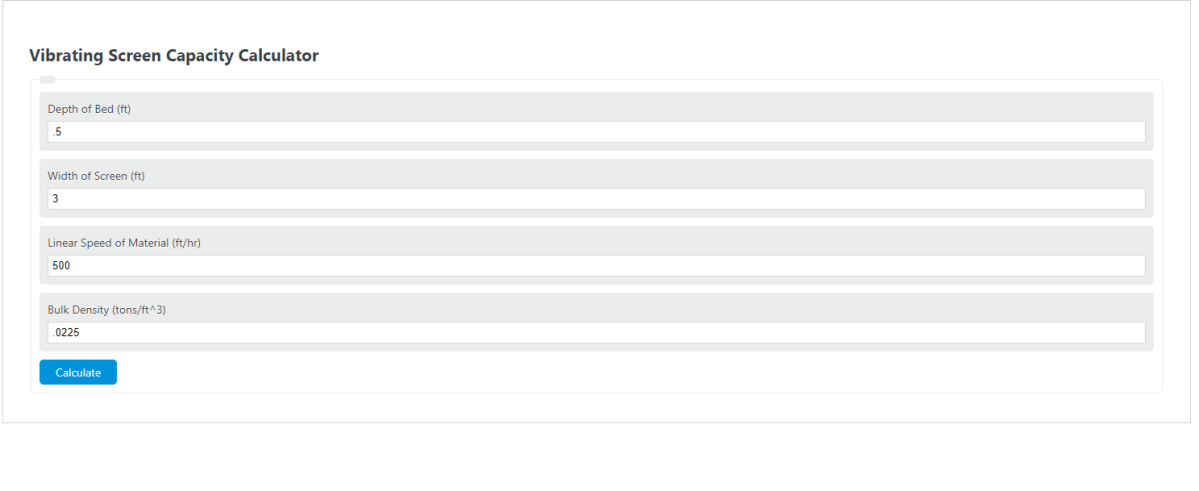
Calculate vibrating screen capacity, bed depth, width, material speed, or bulk density by entering any four values in imperial or metric units.
- Roll Crusher Capacity Calculator
- Silo Capacity Calculator
- All Construction Calculators
- Screw Conveyor Flow Rate Calculator
Vibrating Screen Capacity Formula
The vibrating screen capacity calculator estimates the mass flow rate that can pass over a vibrating screen based on bed volume, material density, open area, screening efficiency, and a correction factor.
- C = vibrating screen capacity in short tons per hour
- C_kg/h = vibrating screen capacity in kilograms per hour
- W = screen width, converted to feet
- D = average bed depth, converted to feet
- V = material travel speed, converted to feet per minute
- rho = bulk density, converted to pounds per cubic foot
- OA = screen open area as a decimal, so 45% becomes 0.45
- E = screening efficiency as a decimal, so 90% becomes 0.90
- F = correction factor for material condition, deck setup, blinding, moisture, or other site-specific effects
The calculator first converts all inputs to imperial working units. Width and bed depth are converted to feet, travel speed is converted to feet per minute, and density is converted to pounds per cubic foot. It then calculates a volumetric flow rate, converts that flow into weight per hour, adjusts for open area and efficiency, and applies the correction factor. The final result is shown in short tons per hour and kilograms per hour.
Common Input Ranges for Vibrating Screen Capacity
The values below are general reference ranges. Actual values depend on screen type, material size distribution, moisture, deck angle, aperture shape, and operating conditions.
| Input | Typical Range | Notes |
|---|---|---|
| Screen open area | 30% to 60% | Higher open area usually increases potential capacity but may reduce wear life depending on media type. |
| Screening efficiency | 80% to 95% | Efficiency below this range can indicate overloading, blinding, poor feed distribution, or unsuitable aperture size. |
| Correction factor | 0.70 to 1.20 | Use less than 1 for difficult conditions and greater than 1 only when conditions improve capacity. |
| Average bed depth | 1 in to 6 in | A deep bed can reduce stratification and screening efficiency even if calculated capacity is high. |
Unit Conversions Used by the Calculator
| Measurement | Conversion |
|---|---|
| Inches to feet | ft = in / 12 |
| Meters to feet | ft = m × 3.280839895 |
| Meters per minute to feet per minute | ft/min = m/min × 3.280839895 |
| kg/m³ to lb/ft³ | lb/ft³ = kg/m³ × 0.0624279606 |
| Short tons/hour to kg/hour | kg/h = short tons/h × 907.18474 |
Example Calculations
Example 1: Capacity using imperial inputs
Suppose you enter these values:
- Screen width = 6 ft
- Average bed depth = 3 in
- Material travel speed = 40 ft/min
- Bulk density = 100 lb/ft³
- Open area = 45%
- Screening efficiency = 90%
- Correction factor = 1.00
Convert bed depth to feet: 3 in / 12 = 0.25 ft.
The capacity is 72.9 short tons/hour, which is about 66,137.77 kg/hour.
Example 2: Capacity using metric inputs
Suppose you enter these values:
- Screen width = 2 m
- Average bed depth = 0.08 m
- Material travel speed = 12 m/min
- Bulk density = 1,600 kg/m³
- Open area = 50%
- Screening efficiency = 85%
- Correction factor = 0.95
After converting to the calculator’s working units, the capacity is approximately 106.839 short tons/hour, which is about 96,923.92 kg/hour.
FAQs
What is a correction factor in vibrating screen capacity?
The correction factor adjusts the calculated capacity for conditions not fully captured by width, depth, speed, density, open area, and efficiency. Use a value below 1 when material is wet, sticky, poorly distributed, near-size-heavy, or likely to blind the screen. Use 1 for a neutral estimate. Use a value above 1 only when the setup is known to perform better than the base assumptions.
Why does open area affect screen capacity?
Open area is the percentage of the screen surface that is open for material to pass through. A higher open area gives particles more available openings, which can increase capacity. However, capacity is not controlled by open area alone. Bed depth, stratification, particle size distribution, moisture, and screen motion can still limit actual performance.
Is the result the same as guaranteed plant throughput?
No. The result is an estimated screen capacity based on the entered operating values. Actual throughput can be lower if the screen is overloaded, the feed is uneven, material is too wet, apertures are blinded, the deck angle is unsuitable, or the selected screen media is not matched to the application.