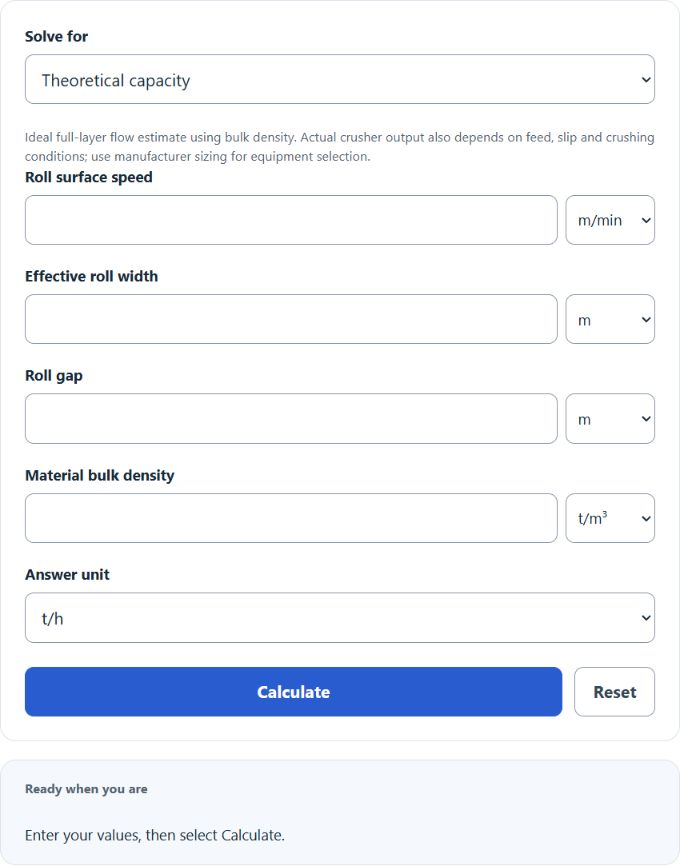
Choose theoretical capacity, speed, width, gap or bulk density and enter the other four quantities. Unit selectors convert entered quantities.
- All Construction Calculators
- Outside Diameter of a Roll Calculator
- Roll Length Calculator
- Screw Conveyor Flow Rate Calculator
- Vibrating Screen Capacity Calculator
- Bulk Density Calculator
- Specific Gravity Calculator
Roll Crusher Capacity Formula
The roll crusher capacity calculator estimates the theoretical mass flow rate through a roll crusher using roll surface speed, roll width, discharge opening, and material density. This is most useful for quick sizing, process checks, and comparing operating scenarios such as changing the roll gap or increasing peripheral speed.
When the inputs are entered as meters per minute, meters, meters, and tonnes per cubic meter, the result is produced in tonnes per hour.
| Variable | Meaning | Common Units |
|---|---|---|
| C | Roll crusher capacity | t/hr, kg/hr, lb/hr |
| V | Roll surface or peripheral speed | m/min, ft/min |
| L | Effective roll width | m, ft |
| D | Roll gap or set opening | m, mm, ft |
| ρ | Material density used for throughput calculations | t/m³, kg/m³, lb/ft³ |
What the Formula Means
This equation treats the crusher opening as a moving rectangular flow area. The roll surface speed moves material forward, the roll width sets the available crushing width, the roll gap sets the discharge thickness, and density converts volumetric flow into mass flow. Because of that, the calculator gives a theoretical capacity, not a guaranteed plant production rate.
- Higher surface speed increases capacity.
- Wider rolls increase capacity.
- Larger roll gap increases capacity, but also increases product size.
- Higher density increases mass throughput for the same volumetric flow.
How to Use the Calculator Correctly
- Enter the roll surface speed at the roll face, not the motor speed.
- Enter the effective roll width that is actually handling material.
- Enter the roll gap as the discharge opening between the roll surfaces.
- Use the material’s bulk density when estimating production throughput. Bulk density is usually more representative than true particle density for crusher capacity.
- Check that all inputs use compatible units before interpreting the result.
Unit Conversions
If your measurements are not already in the calculator’s preferred units, convert them before checking your hand calculations.
Specific gravity can approximate particle density relative to water; it does not establish the bulk density of a feed bed. Obtain or measure bulk density for this throughput model.
Example Calculation
Assume the following inputs:
- Peripheral speed = 50 m/min
- Roll width = 2 m
- Roll gap = 0.03 m
- Material density = 1.6 t/m³
This means the crusher’s theoretical capacity is 288 tonnes per hour under those conditions.
Theoretical Capacity vs. Actual Capacity
Actual operating capacity is often lower than the theoretical result because real feed does not move as a perfectly full, uniform layer. Production can drop due to:
- feed segregation or uneven distribution across the roll width,
- slip between the material and the roll surface,
- voids in the material bed,
- moisture, stickiness, or bridging,
- oversized feed and inconsistent top size,
- wear on roll surfaces and changing roll settings.
If you want a rough operating estimate rather than a theoretical maximum, apply an efficiency factor to the calculated value.
For example, if the theoretical capacity is 288 t/hr and the process runs at 85% of theoretical performance:
Common Input Mistakes
- Using roll diameter instead of roll width.
- Entering the gap in millimeters while the other dimensions are in meters.
- Using true density instead of bulk density for production estimates.
- Treating the result as a guaranteed plant capacity without allowing for operating losses.
Why This Calculator Is Useful
This calculator helps operators, students, and engineers quickly evaluate how changes in roll speed, roll width, set opening, or material density affect throughput. It is especially useful for preliminary design checks, troubleshooting low capacity, and comparing alternative operating conditions before making mechanical adjustments.