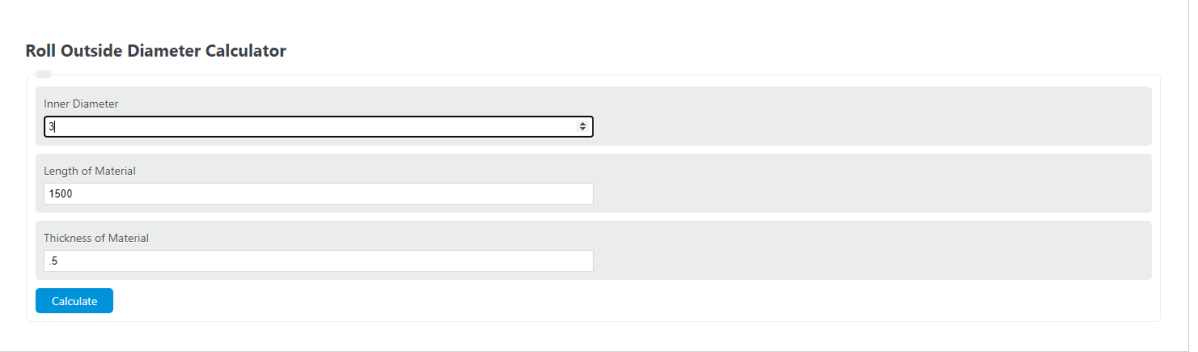
Calculate roll outside diameter, remaining material length, or thickness with consistent units, winding-fill sensitivity, radial build, and wrap estimates.
- All Math and Numbers Calculators
- Roll Length Calculator
- Paper Reel Weight Calculator
- GSM Grams per Square Meter Calculator
- GSM to Thickness Calculator
- Paper Roll Weight Calculator
- Basis Weight Calculator
Roll Outside Diameter Formula
The roll outside diameter is based on the area of material wound around the core. The calculator uses the same unit system internally, converting all diameter, thickness, and length inputs to inches before calculating.
Find outside diameter:
Find length on roll:
- OD = outside diameter of the finished roll
- ID = inside diameter, or core diameter
- L = length of material on the roll
- t = material thickness
- pi = 3.14159…
Use Find Outside Diameter when you know the core size, material thickness, and total length. Use Find Length on Roll when you have a measured outside diameter and want to estimate how much material remains on the roll.
Typical Material Thickness Values
Thickness has a large effect on roll diameter and length estimates. Use the actual measured thickness when possible.
| Material | Typical thickness | Approx. mm |
|---|---|---|
| Aluminum foil | 0.0005 in | 0.013 mm |
| Plastic film / poly | 0.001 in | 0.025 mm |
| Masking tape | 0.002 in | 0.051 mm |
| Office paper | 0.003 in | 0.076 mm |
| Receipt paper / newsprint | 0.004 in | 0.102 mm |
| Cardstock | 0.007 in | 0.178 mm |
| Corrugated cardboard | 0.016 in | 0.406 mm |
Roll Diameter Reference
| Outside diameter | General interpretation |
|---|---|
| Under 2 in | Small roll, similar to some tape or ribbon rolls |
| 2 to 5 in | Common small roll size, such as tape, labels, or small paper rolls |
| 5 to 10 in | Medium roll, often seen with receipt paper, labels, film, or craft material |
| 10 to 20 in | Large roll, common for shipping paper, sign vinyl, and production materials |
| Over 20 in | Industrial-size roll |
Example Calculations
Example 1: Find the outside diameter
You have a 3 in core, 500 ft of material, and the material is 0.004 in thick.
The finished roll outside diameter is about 6.29 in.
Example 2: Find the length on a roll
You measure an 8 in outside diameter roll with a 3 in core. The material thickness is 0.004 in.
The roll contains about 900 ft of material.
FAQ
Why does material thickness matter so much?
Roll diameter depends on the total cross-sectional area of material wound around the core. A small thickness error is repeated across many wraps, so the final diameter or length estimate can change noticeably. For the best result, measure the material thickness with calipers or use a verified product specification.
Should I use radius or diameter?
Use diameter. Enter the full distance across the core or finished roll, not the radius. The formula uses squared diameters, so entering a radius by mistake will give a result that is far too small.
Why is the result an estimate?
The formula assumes the material winds evenly with no air gaps, compression, stretching, wrinkles, or loose winding. Real rolls can vary depending on tension and material behavior. Flexible materials such as foam, fabric, tape, and film may differ more than paper or other stable materials.