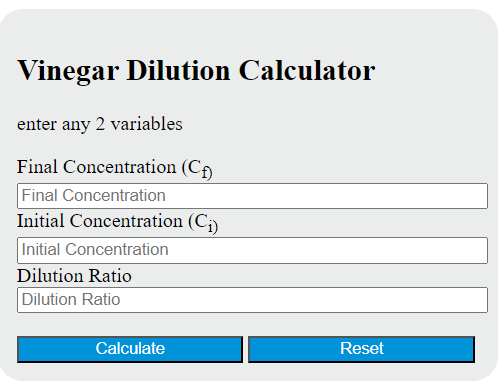
Calculate water to add, vinegar needed, or final acidity using C1V1 = C2V2, with results in mL, liters, cups, fluid ounces, quarts, and gallons.
- All Chemistry Calculators
- Whiskey Dilution Calculator
- Reverse Dilution Calculator
- Liquid Dilution Ratio Calculator
Vinegar Dilution Formula
The following formula is used to calculate the vinegar dilution ratio (as defined on this page):
Variables:
- Dilution Ratio is the ratio of the final concentration to the initial concentration
- C_f is the final concentration of vinegar
- C_i is the initial concentration of vinegar
To calculate the vinegar dilution ratio, divide the final concentration of vinegar by the initial concentration of vinegar. Note: many sources instead define a “dilution factor” as Ci/Cf (the reciprocal of the ratio shown here).
What is a Vinegar Dilution?
A vinegar dilution refers to the process of reducing the concentration of acetic acid in vinegar by adding water. Vinegar is a solution of acetic acid and water, and its acidity is determined by the percentage of acetic acid it contains. For instance, most household vinegar contains around 5% acetic acid. If the vinegar is too strong or concentrated for a particular use, it can be diluted by adding water. The amount of water added will depend on the desired final concentration of acetic acid. For example, if you wanted to reduce a vinegar’s acidity from 5% to 2.5%, you would add an equal amount of water to the vinegar, effectively halving the concentration of acetic acid. This process is commonly used in cooking, cleaning, and other household tasks to adjust the strength of the vinegar to a suitable level.
How to Calculate Vinegar Dilution?
The following steps outline how to calculate the Vinegar Dilution.
- First, determine the initial concentration of the vinegar solution (C1) in terms of percent or molarity.
- Next, determine the desired final concentration of the diluted vinegar solution (C2) in terms of percent or molarity.
- Next, determine the volume of the initial vinegar solution (V1) in milliliters or liters.
- Finally, calculate the final total volume after dilution (Vfinal) using the standard dilution equation C1·V1 = C2·Vfinal, so Vfinal = (C1 · V1) / C2. The volume of diluent (water) to add is Vdiluent = Vfinal − V1.
- After inserting the values into the formula and calculating the result, check your answer with the calculator above.
Example Problem:
Use the following variables as an example problem to test your knowledge.
Initial concentration (C1) = 5% vinegar
Desired final concentration (C2) = 2% vinegar
Volume of initial vinegar solution (V1) = 250 mL