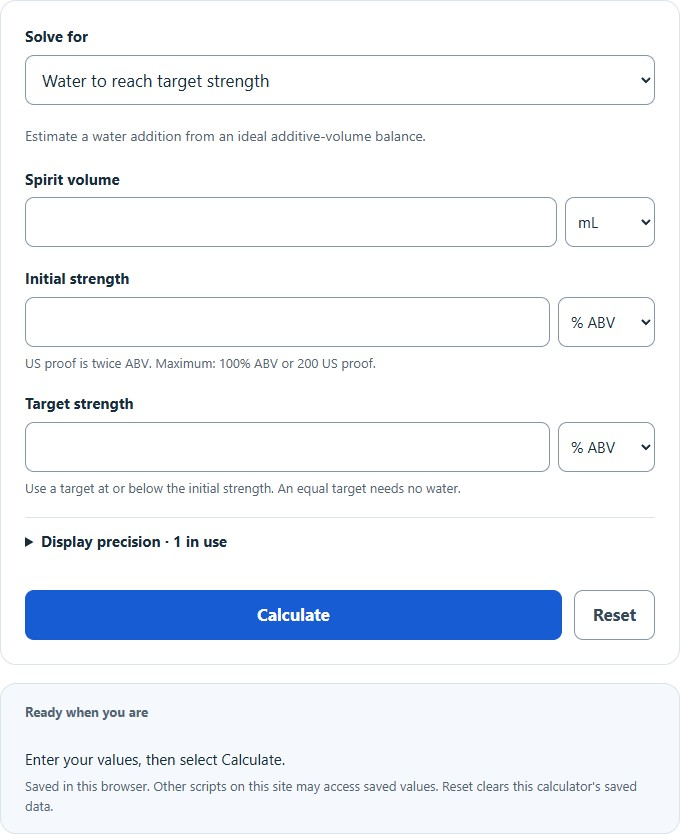
Calculate how much water to add to whiskey to reach a target ABV or proof, or the strength after adding water, in mL, liters or US fluid ounces.
- Food and Cooking Calculators
- Reverse Dilution Calculator
- Liquid Dilution Ratio Calculator
- Dilution Factor Calculator (Dilutant to Stock Ratio)
Whiskey Dilution Formula
The following ideal-volume balance estimates the water to add. Use the same strength basis for BP and DP, and the same volume unit for W and WD. US proof is twice ABV. Real ethanol-water mixtures contract, so this formula is an estimate rather than a precise proofing procedure.
Variables:
- WD is the estimated water to add (US fluid ounces in this example)
- W is the volume of whiskey (US fluid ounces in this example)
- BP is the bottle strength in US proof
- DP is the desired strength in US proof, greater than zero and no higher than BP
How to Calculate Whiskey Dilution?
The following steps outline how to calculate the Whiskey Dilution.
- First, determine the volume of whiskey (US fluid ounces).
- Next, determine the bottle proof.
- Next, determine the desired proof.
- Next, gather the formula from above = WD = (W * (BP / DP – 1)).
- Finally, calculate the Whiskey Dilution.
- After inserting the variables and calculating the result, check your answer with the calculator above.
Example Problem:
Use the following variables as an example problem to test your knowledge.
volume of whiskey (US fluid ounces) = 30
bottle proof = 80
desired proof = 40
WD = 30 × (80 / 40 − 1) = 30 US fluid ounces of water. The ideal final volume is 60 US fluid ounces at 40 US proof (20% ABV), before accounting for contraction or temperature effects.