Convert volts to Hz using a motor’s rated voltage and frequency or a device’s Hz-per-volt sensitivity, or work back from hertz to volts.
- All Physics Calculators
- Volts To Lumens Calculator
- Volts To Megawatts Calculator
- Volts to mA Calculator
Calculator Functions
| Function | What it does | What it requires |
|---|---|---|
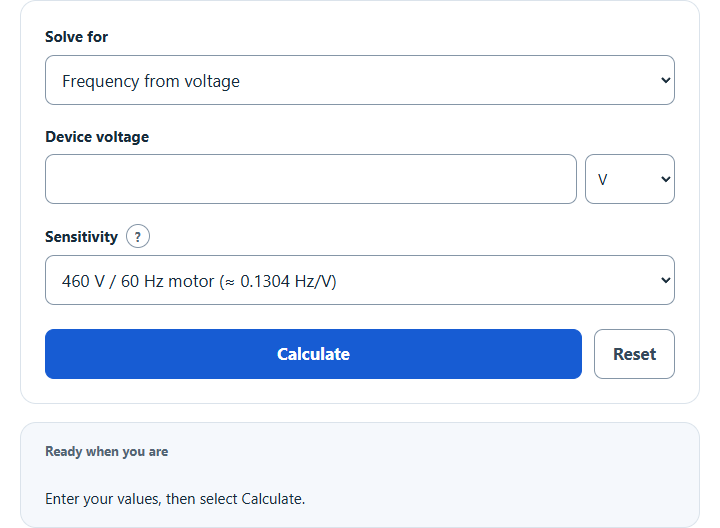
| Frequency from voltage | Finds the frequency that goes with a voltage on a device whose frequency rises in step with voltage | Requires the device voltage and the sensitivity, chosen from a motor rating or entered in Hz/V |
| Voltage from frequency | Finds the voltage that goes with a frequency on the same kind of device | Requires the device frequency and the sensitivity, chosen from a motor rating or entered in Hz/V |
| Sensitivity (Hz/V) | Finds the hertz per volt of a device from one known pair of readings | Requires a voltage and the frequency measured at that voltage |
The sensitivity list holds four motor ratings, 460 V / 60 Hz, 230 V / 60 Hz, 400 V / 50 Hz and 230 V / 50 Hz, and a custom value in Hz/V, kHz/V or MHz/V. Voltage can be entered in volts, kilovolts or millivolts and frequency in hertz, kilohertz or megahertz. Results repeat the answer in the other units and show the reciprocal ratio in volts per hertz.
Volts to Hz Formulas
| f | Frequency (Hz) |
| k | Sensitivity of the device (Hz/V) |
| V | Voltage (V) |
Volts and hertz measure different things, so there is no fixed conversion between them. The formula only describes a device whose frequency is proportional to its voltage, starting from zero. Two common cases fit. A motor run from a variable frequency drive is often kept at a constant volts-to-hertz ratio, such as 460 V at 60 Hz or 380 V at 50 Hz, which leaves its torque and slip unchanged [1]. A voltage-to-frequency converter chip puts out a frequency proportional to its input voltage, with the scale set by its resistors and timing capacitor [2].
A supply voltage such as 110 V, 220 V or 250 V has no frequency of its own. The frequency of a power supply is a separate rating, normally 50 Hz or 60 Hz [1], and is printed on the equipment nameplate.
Frequency from voltage
The main formula applies directly. A motor rating supplies k as rated frequency ÷ rated voltage, so a 460 V / 60 Hz motor has k = 60 ÷ 460 = 0.1304 Hz/V, and 230 V corresponds to 230 × 60 ÷ 460 = 30 Hz. For a converter with a custom sensitivity of 1 kHz/V, an input of 5 V gives 5,000 Hz.
Voltage from frequency
On the 460 V / 60 Hz rating, running at 45 Hz corresponds to 45 ÷ (60 ÷ 460) = 345 V. A 1 kHz/V converter putting out 4 kHz has 4 V at its input.
Sensitivity (Hz/V)
A converter that reads 10 kHz with 10 V applied has k = 10,000 ÷ 10 = 1,000 Hz/V, the full-scale point given for one common converter chip [2]. The pair 460 V and 60 Hz gives 0.130435 Hz/V, or 7.667 V/Hz as the reciprocal. Both readings have to be above zero.
Limits of This Estimate
- The model is a straight line through zero. It does not cover devices with an offset, a curved response or an upper limit.
- The motor ratings give the nominal ratio on the motor nameplate. A drive can be set up with extra voltage at low speed or a voltage ceiling above the motor’s rated frequency, so its own settings decide the real output. These estimates are based on the best available data and estimations.
- A converter chip is only linear over its rated range, and its sensitivity depends on the parts fitted around it [2]. Use the sensitivity from the circuit’s own calibration.
Sources
- U.S. Department of Energy, Premium Efficiency Motor Selection and Application Guide, Chapter 2: constant volts-to-hertz ratio for motors on 60 Hz and 50 Hz supplies
- Texas Instruments, LM231 and LM331 Precision Voltage-to-Frequency Converters data sheet: output frequency proportional to input voltage, full-scale frequency and linearity range