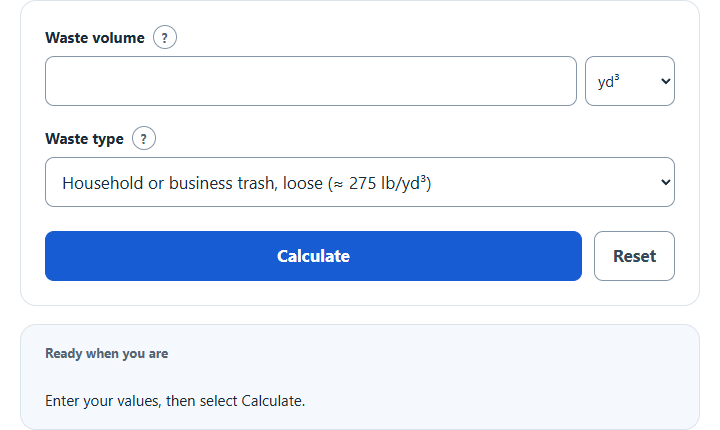
Estimate waste or dumpster weight in pounds, tons and kg from volume in cubic yards, gallons or m³, using typical densities for trash, debris and more.
Related Calculators
- Cable Weight Per Meter Calculator
- Brass Weight Calculator
- Medium Density Fiberboard (MDF) Weight Calculator
- Load Density Calculator
- All Construction Calculators
Calculator Functions
| Function | What it does | What it requires |
|---|---|---|
| Waste weight | Finds the weight of a volume of waste in pounds, US tons, kilograms and metric tonnes | Requires the waste volume and a waste type, or a custom density |
Volume can be entered in cubic yards, cubic feet, US gallons, liters or cubic meters, with shortcuts for 10, 20, 30 and 40-yard dumpsters. A custom density can be entered in lb/yd³, lb/ft³ or kg/m³. The result also shows the density used in lb/yd³ and kg/m³.
Waste Weight Formula
| W | Waste weight (lb) |
| V | Waste volume (yd³) |
| D | Density of the waste as it sits in the container (lb/yd³) |
A full 20-yard dumpster of loose household trash comes to 20 × 275 = 5,500 lb, or 2.75 US tons. The same dumpster filled with drywall comes to 20 × 467 = 9,340 lb. One US ton is 2,000 lb, and one cubic yard is 27 ft³ or 0.7646 m³.
Waste Density by Type
The waste types in the calculator use these densities. All but concrete or brick rubble are taken from the U.S. EPA volume-to-weight conversion factors [1].
| Waste type | lb/yd³ | kg/m³ |
|---|---|---|
| Household or business trash, loose | 275 | 163 |
| Household or business trash, compacted | 550 | 326 |
| Construction and demolition debris | 484 | 287 |
| Concrete or brick rubble | 2,400 | 1,424 |
| Drywall | 467 | 277 |
| Asphalt roofing shingles | 731 | 434 |
| Wood and lumber | 169 | 100 |
| Yard waste, loose | 250 | 148 |
| Food waste | 463 | 275 |
| Cardboard, flattened | 106 | 63 |
The EPA lists mixed residential, institutional and commercial trash as a range: 250 to 300 lb/yd³ uncompacted and 400 to 700 lb/yd³ compacted [1]. The calculator uses the middle of each range. Loose yard waste uses the EPA figure for uncompacted mixed yard waste, and the same table gives 640 lb/yd³ once it is compacted [1].
Concrete or brick rubble is the one type that does not follow the EPA table, which lists 860 lb/yd³ for concrete in a mixed construction load [1]. The calculator uses 2,400 lb/yd³ instead: solid concrete weighs roughly 4,000 lb/yd³, and broken pieces leave air gaps that lower the weight of a full container. This higher figure is the safer one for a dumpster filled only with concrete or brick.
Limits of This Estimate
- Each density is a typical value for a material, not a measurement of a particular load. Moisture, how tightly the container is packed and how much air sits between pieces all change the real weight.
- The EPA factors were compiled from other studies rather than measured directly [1], and the concrete or brick rubble figure is a rule of thumb. These estimates are based on the best available data and estimations.
- A mixed load does not match any single type. Weigh the load on a scale when a hauler's weight limit or a disposal fee depends on it.
Sources
- U.S. Environmental Protection Agency, Volume-to-Weight Conversion Factors, April 2016: density of each waste type except concrete or brick rubble