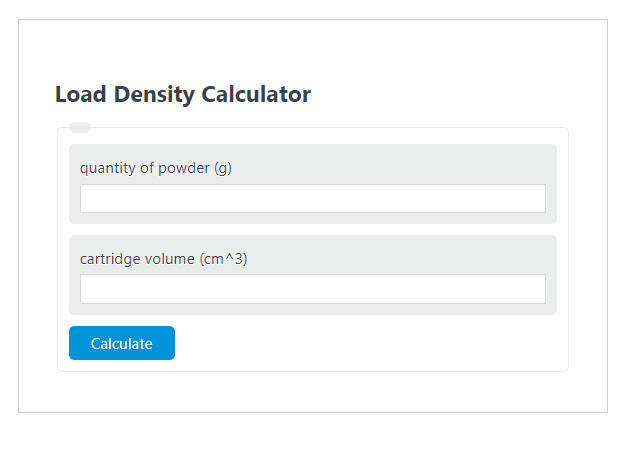
Calculate load density, powder quantity, or cartridge volume from any two values with unit conversions for g, oz, cm³, in³, m³, and density units.
Related Calculators
- CC to Grams of Powder Calculator
- Grain to CC Calculator
- Powder Volume Calculator
- Muzzle Energy Calculator
- Muzzle Velocity Calculator
- Rifle Recoil Calculator
- All Construction Calculators
Load Density Explained
Load density compares the mass of powder to the available cartridge volume. In this calculator, load density is treated as a simple mass-per-volume relationship, which makes it useful for comparing setups, checking consistency, and documenting how much powder mass is associated with a given internal volume.
| Variable | Meaning | Common Units |
|---|---|---|
| LD | Load density | g/cm3, lb/in3, kg/m3 |
| P | Quantity of powder | g, oz, kg |
| CV | Cartridge volume | cm3, in3, m3 |
Rearranged Formula
If you know any two values, the third can be found by rearranging the equation:
How to Use the Load Density Calculator
- Enter the powder quantity.
- Enter the cartridge volume.
- Select the correct units for each input.
- Calculate the result to find load density.
- If needed, solve for powder quantity or cartridge volume by entering the other two values.
How to Interpret the Result
A larger load density means more powder mass per unit of cartridge volume. A smaller load density means less powder mass per unit volume. This is most helpful when comparing similar cases, documenting measurements, or checking whether changes in powder mass or available volume materially change the ratio.
It is important to distinguish load density from the material density of the powder itself. Two powders can have the same mass but occupy different amounts of space because bulk density, grain shape, and packing behavior can vary.
Unit Guidance
The output unit always depends on the input units. Keep the mass and volume units consistent so the result is meaningful.
- grams with cubic centimeters produce g/cm3
- ounces with cubic inches produce lb/in3 only after proper conversion
- kilograms with cubic meters produce kg/m3
If your measurements are in different systems, convert them before comparing results.
Example Calculation
If the powder quantity is 57 g and the cartridge volume is 9 cm3, then:
That result means the load density is 6.33 grams of powder per cubic centimeter of cartridge volume.
Practical Notes
- Use internal usable volume rather than external cartridge dimensions.
- Measure carefully, because small volume errors can noticeably change the ratio.
- Keep your unit system consistent when comparing different entries.
- Use load density as a comparison and record-keeping metric, not as a substitute for pressure-tested load data.
Common Input Mistakes
- Mixing unit systems without converting first.
- Entering external dimensions instead of true cartridge volume.
- Rounding volume too early in the calculation.
- Assuming load density alone can predict performance or safety.
Quick Questions
What happens if powder quantity increases while cartridge volume stays the same?
Load density increases directly with powder mass.
What happens if cartridge volume increases while powder quantity stays the same?
Load density decreases because the same mass is distributed across a larger volume.
Can this calculator determine a safe powder charge?
No. This calculator only evaluates the mass-to-volume ratio. Safe load development depends on validated reloading data, careful measurement, and pressure-tested specifications.