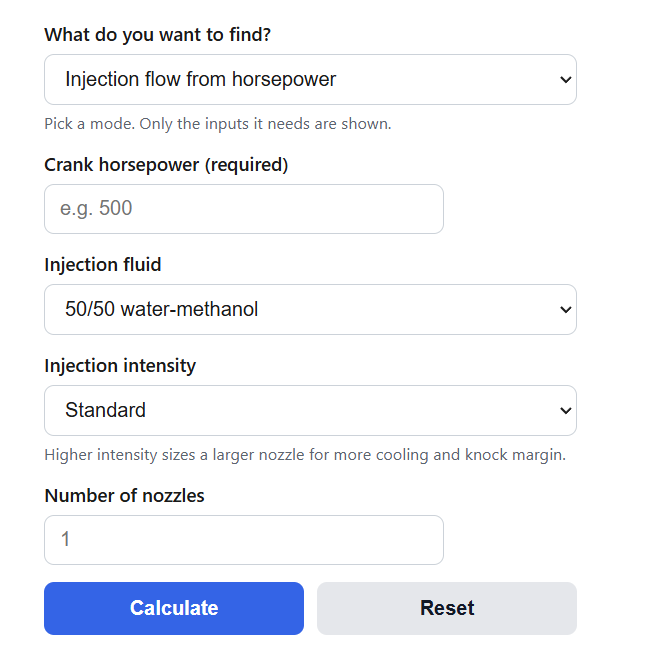
Calculate the water-methanol injection flow your engine needs from horsepower or fuel flow, size the nozzle in cc/min or GPH, and estimate tank run time.
Water-Methanol Injection Flow Formula
The calculator sizes injection flow four ways. The simplest starts from crank horsepower and a fluid factor:
WMI = HP * K
Variables:
- WMI is the required mixture flow, in cc/min
- HP is crank horsepower
- K is the fluid factor: about 0.5 for pure water, 1.0 for a 50/50 mix, and 1.5 to 2.0 for pure methanol
If you already know your fuel flow, the flow is set as a percentage of that fuel flow instead:
WMI = FF * (P / 100)
- FF is total fuel flow, in cc/min
- P is the injection rate as a percent of fuel flow, usually 10 to 15 for water, 15 to 20 for a 50/50 mix, and 20 to 25 for methanol
A nozzle does not flow its rated number once boost pushes back on the spray. Flow scales with the square root of the net pressure across the tip:
Q = Qr * sqrt(Pnet / Pr)
 Pnet = Ppump - Pboost
- Q is the actual delivered flow
- Qr is the rated flow at the rated test pressure Pr
- Pnet is the net pressure across the nozzle, equal to pump pressure Ppump minus manifold boost Pboost
The last mode turns a flow rate into run time from a reservoir:
T = V / (Q * DC)
- T is the driving time before the tank empties
- V is the reservoir volume
- Q is the nozzle flow rate
- DC is the average duty cycle, the share of driving time the pump is actually spraying, written as a decimal
Use the horsepower mode for a quick nozzle size when you only know engine output. Use the fuel flow mode when you have injector data or a logged fuel number and want the injection tied directly to fueling. The pressure mode corrects a nozzle rating for the boost it works against, and the tank mode tells you how long a reservoir lasts so you do not run the pump dry mid pull.
Injection Flow and Nozzle Size Reference
This first table lists the starting mixture flow for common power levels under each fluid, using factors of 0.5, 1.0, and 1.75. Methanol spans 1.5 to 2.0 in practice, so treat the methanol column as a midpoint.
| Crank HP | Pure water | 50/50 mix | Pure methanol |
|---|---|---|---|
| 200 hp | 100 cc/min | 200 cc/min | 350 cc/min |
| 300 hp | 150 cc/min | 300 cc/min | 525 cc/min |
| 400 hp | 200 cc/min | 400 cc/min | 700 cc/min |
| 500 hp | 250 cc/min | 500 cc/min | 875 cc/min |
| 600 hp | 300 cc/min | 600 cc/min | 1050 cc/min |
| 750 hp | 375 cc/min | 750 cc/min | 1313 cc/min |
| 1000 hp | 500 cc/min | 1000 cc/min | 1750 cc/min |
The second table converts the standard nozzle sizes sold by most kit makers, so you can match a required flow to a real part. The horsepower column is the rough 50/50 capacity of each nozzle, since a 50/50 mix uses about 1 cc/min per crank horsepower.
| Nozzle (GPH) | Flow (cc/min) | Approx 50/50 HP |
|---|---|---|
| 1.0 | 63 | ~65 |
| 2.0 | 125 | ~125 |
| 3.0 | 190 | ~190 |
| 4.0 | 252 | ~250 |
| 5.0 | 315 | ~315 |
| 7.0 | 440 | ~440 |
| 8.0 | 500 | ~500 |
| 10 | 630 | ~630 |
| 12 | 755 | ~755 |
| 14 | 880 | ~880 |
Example Problems
Example 1: Size a nozzle from horsepower.
Your engine makes 500 crank horsepower and you plan to run a 50/50 mix at standard intensity. The factor for a 50/50 mix is 1.0, so:
WMI = 500 * 1.0 = 500 cc/min, which is about 7.9 GPH. That splits into 250 cc/min of water and 250 cc/min of methanol, and it lines up with a single 8.0 GPH nozzle.
Example 2: Find how long a tank lasts.
You feed one 500 cc/min nozzle from a 3 liter reservoir and spray about 10 percent of your driving time. At full spray the tank would empty in 3000 / 500 = 6 minutes. At a 10 percent duty cycle it stretches to 3000 / (500 * 0.10) = 60 minutes of driving before a refill.
Frequently Asked Questions
How do you size a water-methanol injection nozzle?
Start from either horsepower or fuel flow. The horsepower method multiplies crank power by a fluid factor of about 0.5 for water, 1.0 for a 50/50 mix, or 1.5 to 2.0 for methanol to get cc/min. The fuel flow method sets injection at roughly 10 to 25 percent of fuel flow depending on the mix. Both give a starting nozzle. Size a little under your target, then tune up while watching intake air temperature and knock, since the real number depends on intercooling, boost, and how aggressive your timing is.
Should you run more water or more methanol?
Water gives the most charge cooling per volume and cannot burn, so it is the safest choice for suppressing knock without touching your fuel tune. Methanol adds octane and acts as extra fuel, so higher methanol content lets you lean on the mix for power, but it changes the air-fuel ratio and needs a matching fuel tune. A 50/50 mix is the common middle ground, and any methanol above about 30 percent also keeps the fluid from freezing in cold climates.
Does boost pressure change nozzle flow?
Yes. A nozzle is rated at a bench test pressure with no boost, but in the manifold it sprays against boost, which lowers the net pressure across the tip. Because flow follows the square root of pressure, a nozzle fed at 200 psi against 20 psi of boost flows as if it saw 180 psi, not 200. Raising pump pressure or reducing the pressure the nozzle works against both increase real delivered flow.