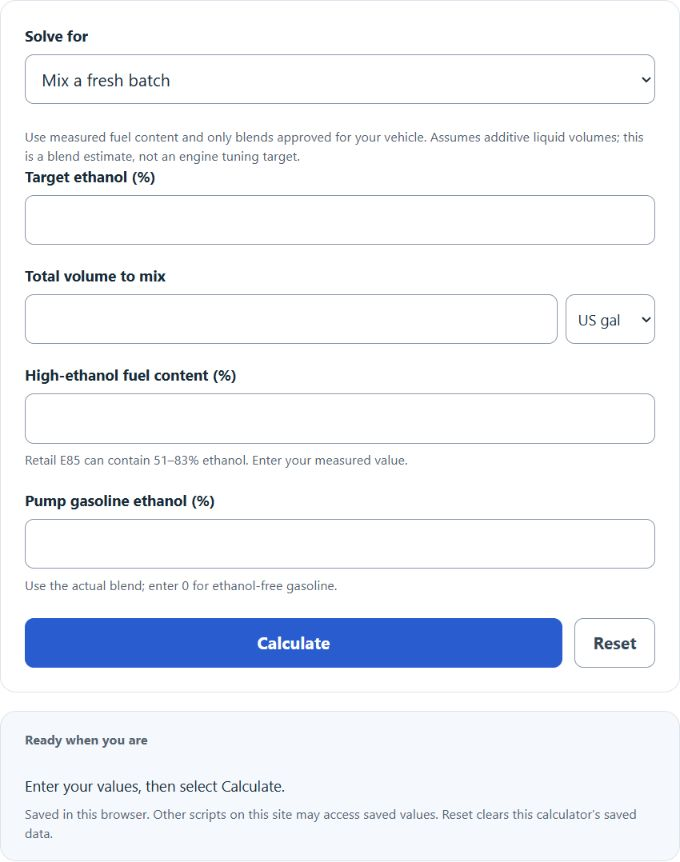
Calculate how much E85 and pump gas to blend for a target like E30 or E50, top off a partly full tank, and get the ethanol percent and stoichiometric AFR.
- All Automotive Calculators
- Gasoline Gallon Equivalent (GGE) Calculator
- Water-Methanol Injection Flow Calculator
- Fuel Pump Horsepower Calculator
E85 Ethanol Blend Formula
Blending E85 with pump gas is a volume-weighted ethanol balance. The finished ethanol percentage is the average of the two fuels, weighted by how much of each you pour in. The calculator solves that balance in three directions.
To mix a fresh batch to a target blend, first find what share of the batch must be E85, then split the total volume:
E85 fraction = (Et - Eg) / (Ea - Eg)
 Volume of E85 = V * E85 fraction
 Volume of pump gas = V - Volume of E85
To top off fuel already in the tank and fill it to full at a target blend:
E85 to add = (C*Et - Vc*Ec - (C - Vc)*Eg) / (Ea - Eg)
 Pump gas to add = (C - Vc) - E85 to add
To find the blend you actually made from two known amounts:
Resulting E% = (Va*Ea + Vb*Eg) / (Va + Vb)
Every mode also gives an idealized mass air–fuel ratio from representative component densities and combustion ratios:
x = E / 100
Stoich AFR = [(1-x)*0.740*14.7 + x*0.790*9.0] / [(1-x)*0.740 + x*0.790]
Variables:
- Et is the target ethanol percent you want in the finished fuel (30 means E30)
- Ea is the measured ethanol percent of the high-ethanol fuel; retail E85 commonly contains 51 to 83 percent
- Eg is the ethanol percent of the pump gas you blend in, usually 10 for E10 or 0 for ethanol free
- Ec is the ethanol percent of the fuel already sitting in the tank
- V is the total volume you are mixing, C is the tank capacity, and Vc is the fuel already in the tank
- Va and Vb are the volumes of E85 and pump gas you added
- E is ethanol percent by volume. Stoich AFR is kg air per kg fuel, assuming gasoline density 0.740 kg/L and ethanol density 0.790 kg/L, with component ratios 14.7 and 9.0. Gasoline properties vary; this is an estimate.
The mix mode answers the most common question, how many gallons of each fuel to pour into an empty can or tank to hit a number like E30. The top off mode is for a car that already has fuel in it: it accounts for the volume and ethanol content already present, so the numbers it gives you actually land on the target once the tank is full. The resulting blend mode works backward from what you poured, which is handy for checking a mix or logging what went in. The air–fuel ratio is a reference estimate of stoichiometry. It is not an engine tuning target; commanded fueling depends on the engine, calibration and operating conditions.
Blend Ratios and Seasonal E85 Content
This hypothetical table uses high-ethanol fuel at exactly 85 percent and E10 pump gasoline, per 10 US gallons. Actual pump E85 may have less ethanol. AFR values use the density-weighted reference model above, not a tuning recommendation.
| Target blend | E85 per 10 gal | Pump gas per 10 gal | Est. stoich AFR |
|---|---|---|---|
| E20 | 1.33 gal | 8.67 gal | 13.50:1 |
| E30 | 2.67 gal | 7.33 gal | 12.91:1 |
| E40 | 4.00 gal | 6.00 gal | 12.33:1 |
| E50 | 5.33 gal | 4.67 gal | 11.76:1 |
| E60 | 6.67 gal | 3.33 gal | 11.19:1 |
| E70 | 8.00 gal | 2.00 gal | 10.63:1 |
| E85 | 10.00 gal | 0.00 gal | 9.81:1 |
Pump E85 is rarely a true 85 percent. ASTM D5798 allows 51 to 83 percent ethanol so the fuel starts in cold weather, so the same pump can change through the year and geography. Enter the value you measure with a test kit or flex fuel sensor for an accurate blend, and treat the seasonal table below as illustrative scenarios, not guaranteed local fuel specifications.
| Season | Illustrative ethanol range | Why it changes |
|---|---|---|
| Summer, warm months | 79% to 83% | Heat supplies volatility, so ethanol runs near the top of the range. |
| Spring and fall | 70% to 79% | Transition blends as suppliers adjust for milder temperatures. |
| Winter, cold months | 51% to 70% | More gasoline is added to raise vapor pressure for cold starting. |
Example Problems
Example 1: Mixing a fresh batch.
You want 15 gallons of E30 in a fuel jug from E85 at 85 percent and E10 pump gas. The E85 fraction is (30 – 10) / (85 – 10) = 20 / 75 = 0.267. Volume of E85 is 15 * 0.267 = 4.0 gallons, and pump gas is 15 – 4.0 = 11.0 gallons. The density-weighted reference AFR is approximately 12.91:1.
Example 2: Topping off a tank.
Your 16 gallon tank holds 4 gallons of E10 and you want E40, with your E85 tested at 80 percent. E85 to add is (16*40 – 4*10 – (16 – 4)*10) / (80 – 10) = (640 – 40 – 120) / 70 = 6.86 gallons. Pump gas to add is (16 – 4) – 6.86 = 5.14 gallons. Filling with those amounts brings the full tank to E40 at approximately a 12.33:1 reference stoichiometric ratio.
Frequently Asked Questions
What ethanol content should I enter for my E85?
Enter the real ethanol percentage of the fuel you are pumping, not a flat 85. Retail E85 legally ranges from 51 to 83 percent under ASTM D5798 and drops in winter for cold starting, so assuming 85 can make your finished ethanol percentage lower than planned. A cheap ethanol test kit or a flex fuel sensor reading gives you the number to type into the fuel content field. If the content is unknown, measure it or obtain documented fuel data rather than relying on an assumed percentage.
Why does the calculator show an air fuel ratio?
Ethanol carries oxygen, so it needs less air to burn completely than gasoline does. That is why the stoichiometric ratio falls from about 14.7:1 on straight gas to roughly 9.8:1 on E85. Lambda 1 describes stoichiometry; it is not a universal operating target. The estimate here combines component masses using declared density assumptions. Richer blends demand more fuel volume, which is the main reason bigger injectors and pumps come up when people move to higher ethanol. Treat the number as an idealized reference; composition, density, temperature, water and denaturants can change actual stoichiometry.
Can I run a homemade E85 blend in any car?
Use only fuel blends approved by your vehicle manufacturer. High-ethanol blends require compatible fuel-system materials and calibration, such as in a suitable flexible-fuel vehicle. This calculator cannot determine compatibility or approve a homemade blend; check your owner’s manual and qualified vehicle guidance.