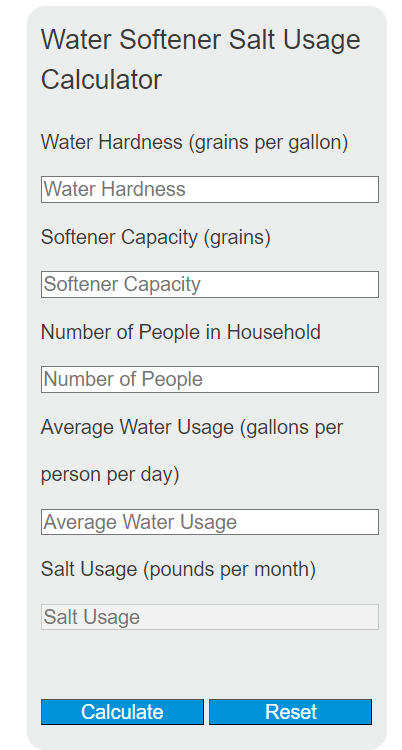
Calculate water-softener regeneration interval, monthly salt use, annual bags, and grain load, or size usable capacity for a target interval in imperial or metric inputs.
- Every Day Life And Education Calculators
- Water Softener Hardness Calculator
- Salt Brine Calculator
- Water Bill Calculator
- PPM Calculator
- Water Factor Calculator
Water Softener Salt Usage Formula
This calculator estimates monthly water softener salt usage from four inputs: water hardness, average daily water use, household size, and softener capacity. In practical terms, the calculation measures how much hardness your home sends through the softener each month and then estimates how many regeneration cycles are needed to handle that load.
For this calculator, the salt dose per regeneration is assumed to be 8 pounds, so the estimating equation becomes:
It is often easier to understand the calculation in three smaller steps: first find the daily hardness load, then estimate the number of regeneration cycles per month, and finally convert those cycles into monthly salt use.
| Variable | Meaning | Typical Unit |
|---|---|---|
| H | Water hardness level entering the softener | grains per gallon (gpg) |
| U | Average water use per person per day | gallons per person per day |
| P | Number of people in the household | people |
| C | Usable softener capacity between regenerations | grains |
| S | Salt used each time the softener regenerates | pounds per cycle |
| L | Daily hardness load removed by the softener | grains per day |
| R | Estimated regeneration cycles each month | cycles per month |
| SU | Estimated salt usage | pounds per month |
How to Calculate Water Softener Salt Usage
- Determine the incoming hardness. Use the water hardness value in grains per gallon if available.
- Estimate water use per person. A better estimate comes from real household consumption rather than a guess.
- Enter the number of people in the home. More occupants generally means more gallons used and more frequent regeneration.
- Use the softener’s usable grain capacity. Capacity should reflect what the unit is actually set up to deliver between cycles, not just the largest marketing number on a brochure.
- Calculate monthly cycles and salt use. Once monthly regeneration frequency is known, multiply by the salt used per cycle.
Estimating Average Water Use from a Monthly Water Bill
If you know total household water use for a month, you can estimate average daily use per person directly instead of guessing.
In this expression, T is the total household gallons used in one month. This method is especially useful when occupancy is stable and your water bill already reflects normal indoor usage.
Unit Conversions
If your water test reports hardness in milligrams per liter instead of grains per gallon, convert it before using the base equation.
If you want the result in kilograms per month instead of pounds per month, use this conversion:
Example
Assume the following inputs:
- Water hardness = 15 gpg
- Average water use = 75 gallons per person per day
- Household size = 4 people
- Softener capacity = 30,000 grains
| Step | Formula | Result |
|---|---|---|
| Daily hardness load | L = 15 × 75 × 4 = 4500 |
4,500 grains per day |
| Monthly regenerations | R = (4500 × 30) / (30000) = 4.5 |
4.5 cycles per month |
| Monthly salt usage | SU = 4.5 × 8 = 36 |
36 pounds per month |
With these assumptions, the softener would use about 36 pounds of salt per month. That is just under one 40-pound bag per month and about 432 pounds over a full year if conditions stay similar.
Planning Salt Purchases
Once you know the monthly estimate, you can convert it into bag count or annual demand for easier purchasing and storage planning.
Here, B40 is the number of 40-pound bags per month, B50 is the number of 50-pound bags per month, and A is annual salt usage in pounds.
Why Actual Salt Usage Can Differ from the Estimate
- Salt dose settings vary. The calculator assumes 8 pounds per regeneration, but some systems are programmed for a different dose.
- Reserve capacity affects cycle timing. If the controller holds back capacity as a reserve, the unit may regenerate earlier than the simple estimate suggests.
- Metered and timer-based systems behave differently. Demand-initiated controls usually follow actual water use more closely, while timer-based systems may regenerate on a fixed schedule.
- Real water use changes. Guests, leaks, seasonal occupancy, and changing habits can increase or decrease monthly salt consumption.
- Other dissolved minerals matter. Additional treatment demand can shorten the effective run length between regenerations.
- Advertised capacity may not equal usable capacity. Using the programmed working capacity gives a more realistic result than using a maximum theoretical number.
Tips for Better Inputs
- Use the most recent hardness test available for the water entering the softener.
- Base water-use estimates on real monthly consumption whenever possible.
- Enter the household’s normal occupancy, not a temporary high or low.
- Use the softener’s actual configured capacity if you know it.
- Recalculate after major changes such as adding occupants, repairing leaks, or changing controller settings.
A good salt-usage estimate helps with more than just buying bags of salt. It also gives you a quick way to judge whether the softener is cycling at a reasonable frequency, whether your settings appear efficient, and how changes in household water use may affect long-term operating cost and maintenance.