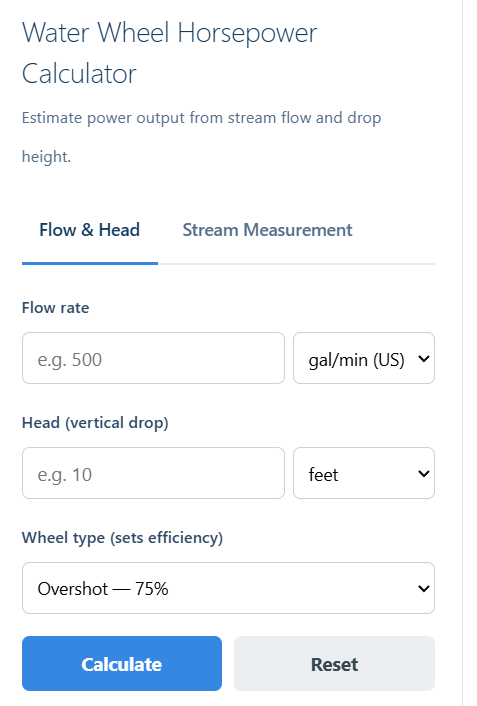
Enter your stream’s flow rate and vertical drop (head), then pick the wheel type to estimate usable horsepower at the shaft.
Related Calculators
- All Automotive Calculators
- Horsepower Head Flow Calculator
- Pump Brake Horsepower Calculator
- Well Pump Horsepower Calculator
Formula
Flow & Head mode:
HP = (Q × H × 62.4 / 550) × η
where Q = flow rate in ft³/s, H = head in ft, 62.4 = weight of water (lb/ft³), 550 = ft·lb/s per hp, η = wheel efficiency (decimal).
Stream Measurement mode:
Q = W × D × Vsurface × 0.85
where W = stream width (ft), D = average depth (ft), Vsurface = surface float velocity (ft/s), 0.85 = correction to average velocity. Q then feeds the formula above.
Interpretation
The output is shaft horsepower — the mechanical power available after losses from the wheel type. Multiply by roughly 0.85–0.90 again if you plan to drive a generator, since alternators and belts add their own losses. Typical results fall into these ranges:
- Under 0.7 hp (< 500 W): Trickle scale. Fine for battery charging, LED lighting, small electronics.
- 0.7–4 hp (500 W – 3 kW): Household micro-hydro. Powers appliances, pumps, off-grid cabins.
- 4–20 hp (3–15 kW): Whole-home capable, including electric heating loads.
- 20+ hp (> 15 kW): Historical mill-grade output. Drives heavy machinery or exports to the grid.
Efficiency is the biggest variable: an overshot wheel on the same stream will produce roughly three times the power of a flat-paddle undershot.
Wheel Efficiency Reference
| Wheel Type | Typical Efficiency | Best For |
|---|---|---|
| Overshot | 70–85% | High head (≥ wheel diameter), low flow |
| Pitchback (backshot) | 60–70% | High head with tailwater issues |
| Breastshot | 45–65% | Moderate head (½ wheel diameter) |
| Undershot — Poncelet | 50–60% | Low head, moderate-to-fast flow |
| Undershot — flat paddle | 20–30% | Very low head, high flow |
FAQ
What if I don't know my flow rate?
Switch to the Stream Measurement tab. Measure width, average depth, and time a floating object (stick, leaf) over a 10-foot stretch to get surface velocity. The calculator applies a 0.85 correction to convert surface velocity to average velocity.
Is "head" the height of the wheel or the water drop?
It's the vertical distance the water falls from where it enters the wheel to where it leaves. For an overshot wheel this is roughly the wheel diameter; for a penstock-fed setup it's the drop from the intake to the wheel.
Why is my undershot result so low?
Flat-paddle undershot wheels only capture a fraction of the kinetic energy in the stream — efficiency is typically 20–25%. For the same stream, an overshot or Poncelet design will deliver two to three times the horsepower.
Does this give me electrical output?
No. This is mechanical shaft power. Expect another 10–20% loss through a generator and any belts or gearing before it becomes usable electricity.