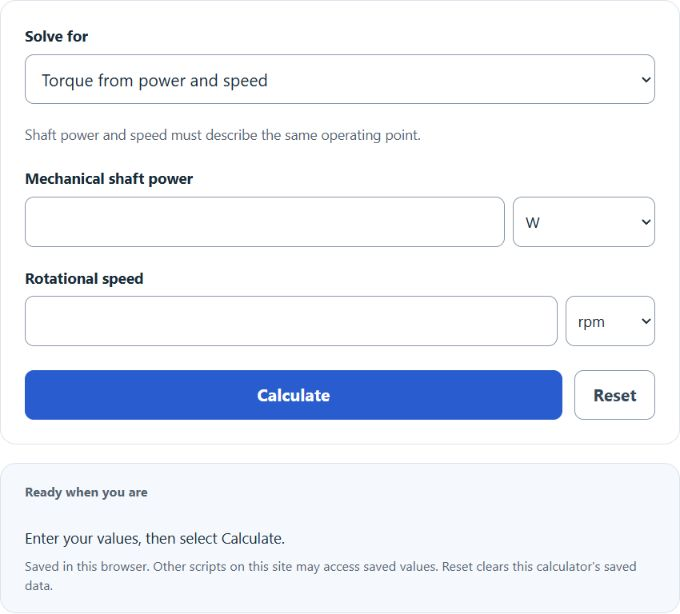
Convert watts to torque in N·m from power and rpm, or find power in watts from torque, or speed from both, using P = T × ω for a rotating shaft.
- All Unit Converters
- Watts To Time Calculator
- Watts To Horsepower Calculator
- Watts To Seconds Calculator
- Watts to Volts
Calculator Functions
| Function | What it does | What it requires |
|---|---|---|
| Torque from power and speed | Finds the torque a shaft delivers at a given power and speed | Requires the mechanical shaft power and the rotational speed |
| Power from torque and speed | Finds the mechanical power a shaft transmits | Requires the torque and the rotational speed |
| Speed from power and torque | Finds how fast a shaft turns for a given power and torque | Requires the mechanical shaft power and the torque |
Power can be entered in W, kW or mechanical hp, speed in rpm or rad/s, and torque in N·m or lbf·ft. A torque result is also shown in lbf·ft and lbf·in, a power result in kW and hp, and a speed result in rad/s.
Watts to Torque Formulas
| T | Torque (N·m) |
| P | Mechanical shaft power (W) |
| ω | Angular speed (rad/s), equal to 2π × rpm ÷ 60 |
Watts do not convert to newton meters on their own, because the same power can be a small torque at high speed or a large torque at low speed. With the speed in rpm the formula becomes T = 9.5493 × P ÷ rpm. A shaft delivering 1,000 W at 1,000 rpm carries 9.549 N·m, which is 7.043 lbf·ft. The unit factors are 1 mechanical hp = 745.6999 W and 1 lbf·ft = 1.355818 N·m [1].
Torque from power and speed
A 250 W motor output at 3,000 rpm is 250 ÷ (3,000 × 2π ÷ 60) = 250 ÷ 314.16 = 0.796 N·m. The speed has to be above zero, because power divided by zero speed has no answer.
Power from torque and speed
A torque of 10 N·m at 1,500 rpm is 10 × 157.08 = 1,570.8 W, or 2.1065 hp.
Speed from power and torque
A shaft that transmits 1,000 W at 5 N·m turns at 1,000 ÷ 5 = 200 rad/s, which is 1,909.9 rpm.
Watts to N·m at Common Speeds
| Speed (rpm) | N·m per 1,000 W | lbf·ft per 1,000 W |
|---|---|---|
| 60 | 159.155 | 117.387 |
| 100 | 95.493 | 70.432 |
| 500 | 19.099 | 14.086 |
| 1,000 | 9.549 | 7.043 |
| 1,500 | 6.366 | 4.695 |
| 1,800 | 5.305 | 3.913 |
| 3,000 | 3.183 | 2.348 |
| 3,600 | 2.653 | 1.956 |
| 6,000 | 1.592 | 1.174 |
Torque scales in step with power at a fixed speed, so 250 W at 1,000 rpm is a quarter of the 1,000 W row: 2.387 N·m.
Limits of This Estimate
- The power is mechanical power at the shaft. The electrical watts drawn by a motor are higher, and its efficiency is needed to get from one to the other.
- Power, torque and speed must describe the same operating point. A motor’s rated watts and its no-load speed do not belong together.
- The result is not a stall or starting torque. At zero speed the shaft transmits no power whatever the torque.
Sources
- National Institute of Standards and Technology, Guide to the SI (Special Publication 811), Appendix B.8: conversion factors for horsepower, pound-force foot and revolutions per minute