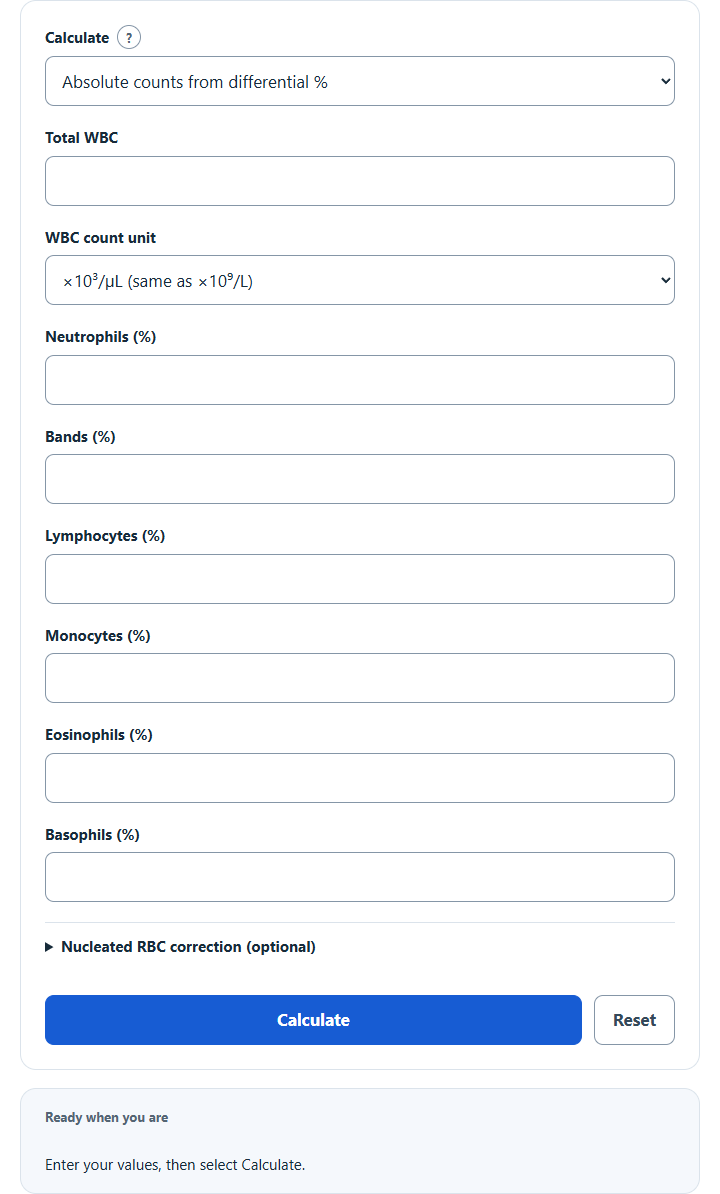
Calculate absolute WBC differential counts and ANC from percentages, with optional nRBC correction, or a manual hemocytometer (Neubauer) WBC count.
- All Health and Medical Calculators
- DO2 Calculator
- Average Blood Pressure Calculator
- MAP Calculator (Mean Arterial Blood Pressure)
Calculator Functions
| Function | What it does | What it requires |
|---|---|---|
| Absolute counts from differential % | Converts the percentages on a differential into absolute counts for each cell type, and gives the absolute neutrophil count (ANC) | Requires the total WBC and at least one differential percentage, with an optional count of nucleated RBCs per 100 WBC |
| Differential % from absolute counts | Converts absolute counts for each cell type into percentages of the total WBC | Requires the total WBC and at least one absolute count in the same unit |
| Hemocytometer (Neubauer) count | Finds the cell concentration from a manual count in a counting chamber | Requires the cells counted, the number of squares counted, the dilution factor and the square size |
The first two functions take the total WBC in ×10³/µL or in cells/µL and cover neutrophils, bands, lymphocytes, monocytes, eosinophils and basophils. Cell types that were not reported can be left blank, and the part of the total they leave over is shown as an unclassified remainder. The chamber count can be reported in cells/µL, cells/mL or ×10⁹/L.
WBC Formulas
| Abs | Absolute count of one cell type, in the same unit as the total |
| WBC | Total white blood cell count |
| P | Share of that cell type on the differential (%) |
Absolute counts from differential %
Each percentage is applied to the total. With a WBC of 7.5 ×10³/µL and a differential of 60% neutrophils, 3% bands and 28% lymphocytes, the counts are 4,500, 225 and 2,100 cells/µL. The headline result is the ANC, which adds neutrophils and bands: 4,500 + 225 = 4,725 cells/µL. Percentages that total more than 100 are rejected.
(100 + nRBC) [2]
Nucleated red blood cells can be counted as white cells, which inflates the total [2]. When a number of nRBCs per 100 WBC is entered, the total is corrected first and the percentages are applied to the corrected figure. A WBC of 19.3 ×10³/µL with 36 nRBCs per 100 WBC corrects to 1,930 ÷ 136 = 14.19 ×10³/µL.
Differential % from absolute counts
This is the main formula solved for the percentage. With a WBC of 8.0 ×10³/µL, absolute counts of 4.8 neutrophils, 0.2 bands, 2.4 lymphocytes and 0.4 monocytes are 60%, 2.5%, 30% and 5%. They account for 97.5% of the total, and the ANC is 5,000 cells/µL. Counts that add up to more than the total are rejected.
Hemocytometer (Neubauer) count
C is the concentration in cells/µL, N is the number of cells counted, D is the dilution factor, n is the number of squares counted, s is the side of one square in mm and d is the chamber depth in mm. A Neubauer chamber is 0.1 mm deep, its large squares are 1 mm on a side and its small squares are 0.2 mm [3]. One cubic millimeter is one microliter, so the result is already per µL.
A manual white cell count normally uses a 1:20 dilution and the four large corner squares [3], which is how the function starts. Those four squares hold 4 × 1² × 0.1 = 0.4 µL, so 150 cells counted gives 150 × 20 ÷ 0.4 = 7,500 cells/µL, or 7.5 ×10⁹/L. A dilution factor of 1 is used for undiluted fluid, and a custom side and depth cover other chambers.
WBC Count Units
A WBC count is a number of cells in a volume of blood. The liter is the recommended volume unit for reporting blood cell counts, though counts per microliter and per cubic millimeter are also seen [3]. The same count can therefore be written several ways. The usual adult range is given as 4,500 to 11,000 WBCs per microliter, or 4.5 to 11.0 ×10⁹/L, as of a February 2025 review [4].
| Unit | A count of 7,500 cells/µL | From cells/µL |
|---|---|---|
| cells/µL, also cells/mm³ | 7,500 | Same number |
| ×10³/µL, also K/µL | 7.5 | Divide by 1,000 |
| ×10⁹/L | 7.5 | Divide by 1,000 |
| cells/mL | 7,500,000 | Multiply by 1,000 |
Limits of This Estimate
- The calculator does laboratory arithmetic for learning and for checking manual counts. It is not medical advice and does not replace a clinical laboratory report or a clinician’s reading of one.
- Reference ranges and units vary slightly between laboratories [4], and with age, pregnancy and health conditions. The range printed on the lab report is the one to use, and abnormal results or symptoms such as fever, chills, shortness of breath, chest pain or confusion call for prompt medical attention.
- A chamber count is only as good as the dilution, the filling of the chamber and the number of cells counted. Low counts in few squares carry a large counting error.
- The nRBC correction applies to totals that include nucleated red cells. Many current analyzers separate them already, and a total from such an instrument should not be corrected a second time [2].
Sources
- Blumenreich, The White Blood Cell and Differential Count, in Clinical Methods, 3rd edition (NCBI Bookshelf), Chapter 153: absolute counts from the differential and the total count
- Nova Scotia Community College, Hematology Laboratory Manual, WBC Correction for the Presence of NRBCs: the correction formula and when it is needed
- Florida Gulf Coast University, Hematology Laboratory 1, CBC Part I: Cell Counts: the chamber count formula, Neubauer dimensions, the 1:20 dilution, the four corner squares and reporting units
- U.S. National Library of Medicine, MedlinePlus, WBC count: the usual range in both units and its variation between laboratories, reviewed February 3, 2025