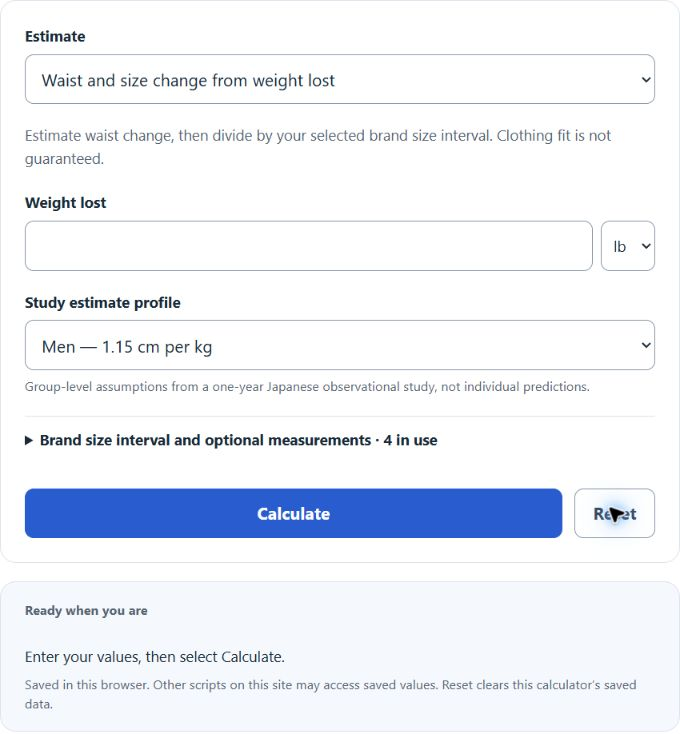
Estimate waist reduction and pant sizes dropped from weight loss, or calculate weight loss for a waist or pant-size goal using research-based averages.
Note: This calculator provides an educational estimate of how weight change may relate to waist circumference change; clothing sizes vary widely by brand and cut, and labeled waist can differ from measured waist. This is not medical advice. For many adults, a commonly cited general pace for weight loss is about 0.5–1 kg (1–2 lb) per week; faster loss may be unsafe for some people—seek medical advice for personalized guidance, especially if you are pregnant, under 18, have chronic conditions, or have a history of disordered eating. If tracking weight or measurements feels distressing, consider not using this tool and seek professional support.
- All Sports and Fitness Calculators
- Weight Loss Inches Calculator
- Weight Loss Time Calculator
- Weight Loss Percentage Calculator
- Weight Loss Calculator
Weight Loss Waist Change Formula
The following relationship is used to estimate the change in waist circumference (not a standardized clothing “size”) associated with weight loss.
Men: ΔWC ≈ 1.15 cm per kg of weight loss (≈ 0.205 inches per lb)
Women: ΔWC ≈ 0.943 cm per kg of weight loss (≈ 0.168 inches per lb)
Formula source:
Miyatake N, Matsumoto S, Miyachi M, Fujii M, Numata T. Relationship between changes in body weight and waist circumference in Japanese. Environ Health Prev Med. 2007;12(5):220–223.
Limitations: This estimate is based on an observational study in Japanese adults. Individual results vary by baseline size, age, body composition, and where fat is lost first.
- Where ΔWC is the estimated change in waist circumference
- WL is the total amount of weight lost
To estimate waist change in inches, multiply weight lost in pounds by the sex-specific factor shown above (≈0.205 in/lb for men, ≈0.168 in/lb for women).
How much weight do I need to lose to change my waist measurement?
Using this estimate, about a 1-inch decrease in waist circumference corresponds to roughly 4.9 lb of weight loss for men and about 5.9 lb for women (on average).
This is not exact. Waist change depends on genetics, baseline size, body composition, and where you tend to lose fat. Clothing “sizes” also vary widely by brand and fit, so a tape measurement is typically more consistent than relying on labeled sizes.
How to calculate weight-loss waist change?
Example:
The following example shows how to estimate the change in waist circumference given the number of pounds someone has lost.
First, determine the total amount of weight the person has lost. In this example, the person has lost a total of 20 lb.
Next, estimate the change in waist circumference (ΔWC). For a male estimate, use ≈0.205 inches per lb:
ΔWC ≈ WL × 0.20537 inches per pound (men’s retained estimate)
ΔWC ≈ 20 × 0.20537 ≈ 4.11 inches
ΔWC ≈ 4.11 inches
For a men’s waist-number reference with an assumed one-inch interval, a label of 34 could estimate to around 30 after this modeled change. Replace the interval with the brand’s chart. Fractional or out-of-range numeric labels do not guarantee an available size, and a modeled reduction at or beyond the current waist cannot be used as a physical waist prediction.
FAQ
How accurate is this waist-change estimate?
This calculator provides a general estimate and is not exact. It does not account for individual differences in body composition, baseline size, age, or where a person tends to lose fat first. The actual waist change can vary significantly.
Can weight-loss calculators help in planning a weight-loss journey?
They can be helpful for getting rough estimates and tracking trends, but results should be interpreted cautiously and alongside sustainable habits (nutrition, activity, sleep) and professional guidance when appropriate.
Does waist change equal “pant sizes dropped”?
Not necessarily. Waist circumference change may correlate with how pants fit, but clothing sizes are not standardized and vary by brand, cut, rise, and fabric stretch. Measuring your waist with a tape is usually more reliable than relying on labeled sizes.