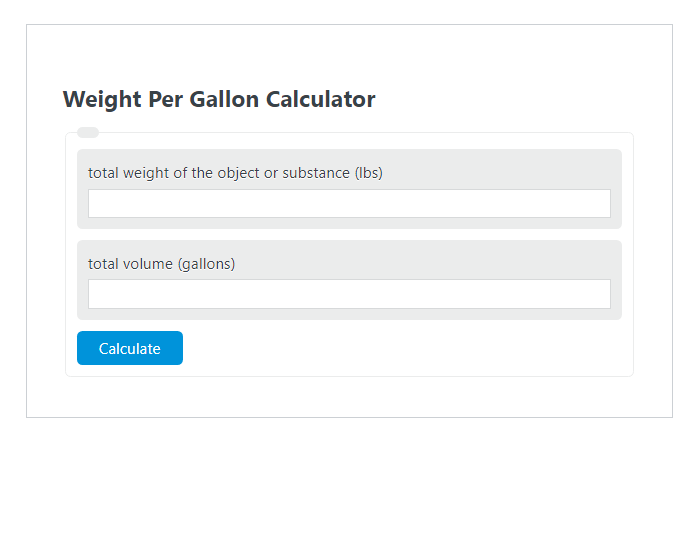
Calculate weight per gallon (lb/gal) for any liquid from its specific gravity, density, or a measured batch, plus total load weight and volume.
- All Unit Converters
- Pool Weight Calculator
- Gallons to Pounds Calculator
- Weight to Volume Calculator
- Liquid Density Calculator
- Specific Gravity Calculator
Understanding Weight Per Gallon
Weight per gallon tells you how much a material weighs for each gallon of volume. It is a practical way to estimate tank loads, compare liquids, size containers, and convert between volume-based and weight-based measurements. In U.S. customary units, the result is usually expressed as lb/gal.
Core Formula
- WPG = weight per gallon
- W = total weight
- G = total volume in gallons
If you know any two values, you can solve for the third.
How to Use the Calculator
- Enter any two known values: total weight, total volume, or weight per volume.
- Select the correct units for each field.
- Calculate to find the missing value automatically.
- Review the result and make sure it matches the gallon system and unit set you intended to use.
Why This Measurement Matters
- Tank loading: estimate the weight of stored liquids before filling.
- Transport: avoid overloading trailers, trucks, totes, and drums.
- Batching and mixing: convert recipes or chemical blends between gallons and pounds.
- Equipment sizing: check whether shelving, stands, floors, or supports can handle the load.
- Quality control: compare a measured liquid against an expected benchmark.
Unit and Conversion Notes
The calculator may also show equivalent weight-per-volume values in metric units such as kg/L or g/mL. Keep your inputs consistent. A mismatch between pounds and liters or kilograms and gallons will produce the wrong interpretation unless the calculator converts the units for you.
| Unit | Meaning |
|---|---|
| lb/gal | U.S. customary weight per U.S. gallon |
| kg/L | Metric weight per liter |
| g/mL | Same numeric value as kg/L |
Water as a Quick Reference
Fresh water is commonly used as the baseline because it weighs about 8.34 lb per U.S. gallon near room temperature. That makes it a helpful comparison point:
- Below 8.34 lb/gal: lighter than water
- Near 8.34 lb/gal: close to water
- Above 8.34 lb/gal: heavier than water
If you know the specific gravity of a liquid, you can estimate weight per gallon quickly.
Examples
Example 1: A liquid weighs 100 lb and occupies 50 gallons.
The result is 2 lb/gal.
Example 2: A tank contains 120 gallons of a liquid that weighs 8.34 lb/gal.
The liquid weight is 1000.8 lb.
Example 3: A batch weighs 375 lb and the known weight per gallon is 7.5 lb/gal.
The batch volume is 50 gallons.
Approximate Reference Values
These values are useful for quick comparisons only. Actual weight per gallon can change with temperature, composition, and product formulation.
| Material | Approximate Weight per U.S. Gallon | Typical Interpretation |
|---|---|---|
| Fresh water | 8.34 lb/gal | Common baseline |
| Seawater | 8.5–8.6 lb/gal | Heavier due to dissolved salts |
| Gasoline | 6.0–6.3 lb/gal | Lighter than water |
| Diesel fuel | 6.8–7.3 lb/gal | Usually heavier than gasoline |
| Milk | About 8.6 lb/gal | Slightly heavier than water |
Using Net Weight Instead of Gross Weight
If you weigh a filled container, the reading may include the container itself. In that case, subtract the tare weight first so the formula uses only the material weight.
Common Mistakes
- Using the wrong gallon type: a U.S. gallon and an Imperial gallon are not the same size.
- Ignoring temperature: many liquids become slightly lighter or heavier per gallon as temperature changes.
- Forgetting tare weight: container weight can distort the result.
- Mixing units: always match pounds with gallons, or kilograms with liters, unless the calculator is converting units.
- Rounding too soon: keep more decimal places for large tanks or precision mixing.
Frequently Asked Questions
Is weight per gallon the same as density?
They are closely related. Density is usually expressed as mass per unit volume, while weight per gallon expresses the weight associated with that volume. In everyday U.S. use, weight per gallon is often treated as a practical density-style measurement.
Does this work only for liquids?
No. If you know an object’s total weight and total volume, you can still calculate its weight per gallon.
What if I only know liters or cubic meters?
Use the unit options provided in the calculator. It can convert the inputs and return a compatible weight-per-volume result.
Why does my result differ from a published value?
Published values may assume a different temperature, product blend, concentration, or gallon definition. Even small changes in composition can shift the final number.