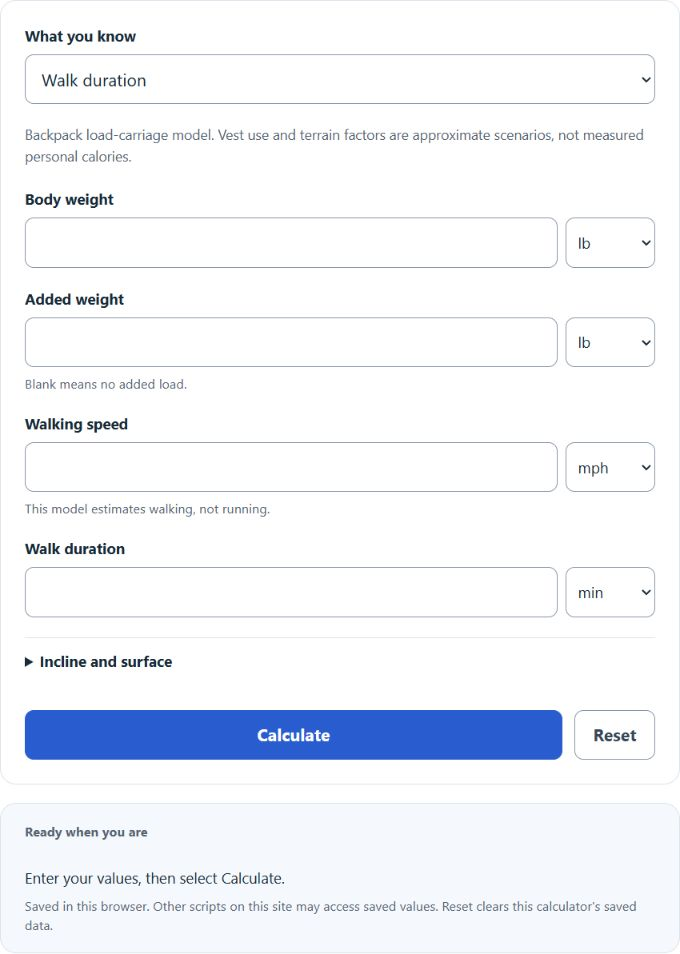
Estimate gross walk energy from body mass, carried load, speed and duration or distance, or invert the model for a gross-calorie target. This backpack load-carriage model is not a personal calorie measurement or a recommendation for load or exercise duration.
Weighted Walking Calories Formula
The calculator uses the Pandolf load-carriage model to estimate gross metabolic power; duration then converts that power to energy:
- P = metabolic power in watts; kcal/hour = P × 3,600 ÷ 4,184
- W = body weight in kilograms
- L = carried weight in kilograms
- V = speed in m/s, G = grade in percent, and η = terrain factor
Calories Burned Per Mile
These rounded gross estimates use a constant 3 mph pace on flat pavement. The effect of added load depends on body mass, speed, grade and terrain; it is not a fixed number of calories per added pound.
| Body Weight | No Extra Load | +20 lb | +40 lb |
|---|---|---|---|
| 120 lb | 66 kcal/mile | 74 kcal/mile | 84 kcal/mile |
| 150 lb | 82 kcal/mile | 90 kcal/mile | 99 kcal/mile |
| 180 lb | 98 kcal/mile | 106 kcal/mile | 115 kcal/mile |
What Is Weighted Walking?
Weighted walking carries added load in a vest, backpack or similar gear. The modeled energy depends on body mass, load, speed, grade, terrain and duration. Backpack equations may differ from vest carriage; a modeled difference is not a guaranteed individual calorie increase.
How to Calculate Weighted Walking Calories
At 150 lb body weight, 20 lb carried load and 3 mph on flat pavement, walking 1.5 miles takes 30 minutes. The model estimates about 269 kcal/hour, or 135 gross kcal for that walk. Gross calories include resting energy during the activity. The model was developed for backpack carriage, so vest loads and other carrying methods may differ. Negative grades use the original correction in Army Technical Note TN03-3: its limited field validation does not establish accuracy for every speed, load or surface. The separate downhill branch can predict more energy near 0% than the flat model. The calculator no longer substitutes a standing-power floor: nonpositive modeled power is rejected, and an invalid no-load baseline is marked unavailable. Positive downhill outputs may still be extrapolations. See the calculation details for the equation, validation conditions and numerical limits.
Weighted Walking Tips
- Keep the load close to your torso with a stable vest or backpack.
- Start light and add weight gradually over time.
- Maintain an upright posture and natural walking stride.
- Use model outputs for comparison; they do not establish a safe load, route or workout duration.