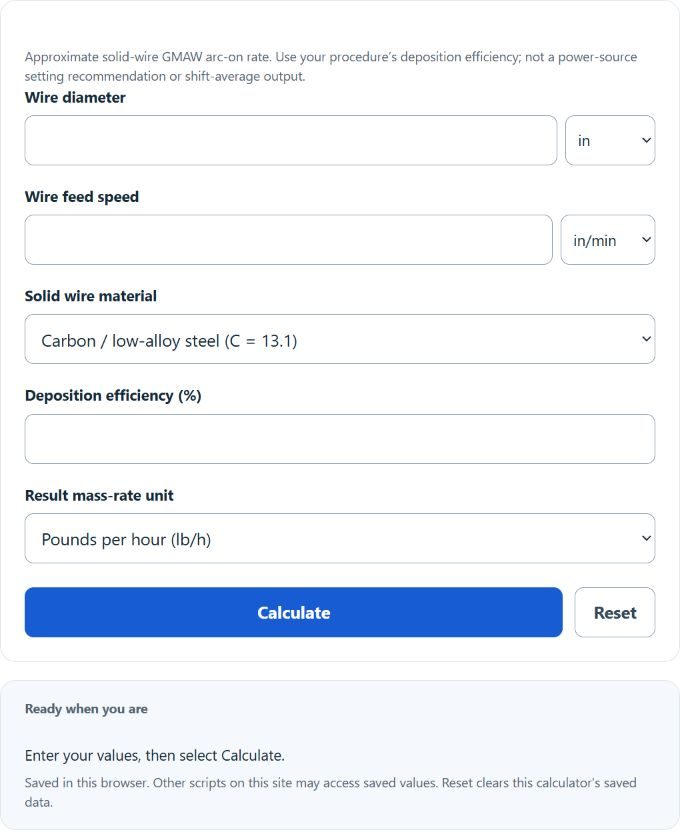
Estimate solid-wire GMAW arc-on deposition rate in lb/h or kg/h from wire material, diameter, feed speed and deposition efficiency.
- All Rate Calculators
- All Construction Calculators
- Welding Machine Amperage Calculator
- Welding Machine Load Calculator
How Weld Deposition Rate Is Calculated
Weld deposition rate is the amount of filler metal that actually becomes part of the weld in one hour. It is usually expressed in pounds per hour and is a practical planning metric for estimating filler usage, comparing wire sizes, and checking whether a procedure can meet production targets.
For solid carbon or low-alloy steel wire, the approximate inch-based relationship is shown below. Aluminum uses 4.32 in place of 13.1; these published guide coefficients are approximations.
Where:
- WDR is the weld deposition rate in lb/hr
- D is the electrode or wire diameter
- FS is the wire feed speed
- EE is the electrode efficiency as a percent
The calculator accepts multiple unit options, so you can enter diameter and wire feed speed in the units shown in the selectors and let the tool handle the conversion.
What Each Input Means
| Input | What it represents | Why it matters |
|---|---|---|
| Material | The filler wire material being deposited | Deposited weight depends on material density, so selecting the correct material keeps the result realistic. |
| Electrode Diameter | The wire diameter fed into the arc | This is the strongest geometric driver because the wire cross-section grows rapidly as diameter increases. |
| Wire Feed Speed | How fast wire is delivered to the weld | Higher feed speed increases wire consumption and usually increases deposition rate directly. |
| Electrode Efficiency | The fraction of consumed solid wire retained as weld metal | For this solid-wire model, it accounts for metal losses such as spatter and fume; use efficiency data for the actual procedure. |
How to Use the Calculator Correctly
- Select solid carbon/low-alloy steel or aluminum wire.
- Enter the electrode diameter using the unit selector that matches your wire size.
- Enter the wire feed speed in the unit your machine or procedure sheet uses.
- Enter electrode efficiency as a percentage.
- Calculate the result in the selected lb/h or kg/h unit.
If you already know your process settings, this gives you a fast estimate of how much weld metal is being placed over time. That makes it useful for quoting, procedure comparison, consumable planning, and production scheduling.
Example
Suppose you are running a wire diameter of 0.045 in, a wire feed speed of 400 in/min, and an electrode efficiency of 95%.
That means the setup is depositing just over 10 pounds of weld metal per hour under those conditions.
Quick Reference Estimates
The values below apply the displayed formula at 95% efficiency. They are useful for fast comparisons between common wire diameters and feed speeds.
| Wire Diameter | 300 in/min | 400 in/min | 500 in/min |
|---|---|---|---|
| 0.035 in | 4.57 lb/hr | 6.10 lb/hr | 7.62 lb/hr |
| 0.045 in | 7.56 lb/hr | 10.08 lb/hr | 12.60 lb/hr |
| 0.052 in | 10.10 lb/hr | 13.46 lb/hr | 16.83 lb/hr |
How Changes in the Inputs Affect the Result
- Diameter has a squared effect. A modest increase in wire diameter can cause a large increase in deposition rate.
- Wire feed speed has a direct effect. If feed speed increases by 10%, deposition rate also increases by about 10% when the other inputs stay fixed.
- Efficiency matters most when waste is significant. Reducing spatter and other losses can noticeably improve true deposited weight.
- Material selection matters for weight-based results. The same volume of wire does not produce the same deposited weight for every material.
As one comparison, moving from 0.035 in wire to 0.045 in wire increases theoretical deposition capacity by about 1.65 times at the same feed speed and efficiency.
Reverse the Formula for Planning
If you know the deposition rate you want and need to estimate the required wire feed speed, rearrange the equation like this:
This steel-only rearrangement estimates a feed speed for planning; it does not establish a qualified or safe machine setting. Use 4.32 rather than 13.1 for the aluminum guide model.
What Deposition Rate Does and Does Not Tell You
- It does tell you how much filler metal is becoming weld metal over time.
- It does not tell you total completed weld length per hour.
- It does not automatically include fit-up delays, repositioning, interpass cleaning, starts and stops, or rework.
- It is not the same as travel speed. A high deposition rate can still produce poor results if travel speed, voltage, amperage, or joint design are mismatched.
Common Reasons Real-World Results Differ
- Incorrect efficiency assumption
- Wire feed speed entered in the wrong units
- Using nominal wire size instead of the actual wire being run
- Comparing shift output to arc-on deposition rate
- Ignoring process losses such as spatter, slag removal, or cutoffs
- Applying a wire-feed equation to a process that is not wire-fed
This calculator is most useful for continuous wire processes where wire feed speed is a real machine setting.
Practical Tips for Improving Deposition Rate
- Use the largest wire size that your procedure, joint design, and position can support.
- Increase wire feed speed only within the limits of your power source and procedure qualification.
- Reduce losses by controlling spatter and maintaining stable arc conditions.
- Match contact tips, drive rolls, liners, and feed settings to the wire size so actual feed speed stays consistent.
- Do not chase deposition rate alone; confirm penetration, profile, fusion, and acceptable heat input.
Common Questions
- Is a higher deposition rate always better?
- No. Higher deposition rate can improve throughput, but only if bead shape, fusion, penetration, heat input, and distortion remain acceptable.
- Why is my shop output lower than the calculator result?
- The calculator estimates arc-on deposited weight. Actual job output is lower when setup time, handling, cleaning, fit-up, inspections, and downtime are included.
- Why does efficiency matter so much?
- Because the calculator is estimating deposited weld metal, not just consumed wire. Any lost metal reduces the amount that becomes part of the joint.
- Can I compare different wire sizes with this calculator?
- Yes. It is especially helpful for comparing how wire diameter and wire feed speed interact before changing procedures or machine settings.