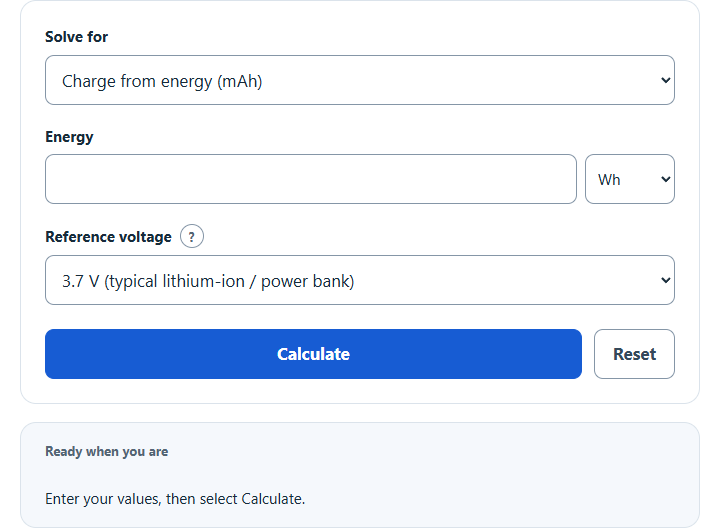
Convert Wh to mAh using the battery’s nominal voltage (3.7 V for most lithium-ion packs), or mAh back to Wh, with kWh, mWh and Ah supported.
- All Unit Converters
- Amp Hour to Watt Hour (Ah ↔ Wh) Calculator
- Battery Capacity Calculator (Amp Hours)
Calculator Functions
| Function | What it does | What it requires |
|---|---|---|
| Charge from energy (mAh) | Converts a battery’s energy in watt-hours to its charge capacity in milliamp-hours | Requires the energy (Wh, kWh or mWh) and the reference voltage |
| Energy from charge (Wh) | Converts a charge capacity to energy in watt-hours | Requires the charge capacity (mAh or Ah) and the reference voltage |
| Implied average voltage (V) | Finds the voltage that links a watt-hour rating to a milliamp-hour rating | Requires the energy and the charge capacity |
Reference voltage is chosen from a list of common battery voltages, starting at 3.7 V for lithium-ion cells and power banks, or entered as a custom voltage in V, mV or kV. The list also has 1.2, 1.5, 3.2, 3.6, 5, 7.4, 9, 11.1, 12, 24 and 48 V.
Wh to mAh Formulas
| mAh | Charge capacity (milliamp-hours) |
| Wh | Energy (watt-hours) |
| V | Nominal voltage of the battery (volts) |
Watt-hours are the battery voltage multiplied by the amp-hours [1], and one amp-hour is 1,000 mAh. The same Wh figure therefore gives a different mAh at each voltage, which is why a voltage is always needed.
Charge from energy (mAh)
100 Wh at 3.7 V is 100 × 1,000 ÷ 3.7 = 27,027 mAh. The same 100 Wh at 12 V is 8,333 mAh. The result also shows the capacity in Ah.
| Watt-hours | mAh at 3.7 V | mAh at 12 V |
|---|---|---|
| 2 Wh | 541 | 167 |
| 7.2 Wh | 1,946 | 600 |
| 29.6 Wh | 8,000 | 2,467 |
| 36.5 Wh | 9,865 | 3,042 |
| 44.4 Wh | 12,000 | 3,700 |
| 59.2 Wh | 16,000 | 4,933 |
| 65 Wh | 17,568 | 5,417 |
| 70 Wh | 18,919 | 5,833 |
| 80 Wh | 21,622 | 6,667 |
| 99 Wh | 26,757 | 8,250 |
| 99.9 Wh | 27,000 | 8,325 |
| 100 Wh | 27,027 | 8,333 |
| 160 Wh | 43,243 | 13,333 |
| 230 Wh | 62,162 | 19,167 |
| 240 Wh | 64,865 | 20,000 |
| 245 Wh | 66,216 | 20,417 |
| 288 Wh | 77,838 | 24,000 |
| 768 Wh | 207,568 | 64,000 |
Power banks and phone batteries are normally rated at the 3.7 V of their cells. Portable power stations and other large packs are often built at higher voltages, so check the label before choosing a column.
Energy from charge (Wh)
A 20,000 mAh power bank with 3.7 V cells holds 20,000 × 3.7 ÷ 1,000 = 74 Wh. Use the nominal voltage of the cells, not the 5 V of the USB output: the mAh on the label is counted at cell voltage.
Implied average voltage (V)
A battery marked 74 Wh and 20,000 mAh works out to 3.7 V. Zero charge is rejected because it gives no voltage.
100 Wh and 160 Wh in mAh
As of the FAA page updated August 11, 2026, lithium-ion batteries carried by airline passengers are limited to 100 Wh each, and up to two spare batteries of 101 to 160 Wh are allowed with airline approval [1]. At 3.7 V, 100 Wh is 27,027 mAh and 160 Wh is 43,243 mAh. Airlines can set stricter limits, and the Wh rating printed on the battery is the figure that counts [1].
Limits of This Estimate
- The conversion uses one nominal voltage. A real battery’s voltage falls as it discharges, so rated Wh and rated mAh do not always divide out exactly.
- It gives rated capacity, not delivered capacity. A power bank loses part of its energy raising 3.7 V to the 5 V or more at its output.
- The voltage list is a set of reference numbers. Choosing one does not identify a battery’s chemistry or its charger setting.
- For air travel, go by the Wh marked on the battery and the airline’s current rules.
Sources
- Federal Aviation Administration, PackSafe: Lithium Batteries: watt-hours as battery voltage multiplied by amp-hours, and the 100 Wh and 101 to 160 Wh passenger limits