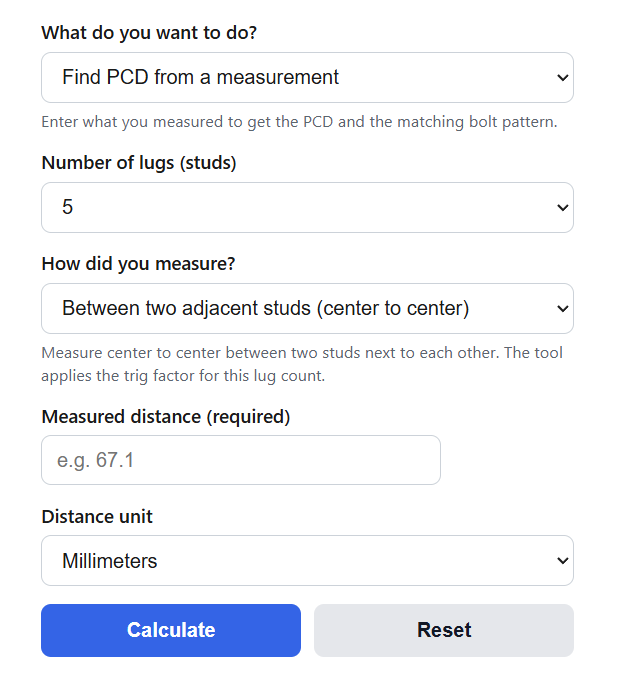
Calculate a wheel bolt pattern and PCD from the number of lugs and a stud measurement, find the stud spacing for a known pattern, and convert between millimeters and inches.
Wheel Bolt Pattern (PCD) Formula
A bolt pattern is written as the number of lugs times the pitch circle diameter, for example 5x114.3. The PCD is the diameter of the imaginary circle that runs through the center of every stud. The calculator works in three directions, and each uses one of the relationships below.
To turn a measurement between two adjacent studs into the PCD, for any lug count:
PCD = d / sin(180 / n)
For an even number of lugs you can measure straight across two opposite studs, and that distance is the PCD:
PCD = D
On a 5 lug wheel there is no stud directly opposite, so a clean reading comes from skipping one stud and measuring the two studs with a gap between them:
PCD = d / sin(360 / n)
Running the first formula in reverse gives the stud spacing you should expect for a pattern you already know:
d = PCD * sin(180 / n)
A method that works for any lug count is to measure from the hub center to one stud center and double it:
PCD = 2 * r
Variables:
- PCD is the pitch circle diameter, the diameter of the circle through every stud center, usually quoted in millimeters
- n is the number of lugs or studs, 4, 5, 6, or 8 on almost all vehicles
- d is the center to center distance you measure between two studs
- D is the center to center distance between two studs that sit directly opposite each other
- r is the distance from the hub center to the center of one stud
Pick what you want to do at the top of the calculator. "Find PCD from a measurement" takes the lug count, how you measured, and the distance, then returns the PCD in millimeters and inches plus the nearest standard pattern. "Get stud distances for a known pattern" runs the math backward and tells you the exact caliper readings a wheel or hub should show for that pattern. "Convert a pattern" changes a PCD between millimeters and inches, since the same pattern is quoted both ways, for example 5x114.3 mm and 5x4.5 in.
Caliper Readings for Common Bolt Patterns
These tables list the stud distances you should measure for each common pattern. Most bolt pattern pages only turn a measurement into a PCD. These work the other way, so you can set a caliper to the expected reading and confirm a wheel or hub before you buy. Read the row for your pattern, measure the matching distance, and it should land within about a millimeter.
Five lug wheels have no stud straight across, so the two readings that matter are adjacent studs and the skip one stud distance.
| 5 lug pattern | Adjacent studs (center to center) | Skip one stud (center to center) |
|---|---|---|
| 5x100 | 58.8 mm / 2.31 in | 95.1 mm / 3.74 in |
| 5x10⁸ | 63.5 mm / 2.50 in | 102.7 mm / 4.04 in |
| 5x112 | 65.8 mm / 2.59 in | 106.5 mm / 4.19 in |
| 5x114.3 | 67.2 mm / 2.65 in | 108.7 mm / 4.28 in |
| 5x120 | 70.5 mm / 2.78 in | 114.1 mm / 4.49 in |
| 5x127 | 74.6 mm / 2.94 in | 120.8 mm / 4.76 in |
| 5x139.7 | 82.1 mm / 3.23 in | 132.9 mm / 5.23 in |
Four, six, and eight lug wheels have a stud directly opposite, so the across reading equals the PCD. The adjacent reading is a useful second check.
| Pattern | Adjacent studs (center to center) | Across opposite studs (the PCD) |
|---|---|---|
| 4x100 | 70.7 mm / 2.78 in | 100 mm / 3.94 in |
| 4x10⁸ | 76.4 mm / 3.01 in | 108 mm / 4.25 in |
| 4x114.3 | 80.8 mm / 3.18 in | 114.3 mm / 4.50 in |
| 6x135 | 67.5 mm / 2.66 in | 135 mm / 5.31 in |
| 6x139.7 | 69.8 mm / 2.75 in | 139.7 mm / 5.50 in |
| 8x165.1 | 63.2 mm / 2.49 in | 165.1 mm / 6.50 in |
Example Problems
Example 1: finding the pattern from a measurement.
You have a 5 lug wheel and measure 67.1 mm center to center between two adjacent studs. Using PCD = d / sin(180 / 5), the PCD is 67.1 / sin(36) = 67.1 / 0.5878 = 114.2 mm. That rounds to the standard 5x114.3 pattern, which is 5x4.5 in. This is the fitment shared by many Honda, Toyota, and Nissan models.
Example 2: confirming a pattern you already think you have.
You believe a hub is 5x114.3 and want to check before ordering wheels. When you run the formula backward, adjacent studs should read 114.3 x sin(36) = 67.2 mm and the skip one stud distance should read 114.3 x sin(72) = 108.7 mm. If your caliper shows about 65.8 mm across adjacent studs instead, the hub is really 5x112, not 5x114.3, and standard 5x114.3 wheels will not seat correctly.
Frequently Asked Questions
How do you measure a 5 lug bolt pattern?
Because a 5 lug wheel has no stud sitting directly across from another, you cannot read the PCD straight off the ruler. Measure center to center between two adjacent studs and divide by sin(36), which is 0.5878, or use the calculator. A steadier method is to skip one stud and measure center to center across the gap, then divide by sin(72). The skip one distance is larger, so a small ruler error changes the result less. Take two readings and use a caliper, since 1 mm decides between patterns like 5x112 and 5x114.3.
Is 5x114.3 the same as 5x4.5?
Yes. They are the same pattern written in different units. 114.3 mm divided by 25.4 is exactly 4.5 in, so 5x114.3 mm and 5x4.5 in describe an identical wheel. Manufacturers and catalogs mix the two, which is why the convert mode is useful. Other common pairs are 5x127 mm equal to 5x5 in, 6x139.7 mm equal to 6x5.5 in, and 8x165.1 mm equal to 8x6.5 in.
Can I fit a wheel whose bolt pattern is only 2 or 3 mm different?
No. Even a 2 mm difference in PCD, such as 5x112 against 5x114.3, means the studs do not line up with the wheel holes. The lug nuts may start but they pull the wheel off center, which causes vibration, uneven clamping, and loosening over time. The lug count and the PCD both have to match exactly. Adapter plates exist to bridge different patterns, but they add width and weight and must be installed and torqued correctly, so verify the pattern first rather than forcing a near miss.