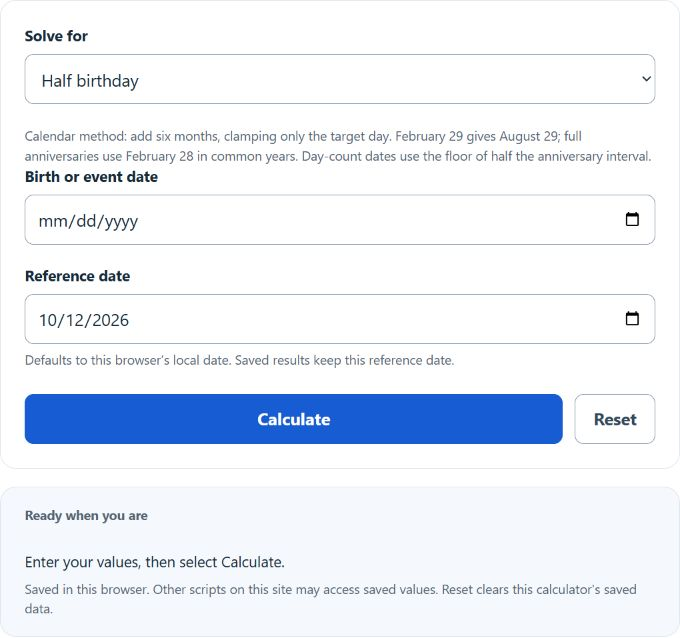
Calculate your next half birthday or half anniversary, with the previous date, countdown, quarter dates, and rounded day-count comparison.
Related Calculators
- Absolute Age Calculator
- Birthday Countdown Calculator
- Leap Calculator
- Date Calculator
- All Everyday Life and Education Calculators
Half Birthday Formula
The calculator uses two methods to find a half birthday. Pick the one that fits how you want to count.
- Birth Date: the original birth or event date you enter.
- 6 months: same day number, six calendar months later. If that day does not exist in the target month (for example, August 31 plus 6 months), the result clamps to the last day of the month.
- Annual interval: count calendar days between consecutive full anniversaries, using February 28 for a February 29 anniversary in a common year. The whole-day convention adds 182 or 183 days after rounding down; an exact 365-day midpoint is 182.5 days. The calendar six-month method maps February 29 directly to August 29.
The Half birthday mode returns the next calendar half date, previous date, next full birthday, and quarter dates in the latest birthday cycle. Half anniversary uses the same conventions for an event. Both list five upcoming half dates and compare the calendar and rounded day-count methods within the same annual cycle. The reference date defaults to the browser’s local date and is saved with the result.
Reference Tables
The two methods usually agree within a few days. The table below shows the typical gap.
| Birth month | Calendar half date | Rounded half date (365-day interval) | Gap |
|---|---|---|---|
| Jan 15 | Jul 15 | Jul 16 | 1 day |
| Mar 31 | Sep 30 | Sep 29 | 1 day |
| Jun 1 | Dec 1 | Nov 30 | 1 day |
| Aug 31 | Feb 28 or 29 | Mar 1 | 1 to 2 days |
| Feb 29 (2024–2025 cycle) | Aug 29 | Aug 29 | 0 days |
Quarter points are useful for tracking infants and toddlers, where every three months matters.
| Milestone | Months from birthday | Age label |
|---|---|---|
| Quarter birthday | +3 | x.25 |
| Half birthday | +6 | x.5 |
| Three-quarter birthday | +9 | x.75 |
| Full birthday | +12 | x+1 |
Examples and FAQ
Example 1. Birth date: April 10, 2015. The 2025 birthday cycle has a calendar half birthday on October 10, 2025, when the calendar age label is 10.5 years.
Example 2. Birth date: August 31, 2010. Six months later is February 31, which does not exist. The calendar method clamps to the last day of February, so the half birthday is February 28 (or February 29 in a leap year).
What if I was born on February 29? The calendar method puts your half birthday on August 29 every year, since August has 29 days. The full anniversary uses February 28 in common years and February 29 in leap years.
Why do the two methods sometimes differ? Six calendar months need not equal half the interval between full anniversaries. The displayed day-count convention rounds down to a whole date, while an odd-day interval has a half-day exact midpoint. The calculator compares both dates from the same annual cycle.
Is the half birthday a real holiday? No. It is an informal date people use for kids whose birthdays fall on holidays, for school cutoffs, or just for an extra reason to celebrate.
Can I use this for wedding anniversaries? Yes. Switch to the Anniversary tab and enter the event date. The math is identical, but the result is labeled in years since the event instead of age.