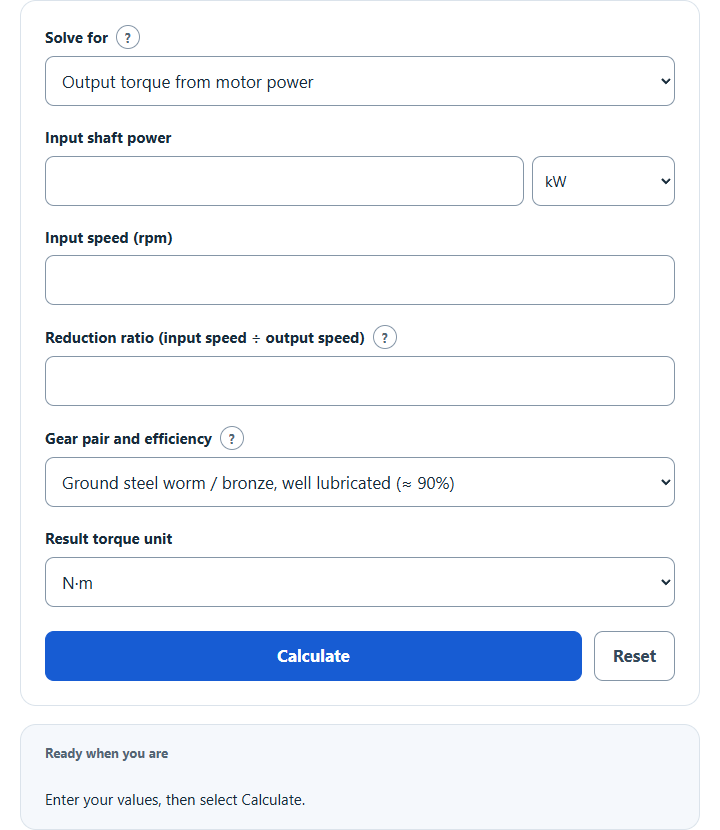
Calculate worm gear output torque and speed from motor power, input rpm, reduction ratio and gear efficiency, or torque from tooth force and pitch radius.
- All Physics Calculators
- All Torque Calculators
- Gear Torque Calculator
- Wrench Torque Calculator
- Gear Mesh Frequency Calculator
Worm Gear Torque Formula
The following formula is used to calculate the Worm Gear Torque.
- Where Twg is the Worm Gear Torque (N-m)
- L is the tangential tooth-load component (N), not the total contact force
- r is the radius of the pitch circle (m)
Choose Torque from tooth force, Tangential tooth force or Pitch radius. Use the tangential component and pitch radius of the same gear: T = F × r. In Output torque from input power, nout = nin ÷ i, Pout = Pin × efficiency/100 and Tout = Pout ÷ (2πnout/60). The reduction ratio i = input speed/output speed is at least 1. Efficiency examples are not predictions; this is a forward steady-state estimate, not a strength, thermal, starting-torque or self-locking check.
Estimate Worm Gear Mesh Efficiency
Choose Mesh efficiency from geometry to estimate the tooth-mesh efficiency when the worm drives the wheel. Enter the worm lead angle λ, the normal pressure angle αn in degrees, and the dimensionless effective sliding friction coefficient μ for the actual operating conditions. The editable 20° pressure angle is a typical value, not a measurement of your gears.
η = tan λ × (cos αn − μ tan λ) ÷ (cos αn tan λ + μ)
The calculator reports 100η as a percentage, the complementary mesh-loss percentage, and the apparent sliding friction angle ρ = atan(μ ÷ cos αn). The equivalent efficiency expression is η = tan λ ÷ tan(λ + ρ). Use a lead angle greater than 0° and less than 90°, a normal pressure angle from 0° to less than 90°, and nonnegative μ. The combination must give λ + ρ < 90° for this positive forward-efficiency model.
This is a mesh estimate, not complete gearbox efficiency: bearings, seals and lubricant churning add losses. Friction varies with lubrication, surface finish, speed, load and temperature; use measured or manufacturer data rather than choosing μ from materials alone. Sliding friction does not establish static self-locking, and a worm drive must not be relied on as a safety brake. The existing motor-power mode continues to use the overall efficiency you select or enter.
How to Calculate Worm Gear Torque?
The following two example problems outline how to calculate the Worm Gear Torque.
Example Problem #1:
- First, determine the tangential tooth load (N). In this example, it is 50 N.
- Next, determine the radius of the pitch circle (m). For this problem, the radius of the pitch circle (m) is calculated to be .23.
- Finally, calculate the Worm Gear Torque using the formula above:
Twg = L * r
Inserting the values from above and solving the equation with the imputed values gives:
Twg = 50 * .23 = 11.5 (N-m)
Example Problem #2:
Using the same process as example problem 1, we first define the variables outlined by the formula. In this case, the values are:
tangential tooth load (N) = 1000
radius of the pitch circle (m) = .10
Entering these values yields:
Twg =1000 * .10 = 100 (N-m)