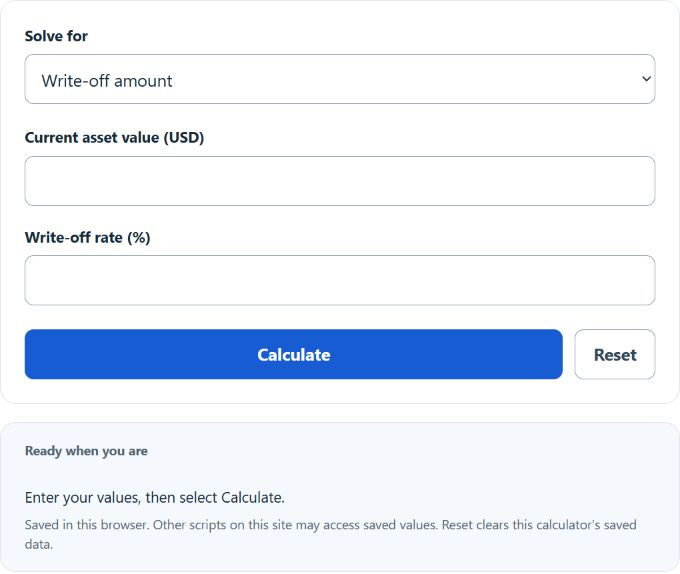
Choose a write-off amount, rate, or current asset value solve and enter the two named inputs. This is a simple USD percentage model, not a tax, accounting or insurance decision.
Write-Off Value Formula
The write-off value calculator uses the relationship between current value, write-off rate, and write-off amount. Select the quantity to solve for, then enter its two required inputs. The expandable details show the formula and value remaining after the write-off.
- WOV = write-off value or write-off amount
- CV = current value of the car or asset
- WOR = write-off rate as a percentage
To calculate the write-off rate, the formula is rearranged:
To calculate the current value, the formula is rearranged again:
- Find write-off amount: Enter the current value and write-off rate. The calculator multiplies the value by the rate as a decimal.
- Find write-off rate: Enter the current value and write-off amount. The calculator divides the amount by the current value, then converts it to a percentage.
- Find current value: Enter the write-off amount and write-off rate. The calculator divides the amount by the rate as a decimal.
Illustrative Write-Off Rate Examples
These examples show how different write-off rates affect the amount written off from a car, equipment item, or other asset.
| Current Value | Write-Off Rate | Write-Off Amount |
|---|---|---|
| $5,000 | 10% | $500 |
| $10,000 | 25% | $2,500 |
| $20,000 | 40% | $8,000 |
| $30,000 | 75% | $22,500 |
How to Read the Write-Off Rate
| Write-Off Rate | Meaning |
|---|---|
| 0% | No value is written off. |
| 25% | One quarter of the current value is written off. |
| 50% | Half of the current value is written off. |
| 100% | The full current value is written off. |
Example Problems
Example 1: Calculate the write-off amount
You have an asset with a current value of $12,000 and a write-off rate of 30%.
The write-off amount is $3,600.
Example 2: Calculate the write-off rate
An asset has a current value of $8,000 and a write-off amount of $2,000.
The write-off rate is 25%.
FAQ
What does write-off value mean?
Write-off value is the amount of an asset’s current value that is being written off. For example, if a car is worth $10,000 and the write-off rate is 40%, the write-off value is $4,000.
Can the write-off rate be more than 100%?
No. In this calculator, the write-off rate must be between 0% and 100%. A 100% write-off means the full current value is written off.
Why does each solve require two inputs?
Each named solve uses two independent inputs. A zero value and zero amount do not determine a unique rate; a zero rate and zero amount do not determine a unique current value. A positive amount with a zero denominator has no solution. The rate model is limited to 0–100%, so an amount above current value is rejected. Currency displays round half up to cents. These illustrative rates do not establish a tax deduction, accounting impairment or insurance entitlement; applicable rules and approved values must be established separately.