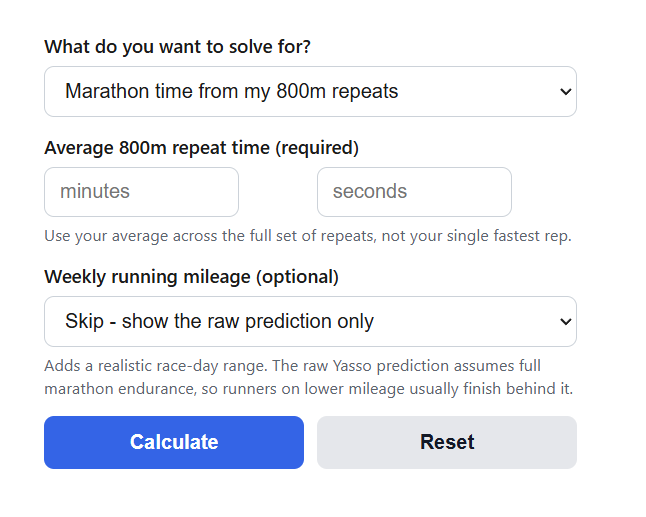
Calculate your predicted marathon time from your Yasso 800 repeat time, or the exact 800m target you need to train for your goal marathon.
Yasso 800 Marathon Predictor Formula
MT = T800 * 60
T800 = MT / 60
MP = MT / 26.219
- MT is the predicted marathon finish time in seconds
- T800 is the average time per 800m repeat in seconds
- MP is the marathon pace in seconds per mile (divide MT by 42.195 instead for seconds per kilometer)
The Yasso 800 rule, popularized by Bart Yasso of Runner’s World, says that the minutes and seconds of your average 800m repeat become the hours and minutes of your marathon. If you can run 10 x 800m averaging 3:30 per rep, the method predicts a 3:30:00 marathon. Multiplying the 800m time in seconds by 60 is the same conversion written as a formula.
The calculator works in both directions. The predict mode applies the first formula to your average 800m time and returns your projected finish time, marathon pace per mile and per kilometer, the equal-time recovery jog, and the total length of a full 10-rep session. The target mode applies the second formula to a goal marathon time and returns the 800m time you need to hit in training. The optional weekly mileage setting adds a realistic race-day range on top of the raw prediction, because the raw rule assumes full marathon endurance that not every runner has built.
Yasso 800 Times and Realistic Marathon Results
The first table converts common 800m repeat times into the raw Yasso prediction and the matching race pace. The last column shows a typical actual result for a runner training on 30 to 55 miles per week, since real-world finishes usually land 5 to 15 minutes behind the raw prediction.
| Average 800m time | Raw Yasso prediction | Marathon pace | Typical race-day result |
|---|---|---|---|
| 2:40 | 2:40:00 | 6:06 /mi | 2:45 to 2:55 |
| 3:00 | 3:00:00 | 6:52 /mi | 3:05 to 3:15 |
| 3:20 | 3:20:00 | 7:38 /mi | 3:25 to 3:35 |
| 3:30 | 3:30:00 | 8:01 /mi | 3:35 to 3:45 |
| 3:45 | 3:45:00 | 8:35 /mi | 3:50 to 4:00 |
| 4:00 | 4:00:00 | 9:09 /mi | 4:05 to 4:15 |
| 4:30 | 4:30:00 | 10:18 /mi | 4:35 to 4:45 |
| 5:00 | 5:00:00 | 11:27 /mi | 5:05 to 5:15 |
| 5:30 | 5:30:00 | 12:35 /mi | 5:35 to 5:45 |
The second table shows how to read your prediction against your training volume. The Yasso session tests speed endurance, but the marathon is decided by aerobic endurance built through mileage and long runs, so the gap between prediction and reality shrinks as volume rises.
| Weekly mileage | Longest run | How to read the prediction | Typical gap |
|---|---|---|---|
| Under 30 mi (48 km) | Under 16 mi | Best-case scenario; endurance is the limiter, not speed | 15 to 25+ min slower |
| 30 to 40 mi (48 to 64 km) | 16 to 18 mi | Optimistic; start the race slower than predicted pace | 10 to 15 min slower |
| 40 to 55 mi (64 to 89 km) | 18 to 20 mi | Reasonable goal with even pacing and good fueling | 5 to 10 min slower |
| 55+ mi (89+ km) | 20 to 22 mi | Usually close to the actual result | 0 to 5 min slower |
Example Problems
Example 1: Predict a marathon time from 800m repeats. You run 10 x 800m on the track and average 3:30 per rep. Convert the rep time to seconds: 3*60 + 30 = 210 seconds. Multiply by 60: MT = 210 * 60 = 12,600 seconds, which is 3:30:00. The matching pace is 12,600 / 26.219 = 481 seconds per mile, about 8:01 /mi. If you train on 30 to 40 miles per week, the realistic race-day range is roughly 3:40 to 3:45.
Example 2: Find the 800m target for a goal marathon. Your goal is a 4:00:00 marathon. Convert to seconds: MT = 14,400. Divide by 60: T800 = 14,400 / 60 = 240 seconds, so each 800m repeat should take 4:00 with a 4:00 recovery jog between reps. Start with 4 reps in an early-season session and add one rep per week until you can complete all 10 at 4:00, which is about 8:03 per mile of fast running against a 9:09 per mile race pace.
FAQ
Why was my marathon slower than the Yasso prediction? The workout measures speed over 800m intervals, which depends heavily on VO2 max, while the marathon depends on aerobic endurance, fuel storage, and running economy. A runner can have the speed for fast reps without the endurance to hold goal pace past 20 miles. This is why the prediction is most reliable for runners with high weekly mileage and 20-mile long runs, and why the calculator offers a mileage-adjusted range instead of only the raw number.
Should I run the 800s faster than my goal time suggests? Many coaches suggest averaging 5 to 15 seconds per rep faster than the formula target if you want a comfortable buffer, because the raw rule tends to flatter race results. The cleaner approach is to run the reps at the formula time, complete the full set of 10 with equal-time jogs, and then apply the mileage table above to set your race pacing plan.
What should the recovery between repeats be? The original workout uses a recovery jog equal in time to the rep itself, so a 3:30 rep gets a 3:30 jog. Some plans substitute a 400m jog, which shortens the rest for most runners and makes the session harder. If you cut the recovery short and still hit your times, that is a stronger sign of fitness than the standard version, but keep the recovery format consistent from week to week so your results are comparable.