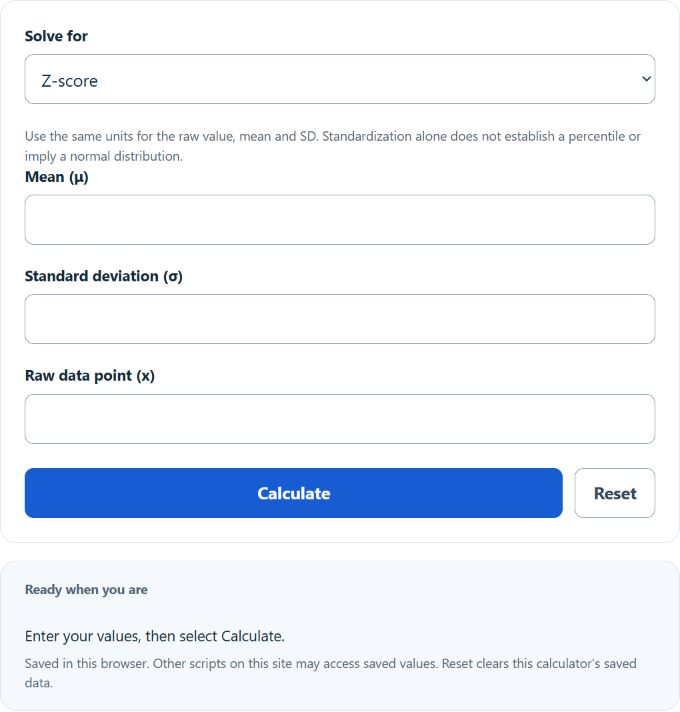
Calculate any missing Z-score, mean, standard deviation, or raw data point from three known values using the Z = (x – μ) / σ formula.
Related Calculators
- Modified Z Score Calculator
- Outlier Calculator
- Scaling (Curving) Grades Calculator
- Standard Error Of Proportion Calculator
- All Statistics Calculators
Z-Score Formula
The z-score shows how many standard deviations a raw data point is from the mean. A positive z-score is above the mean. A negative z-score is below the mean.
To solve for the raw data point:
To solve for the mean:
To solve for the standard deviation:
- Z = z-score, also called the standard score
- x = raw data point
- μ = mean of the data set
- σ = standard deviation of the data set
Select the variable to solve for and enter the other three values. Z = (x − μ) / σ, x = μ + Zσ, and μ = x − Zσ. For standard deviation, σ = (x − μ) / Z requires a nonzero Z with the same sign as x − μ and a positive result. If x = μ and Z = 0, the SD is not uniquely determined; inconsistent signs cannot be repaired by taking an absolute value.
Common Z-Score Interpretations
| Z-score | Meaning | Position relative to mean |
|---|---|---|
| 0 | The value equals the mean | At the mean |
| 1 | One standard deviation above the mean | Above average |
| -1 | One standard deviation below the mean | Below average |
| 2 | Two standard deviations above the mean | Unusually high in many data sets |
| -2 | Two standard deviations below the mean | Unusually low in many data sets |
Normal Distribution Reference Values
| Range | Approximate percent of values in range | What it means |
|---|---|---|
| -1 to 1 | 68% | Most typical values |
| -2 to 2 | 95% | Most values in a normal distribution |
| -3 to 3 | 99.7% | Nearly all values in a normal distribution |
Example Problems
Example 1: Find the z-score
A test has a mean score of 80 and a standard deviation of 5. You scored 90.
Your score is 2 standard deviations above the mean.
Example 2: Find the raw data point
A data set has a mean of 50 and a standard deviation of 8. The z-score is -1.5.
The raw data point is 38.
FAQ
What does a z-score of 0 mean?
A z-score of 0 means the raw data point is exactly equal to the mean. It is not above or below average for that data set.
Can a z-score be negative?
Yes. A negative z-score means the raw data point is below the mean. For example, a z-score of -2 means the value is 2 standard deviations below the mean.
Why must standard deviation be greater than zero?
Standard deviation measures spread. If it is zero, all values are the same, so you cannot divide by it in the z-score formula. A standard deviation less than zero is not valid because spread cannot be negative.