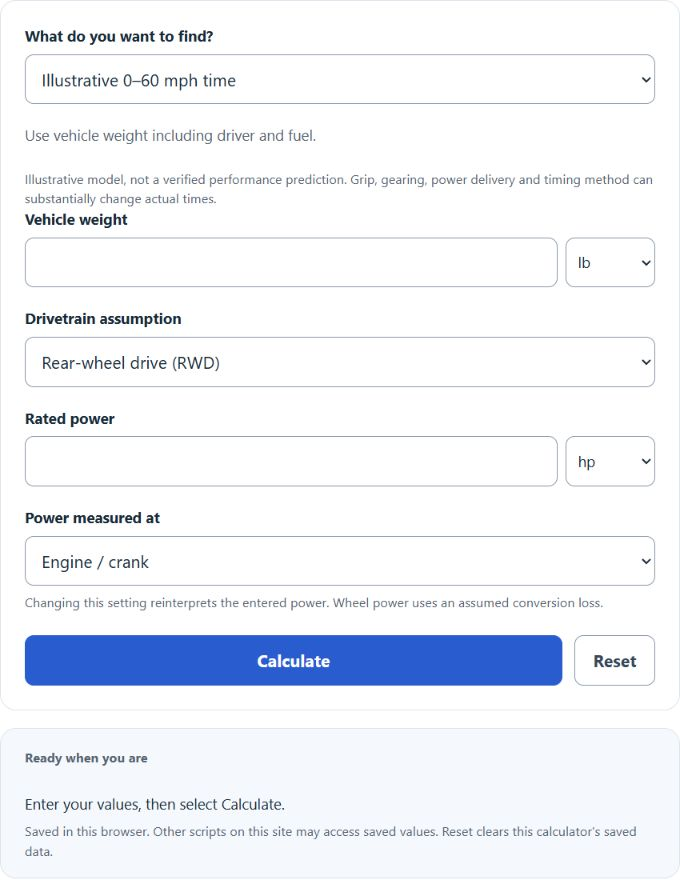
Explore an illustrative 0-60 mph model using power, vehicle weight and drivetrain assumptions, or find the model-derived power associated with a target time. This simplified model has not been independently validated as a vehicle-performance prediction.
0-60 Time Formula
The calculator retains the following simplified relationship between vehicle weight and crank horsepower. Its original coefficients have no identified calibration dataset, so treat its outputs as illustrative model values:
t = K * (W / P)^{0.8}
To find the power needed for a target 0-60 time, it rearranges the same relationship:
P = W / (t / K)^{1.25}
Variables:
- t is the estimated 0-60 mph time, in seconds
- W is the vehicle weight in pounds, including the driver and fuel
- P is the crank (engine) horsepower
- K is the model’s assumed drivetrain coefficient: 0.70 for AWD, 0.76 for RWD, and 0.80 for FWD; these values are not independently validated traction measurements
Choose a calculation at the top. Time mode uses vehicle weight and rated power; target-time mode gives model-derived crank power and assumed wheel power. Power units convert the entered quantity between mechanical hp and kW. Changing the engine/wheel basis reinterprets the number. Wheel-to-crank conversion assumes losses of 15% for RWD, 20% for AWD and 12% for FWD; actual losses vary. The rough 0-100 km/h value is 1.05 times the model time, an approximation rather than a speed-unit conversion. Target times below 1.5 seconds are outside this tool’s supported model range, not a proven physical impossibility.
The original exponent of 0.8 is retained as a model assumption. This relationship does not simulate traction, gearing, aerodynamic drag, power delivery or shift timing; no accuracy tolerance has been established.
Estimated 0-60 Times by Power-to-Weight Ratio
This table shows outputs of the illustrative model for common weight-to-power ratios, not measured vehicle performance. Divide as-driven weight including driver and fuel (in pounds) by mechanical crank horsepower.
| Weight-to-power (lbs/hp) | AWD | RWD | FWD |
|---|---|---|---|
| 5 lbs/hp | 2.5 s | 2.8 s | 2.9 s |
| 6 lbs/hp | 2.9 s | 3.2 s | 3.4 s |
| 8 lbs/hp | 3.7 s | 4.0 s | 4.2 s |
| 10 lbs/hp | 4.4 s | 4.8 s | 5.0 s |
| 12 lbs/hp | 5.1 s | 5.6 s | 5.8 s |
| 14 lbs/hp | 5.8 s | 6.3 s | 6.6 s |
| 16 lbs/hp | 6.4 s | 7.0 s | 7.4 s |
| 20 lbs/hp | 7.7 s | 8.3 s | 8.8 s |
| 25 lbs/hp | 9.2 s | 10.0 s | 10.5 s |
Example Problems
Example 1: Estimate a 0-60 time.
Your RWD car weighs 3,400 lbs with you in it and makes 300 crank horsepower. The weight-to-power ratio is 3400 / 300 = 11.33 lbs/hp. Applying the formula:
t = 0.76 * (11.33)^0.8 = 0.76 * 6.97 = 5.3 seconds, with an estimated 0-100 km/h time of about 5.6 seconds.
Example 2: Find the power needed for a target time.
You want a 4.0-second 0-60 in a 3,500 lb AWD car. Rearranging the formula:
P = 3500 / (4.0 / 0.70)^1.25 = 3500 / 8.84 = 396 crank horsepower, which is about 317 wheel horsepower after a typical 20% AWD drivetrain loss.
Frequently Asked Questions
How accurate is a 0-60 time estimated from horsepower and weight?
No independently validated accuracy range was found for this model. Tire grip, gearing, power delivery, launch control, surface conditions and timing methods can substantially change actual times. Use measured vehicle tests when assessing real acceleration; a calculator result does not establish that a target is achievable.
Why does drivetrain type change the estimate?
The selected drivetrain chooses the original model coefficient and an assumed power-loss percentage. Actual traction depends on the specific tires, vehicle, surface and control systems, so these settings do not establish a universal performance ranking.
Should I enter crank horsepower or wheel horsepower?
Select the matching engine/crank or wheel measurement basis and power unit. Changing the basis reinterprets the entered number; changing hp/kW converts the quantity. Wheel figures are converted using an assumed drivetrain loss. That assumption does not make a wheel-dyno entry inherently more accurate, because actual losses vary with operating conditions.