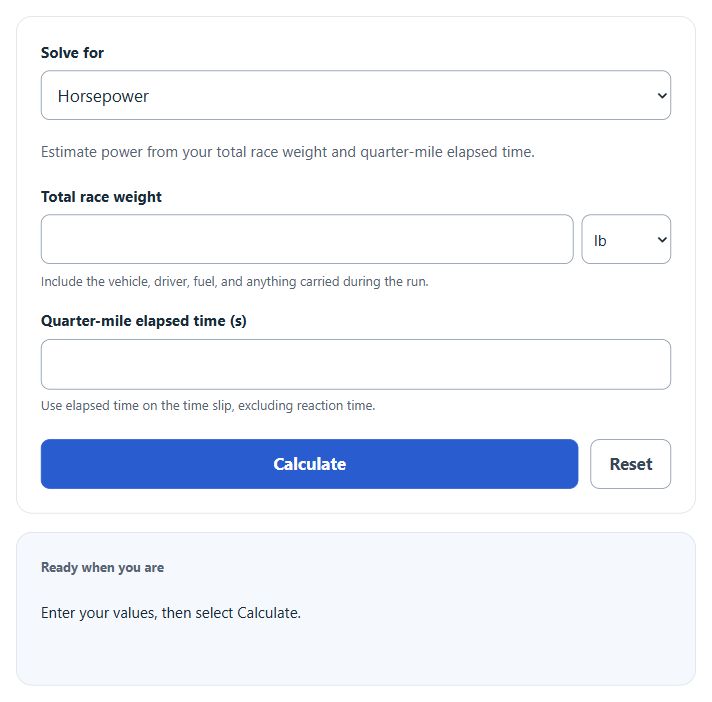
Estimate horsepower from your 1/4 mile time and race weight, or your quarter-mile ET from horsepower, with an estimated trap speed in mph and km/h.
Calculator Functions
The calculator links horsepower, race weight and quarter-mile elapsed time, so any two give the third. Every function also estimates trap speed. Select a function to open it in the calculator.
| Function | Use it when | You enter |
|---|---|---|
| Horsepower | You have a time slip and want to estimate power | Total race weight and elapsed time |
| Quarter-mile elapsed time | You want to predict a run from power | Total race weight and horsepower |
| Total race weight | You want the weight that fits a power and time | Horsepower and elapsed time |
Race weight covers the vehicle, driver, fuel and anything carried on the run, in lb or kg. Use the elapsed time on the slip, not counting reaction time.
1/4 Mile HP Formulas
| ET | Quarter-mile elapsed time (seconds) |
| W | Total race weight (lb). 1 lb = 0.45359237 kg [1] |
| HP | Horsepower. The formula does not say whether this is wheel or crankshaft power |
| 5.825 | Empirical coefficient. The cube-root form follows constant-power physics [2] |
Quarter-mile elapsed time uses this directly. A 3,200 lb car with 400 hp comes out at 5.825 × (8)1/3 = 11.65 seconds.
Horsepower and Total race weight
Both rearrange the same formula. A 3,200 lb car running 13.00 seconds comes out at about 288 hp.
Estimated trap speed
This is a separate empirical formula with the same cube-root form [2], shown in mph and km/h, with 1 mile = 1.609344 km [1]. The 3,200 lb, 400 hp car gives 117 mph.
Limits of This Estimate
- An empirical performance estimate, not a dynamometer measurement. Traction, shifts, gearing, weather and track conditions all change real runs.
- The 5.825 and 234 coefficients are rules of thumb, not values derived from physics. These estimates are based on the best available data and estimations.
- The estimate does not separate wheel from crankshaft horsepower or account for drivetrain loss, so power entered or solved on one basis stays on that basis.
Sources
- NIST, Guide to the SI (SP 811), Appendix B.8: pound and mile conversions
- Lin, The Inverse Velocity Force and Automotive Physics, Am. J. Phys., 2026: general physics of motion at constant power