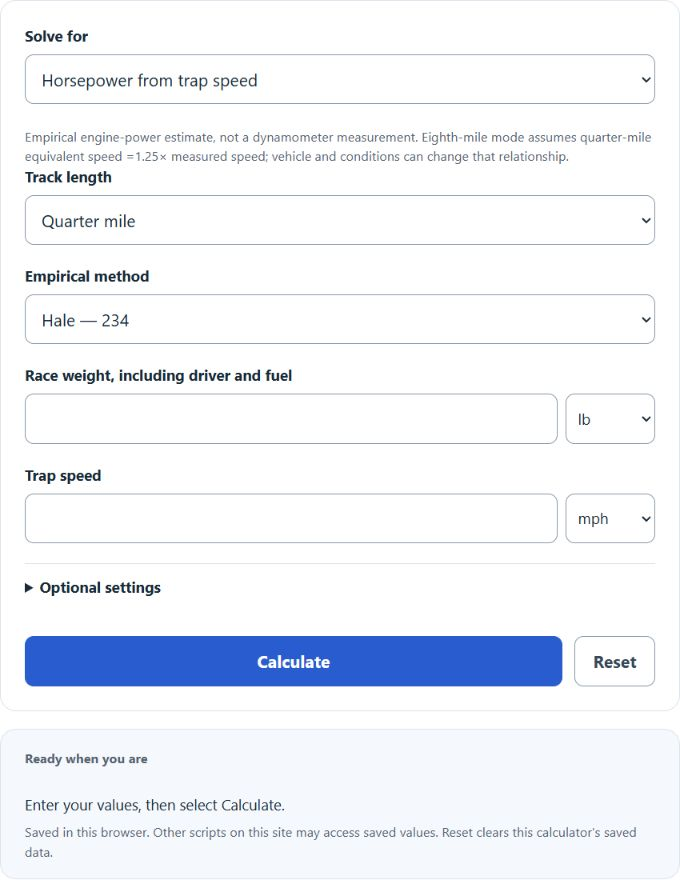
Calculate horsepower from quarter or eighth mile trap speed and race weight, or solve for the trap speed and weight a given horsepower supports.
Horsepower from Trap Speed Formula
HP = W * (V / 234)^3
- HP = estimated engine (flywheel) horsepower
- W = vehicle weight as raced, in pounds, including driver and fuel
- V = quarter-mile trap speed in miles per hour
- 234 = the empirical quarter-mile coefficient used by the Hale model, with pounds and mph
The same relationship can be rearranged to solve for the other two variables, which is how the trap speed and race weight modes of the calculator work:
V = 234 * (HP / W)^(1/3)
W = HP * (234 / V)^3
The horsepower mode takes your race weight and trap speed and returns estimated flywheel horsepower. The trap speed mode predicts the finish-line speed a given horsepower and weight should produce. The race weight mode rearranges the empirical equation for a reference race weight. It does not establish a guaranteed performance limit or a safe maximum weight.
The formula method setting swaps the constant 234 (Hale) for 230 (Fox) or 224 (Huntington), or uses their mean horsepower model. The mean model averages the three horsepower estimates and inverts that same relationship for speed and weight; it does not average separately inverted answers. For eighth-mile mode, the calculator assumes a quarter-mile equivalent speed of 1.25 times the eighth-mile speed. This retained approximation is not a universal conversion; real split-speed ratios vary. The optional drivetrain loss field converts the flywheel estimate to approximate wheel horsepower.
Estimated Horsepower by Trap Speed and Race Weight
The table below uses Hale’s formula (constant 234) with quarter-mile trap speeds. Find your trap speed row and the column closest to your as-raced weight to sanity-check the calculator or a friend’s time slip.
| Trap Speed (mph) | 2,500 lb | 3,000 lb | 3,500 lb | 4,000 lb |
|---|---|---|---|---|
| 90 | 142 hp | 171 hp | 199 hp | 228 hp |
| 100 | 195 hp | 234 hp | 273 hp | 312 hp |
| 110 | 260 hp | 312 hp | 364 hp | 416 hp |
| 120 | 337 hp | 405 hp | 472 hp | 539 hp |
| 130 | 429 hp | 514 hp | 600 hp | 686 hp |
| 140 | 535 hp | 642 hp | 750 hp | 857 hp |
These historical empirical models use different coefficients; none is a universal accuracy guarantee. The comparison is not a confidence interval. For a 3,500 lb car trapping 110 mph, the spread looks like this:
| Method | Constant | Estimate at3,500lb,110mph |
|---|---|---|
| Hale | 234 | 363.58hp |
| Fox | 230 | 382.88hp |
| Huntington | 224 | 414.48hp |
Trap speed is generally less sensitive to launch technique than elapsed time, but it still depends on the pass, aerodynamic drag, gearing, traction and conditions. A slow elapsed time with a relatively high trap speed does not by itself diagnose the cause.
Example Problems
Example 1: A car weighs 3,200 lb as raced and traps 115 mph in the quarter mile. HP = 3200 * (115 / 234)^3 ≈379.84 hp under the engine-power model. That works out to about8.42 lb per horsepower.
Example 2: A truck weighs 3,600 lb and traps 88 mph on an eighth-mile track. Convert to a quarter-mile equivalent first: 88 * 1.25 = 110 mph. Then HP = 3600 * (110 / 234)^3 ≈373.97 hp under that assumed split-speed relationship.
Frequently Asked Questions
Does this estimate wheel horsepower or crank horsepower?
The tool interprets these historical formulas as engine-power estimates, not measured wheel power. An optional user-entered drivetrain-loss percentage gives a separate wheel-power scenario; no drivetrain efficiency is inferred from the time slip or supplied as a universal default.
Why use trap speed instead of elapsed time to estimate horsepower?
Elapsed time is particularly sensitive to launch and traction. Trap speed can be useful for a rough power estimate, but the empirical model is still affected by gearing, drag, weather and the quality of the pass. It does not replace a dynamometer measurement.
What weight should I enter?
Use the weight as it crosses the finish line: vehicle, driver, and remaining fuel. The formula is linear in weight, so a 100 lb error on a 3,500 lb car shifts the estimate by about 3 percent, roughly 10 hp on a 360 hp result. Use measured race weight when available. A generic addition to brochure curb weight cannot account accurately for a particular driver, fuel load or modifications.
The Calculation details area retains a separate illustrative ET relationship: ET =5.825×cube root(W/HP) for a quarter mile or3.734×cube root(W/HP) for an eighth mile. These fixed coefficients are separate from the selected trap-speed method. Sources: Robert Szabo, Horsepower from Racecar Weight & Speed, and Jeff Lucius, quarter-mile formula comparison and original Road & Track analysis. None of these models guarantees a particular vehicle’s performance.