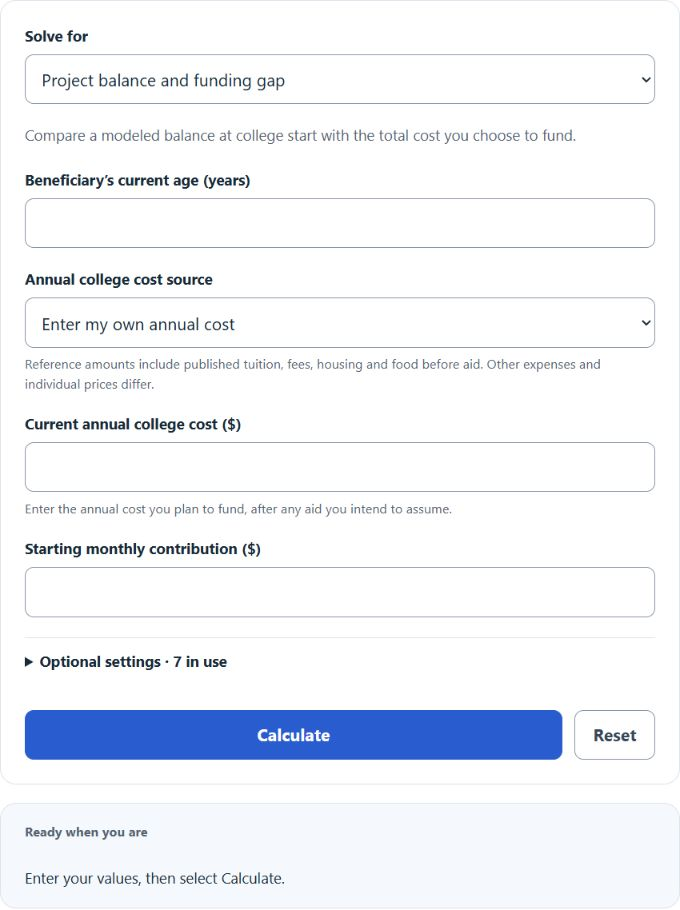
Calculate how your 529 college savings will grow, compare it to projected college costs, and find the monthly contribution needed to close any shortfall.
529 College Savings Formula
The calculator works in two directions. It can project what your 529 balance will grow to and compare that to future college costs, or it can solve for the monthly contribution you need to reach a funding goal. Both modes use the same two building blocks: the future value of your savings and the inflated cost of college.
Your projected balance is the future value of the money already in the account plus the future value of your monthly contributions:
FV = B * (1 + i)^n + M * ((1 + i)^n - 1) / i
College cost is projected forward with an annual cost inflation rate. The cost of one year of college that begins t years from now, and the total across all years of enrollment, are:
Cost_y = C0 * (1 + g)^(t + y) | TotalCost = sum of Cost_y for y = 0 to Y - 1
To find the monthly contribution required to hit a savings goal, the future value formula is rearranged to solve for M:
M = (Goal - B * (1 + i)^n) / (((1 + i)^n - 1) / i)
Variables:
- FV is the projected 529 balance at the start of college
- B is the current balance already in the 529 plan
- M is the monthly contribution
- i is the monthly rate of return, equal to the annual return divided by 12
- n is the number of months until college begins
- C0 is the current annual cost of college in today’s dollars
- g is the annual college cost inflation rate
- t is the number of years until college begins
- Y is the number of years the student is enrolled
- Goal is the total projected cost multiplied by the share of cost you plan to cover
These closed forms assume level month-end deposits and a nonzero monthly rate. At zero return, FV = B + M × n; if college starts now, there are no future deposits and the result is the amount needed now. When annual contribution changes are selected, the calculator uses a monthly recurrence and solves with the future value of a $1 starting deposit stream. It rounds months to the nearest whole month and required deposits upward to cents. All nominal college-year costs are funded at enrollment; investment growth and withdrawals during college are not modeled.
The first term of the future value formula grows your existing balance, and the second term is the future value of a stream of equal monthly deposits. The cost formula compounds today’s price forward at the inflation rate, so a college that costs C0 now will cost much more by the time a young child enrolls. Your goal is the total projected cost scaled by the share you want to fund, so covering 50% of cost halves the target. The amount by which the balance falls short of the goal is your funding gap, and the rearranged formula converts that gap into the level monthly deposit needed to close it.
College Costs and the 529 Tax Advantage
The first table uses College Board 2025–26 reference prices for tuition, fees, housing and food, before grant aid. These are not complete student budgets or individual quotes. The last column projects the full four-year bill for a child born today, assuming costs rise 5% per year until enrollment at age 18.
| College type | Annual tuition, fees, housing and food (2025–26) | Four-year cost (today’s dollars) | Projected four-year cost for a child born today |
|---|---|---|---|
| In-state public, 4-year | $25,850 | $103,400 | $268,138 |
| Out-of-state public, 4-year | $45,780 | $183,120 | $474,868 |
| Private nonprofit, 4-year | $60,920 | $243,680 | $631,913 |
The second table is an illustration using $300 month-end deposits, a 6% nominal annual return divided by 12, and a hypothetical 15% tax on positive growth at the end. It does not simulate a taxable account’s yearly taxes, dividends, basis, state treatment or actual tax savings. Qualified 529 distributions can receive federal tax benefits subject to requirements.
| Years invested | Total contributions | Modeled earnings | Hypothetical terminal tax (15%) |
|---|---|---|---|
| 5 years | $18,000 | $2,931 | $440 |
| 10 years | $36,000 | $13,164 | $1,975 |
| 15 years | $54,000 | $33,246 | $4,987 |
| 18 years | $64,800 | $51,406 | $7,711 |
With the constant positive return in this illustration, modeled growth increases over time. Actual returns vary, losses are possible, and the tax proxy is not added to the projected account balance.
Example Problems
Example 1: Will your savings be enough?
Your child is 5 years old and college begins at 18, so you have 13 years. You have $10,000 saved and add $250 per month. Using a 6% annual return, your balance grows to about $80,634 by the first day of college. A custom annual college-cost scenario of $24,920 today, inflated at 5% per year, adds up to about $202,534 across the four years. Your savings cover roughly 40% of that, leaving a shortfall near $121,900. To fully fund the goal instead, you would need to raise your deposit to about $768 per month.
Example 2: How much should you save?
Take the same 5-year-old and $10,000 starting balance, but now solve for the contribution that funds the same custom $24,920 annual-cost scenario. The $202,534 goal, minus the future value of your current balance, divided by the future value factor for 13 years of monthly deposits, works out to about $768 per month. Over the 13 years that adds up to roughly $119,800 of contributions and about $72,800 of modeled growth.
Frequently Asked Questions
What return and inflation rate should you assume?
The 6% return and 5% college-cost change are illustrative defaults, not forecasts or recommended assumptions. Enter a return assumption after fees and test a range of scenarios in Optional settings, including lower or negative returns. Costs, grant aid and investment results vary.
Does the calculator include the 529 tax break?
The balance model applies no annual tax drag. A separate proxy multiplies positive modeled growth by your hypothetical gains-tax rate; it is not an estimate of actual tax savings and is not included in the balance. State deductions, credits, recapture and distribution eligibility are not modeled. See IRS qualified tuition program guidance.
What happens if your child gets a scholarship or skips college?
Options can include changing to an eligible family beneficiary or using funds for other qualified education expenses. A scholarship-related distribution may qualify for an exception to the additional 10% federal tax; taxable earnings can still be included in income. Eligible direct transfers to the beneficiary’s Roth IRA are subject to annual limits, a $35,000 lifetime limit, an account age requirement of at least 15 years, and restrictions on recent contributions and earnings. Requirements and state treatment matter; consult current IRS Publication 970 and your plan before a distribution.