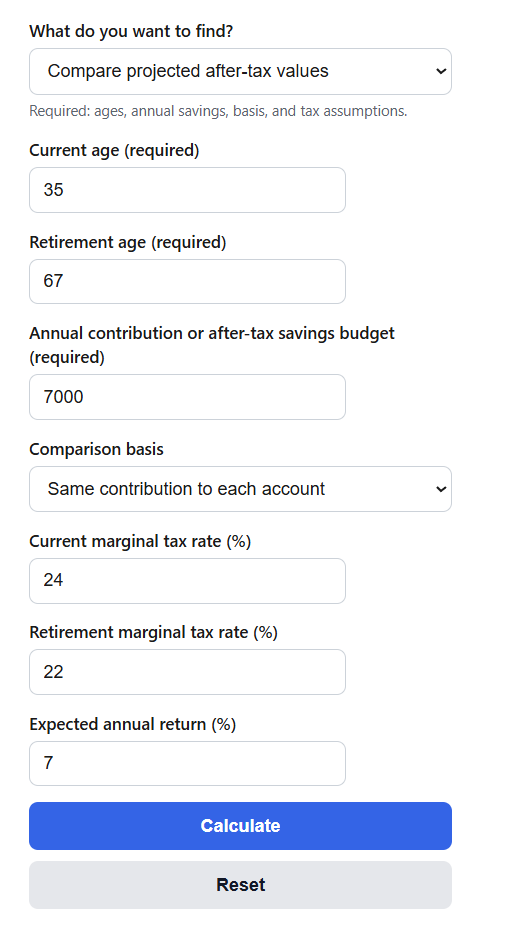
Compare Roth and traditional IRA savings on an after-tax basis or calculate the break-even retirement tax rate using equal contributions or take-home cost.
Roth vs Traditional IRA Formula
Both accounts use the future value of annual contributions; the main simplified difference is when income tax is paid.
Contribution growth is:
FV=C*((1+r)^n-1)/r
The traditional account after tax is:
Traditional_{after-tax}=FV_{traditional}*(1-T_f)
The break-even future rate is:
T_{break-even}=1-FV_{Roth}/FV_{Traditional}
Variables:
- C is annual contribution
- r is annual return
- n is contribution years
- Tf is the retirement tax rate
Same-contribution mode puts the same dollars into both accounts. Same-take-home-cost mode grosses up the traditional contribution for the current deduction.
Equalizing contribution and equalizing take-home cost answer different questions.
Eligibility, deductibility, income phaseouts, and contribution limits must be checked separately.
Tax-Rate Comparison Guide
The simplified preference depends on current and future tax rates and the comparison basis.
| Tax pattern | Simplified tendency | Reason |
|---|---|---|
| Future rate higher | Roth favored | Tax is paid at a lower current rate |
| Rates equal | Often similar | Equivalent tax rate |
| Future rate lower | Traditional favored | Deduction occurs at the higher rate |
| Same nominal contribution | Roth often looks larger after tax | Roth has a higher current cost |
Example Problems
Example 1: Compare the same contribution.
Contribute $7,000 annually for 32 years at 7 percent. The Roth result is tax-free in the model, while the traditional result is reduced by the future rate.
Example 2: Compare the same take-home cost.
At a 24 percent current rate, a $7,000 Roth budget corresponds to about $9,210.53 of deductible traditional contribution before applying limits.
Frequently Asked Questions
Does the calculator enforce contribution limits?
No. Limits and catch-up amounts change, and eligibility can depend on income.
Why does the comparison basis matter?
The same nominal contribution does not create the same current take-home cost.
Are Roth withdrawals always tax-free?
The model assumes qualified Roth IRA withdrawals. Actual account-age and distribution rules still apply.