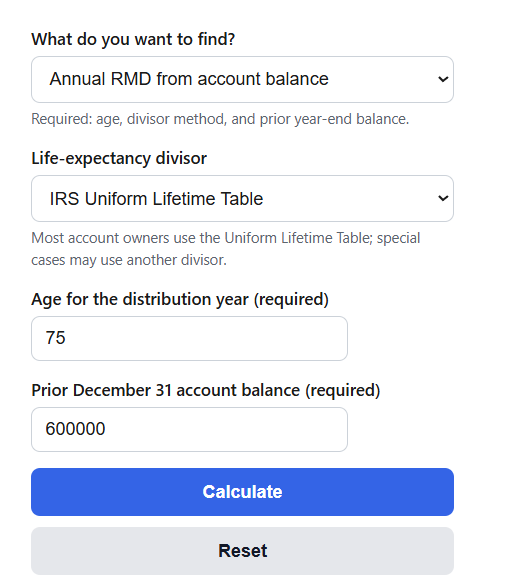
Calculate an annual RMD or the account balance behind a target distribution using IRS Uniform Lifetime factors or a custom divisor for retirement planning.
Required Minimum Distribution Formula
A required minimum distribution is generally the prior December 31 account balance divided by the applicable life-expectancy divisor.
The annual amount is:
RMD=B/F
To solve for the balance:
B=RMD*F
Variables:
- RMD is the annual distribution
- B is the prior year-end balance
- F is the applicable life-expectancy divisor
Choose the Uniform Lifetime Table for the common account-owner case or enter a custom divisor when a different table applies.
Monthly and quarterly figures are scheduling equivalents; the annual amount is the controlling result.
The tool calculates the amount but does not determine whether an RMD is required for the selected year.
Selected Uniform Lifetime Factors
The divisor declines with age, increasing the implied distribution percentage.
| Age | Divisor | Approximate rate |
|---|---|---|
| 72 | 27.4 | 3.65% |
| 75 | 24.6 | 4.07% |
| 80 | 20.2 | 4.95% |
| 85 | 16.0 | 6.25% |
| 90 | 12.2 | 8.20% |
| 95 | 8.9 | 11.24% |
| 100 | 6.4 | 15.63% |
Example Problems
Example 1: Calculate an RMD.
At age 75, divide a $600,000 prior year-end balance by 24.6 to get approximately $24,390.24.
Example 2: Find the underlying balance.
A target RMD of $25,000 at age 75 corresponds to $25,000 times 24.6, or $615,000.
Frequently Asked Questions
Which balance should I use?
Use the account value on December 31 of the year before the distribution year, subject to the rules for that account.
Does everyone use the Uniform Lifetime Table?
No. A substantially younger sole-beneficiary spouse and some beneficiary situations may use different tables.
Does the calculator determine the RMD starting age?
No. Starting ages vary by birth year and law, so first confirm whether a distribution is required.
IRS table review: October 20, 2026. The embedded Uniform Lifetime factors are the revised factors applicable beginning in 2022, as reproduced in the latest posted IRS Publication 590-B, Appendix B, Table III. They are not a new table issued every year. Enter your age attained in the distribution year. This tool does not decide whether an RMD is due, a beneficiary rule, or whether a different table is required.