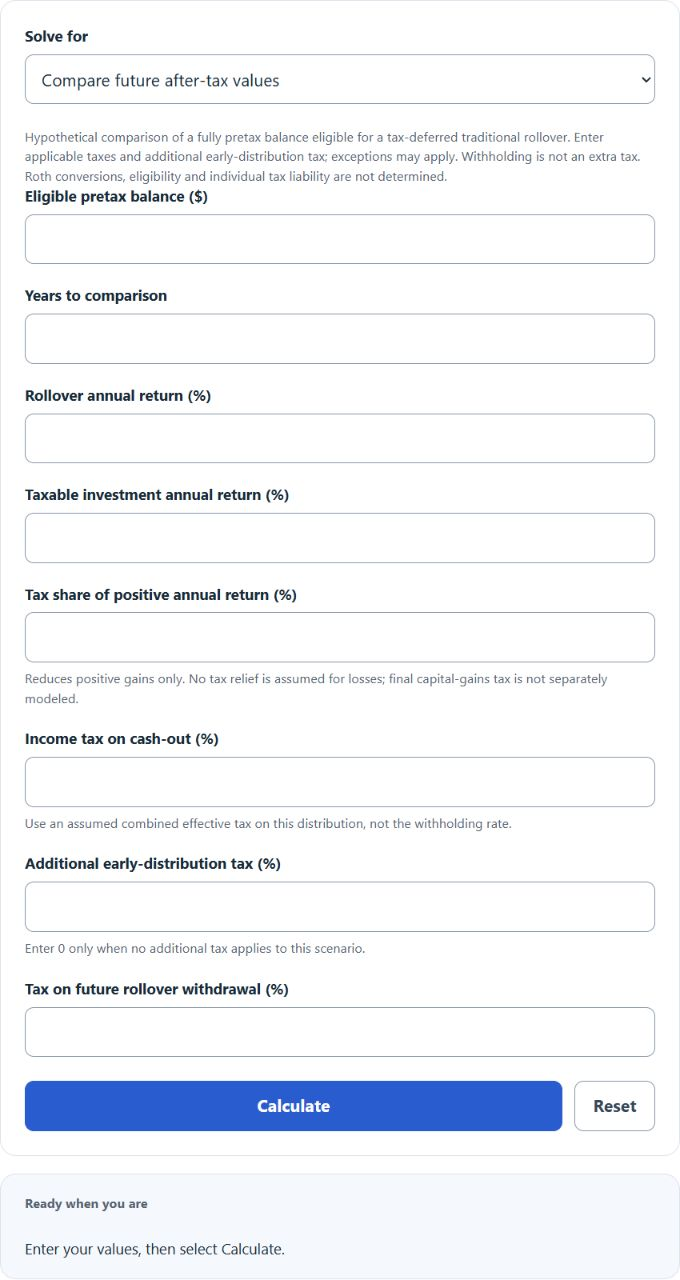
Compare an IRA rollover with cashing out a retirement plan, including taxes, penalties, investment growth, tax drag, and future withdrawal tax over time.
IRA Rollover vs Cash-Out Formula
This scenario assumes a fully pretax balance eligible for a tax-deferred traditional rollover. A cash-out begins with the amount left after assumed income tax and additional early-distribution tax. Roth conversions, after-tax basis and rollover eligibility are not modeled.
Cash available to invest:
Cash_{today}=Balance*(1-Tax-Penalty)
Rollover after tax:
Rollover_{after-tax}=Balance(1+r_R)^n(1-T_R)
Taxable investment future value:
CashFuture=Cash_{today}(1+g_C)^n
Variables:
- rR is rollover return
- rC is taxable investment return
- TR is retirement withdrawal tax
- TaxDrag is the share of positive annual return lost to taxes; gC = rC(1 − TaxDrag) when rC is positive, and gC = rC otherwise. No tax benefit is assumed for losses.
- n is years
Comparison mode reports both future values. Return-needed mode solves for the gross taxable return that matches the rollover.
The cash-out side assumes every dollar left after tax and penalty is invested.
Enter the additional early-distribution tax that applies to the scenario, including zero when none applies. Plan type and statutory exceptions matter; the calculator does not determine eligibility. Withholding is a tax prepayment, not an extra final tax deduction.
Cash Remaining from $100,000
Immediate proceeds depend heavily on tax and penalty.
| Income tax | Penalty | Cash remaining |
|---|---|---|
| 22% | 10% | $68,000 |
| 24% | 10% | $66,000 |
| 32% | 10% | $58,000 |
| 24% | 0% | $76,000 |
Example Problems
Example 1: Compare future values.
Compare a $100,000 rollover at 7 percent with $66,000 invested after a 24 percent tax and 10 percent penalty.
Example 2: Solve for return.
Find the taxable-account return needed for the smaller starting amount to match the rollover after tax drag.
Frequently Asked Questions
Does a direct rollover create current tax?
A properly executed eligible direct rollover to a traditional IRA generally preserves tax deferral; the model assumes the full pretax balance rolls over. A Roth conversion is outside this model.
Why include tax drag?
Taxable interest, dividends, and realized gains can reduce compounding. Here, a constant tax share reduces positive assumed annual returns only. Actual realized losses follow netting, deduction and carryforward rules; no loss relief or final taxable-account sale tax is modeled.
Is the early-withdrawal penalty always due?
No. Age and statutory exceptions can change the rate; enter the rate that applies to the scenario.