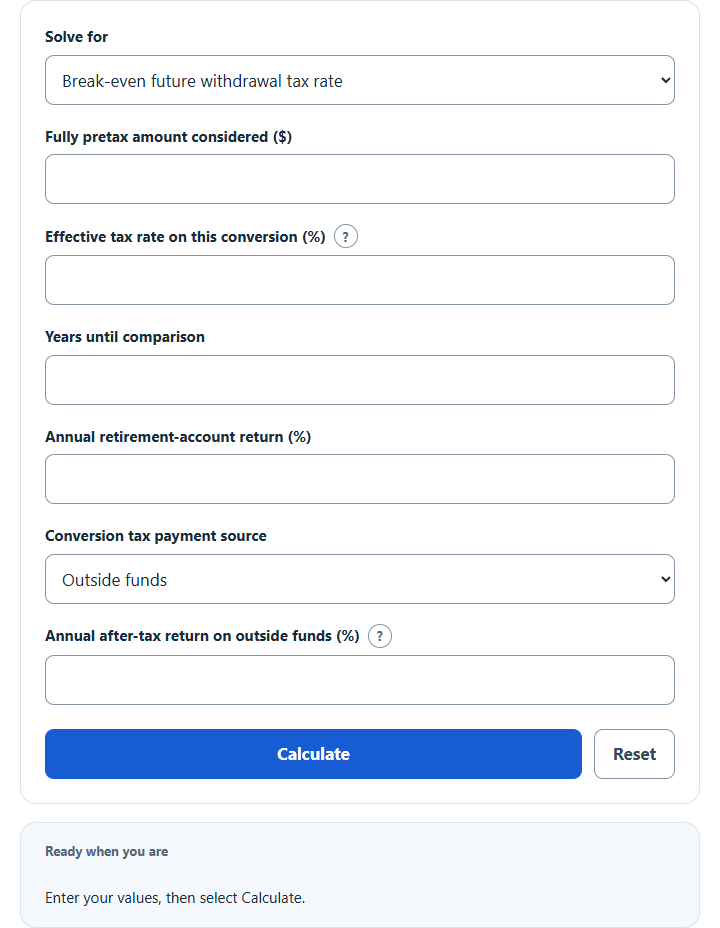
Calculate the Roth conversion break-even tax rate, where converting equals keeping funds traditional, or compare projected net wealth for both choices.
Roth Conversion Break-Even Formula
This simplified model assumes fully pretax funds, flat scenario tax rates and qualified Roth withdrawals. It includes the opportunity cost of outside money used to pay tax. It does not determine the actual tax bill or whether a distribution is qualified. IRA basis can change the taxable amount under Form 8606; bracket changes and income-based effects require a separate calculation.
The converted account grows as:
The no-conversion alternative is:
The break-even future tax rate is:
Variables:
- B is the gross fully pretax amount considered: the full conversion when tax is paid outside, or the conversion plus tax withheld when paid from the account
- ra is retirement-account return
- ro is outside-fund after-tax return
- Tf is the future withdrawal tax rate; tax rates in the formulas are decimal fractions, while calculator inputs are percentages
When tax is paid outside, the full amount enters the Roth but the tax dollars are no longer available to invest.
When tax is paid from the account, only B minus the modeled tax enters the Roth. The model assumes the entire gross distribution B is taxable. Withholding can create an early distribution and additional tax that this model excludes; a Roth conversion itself does not automatically incur that additional tax.
Actual conversion timing may affect tax brackets, Medicare premiums and other income-based amounts. Qualified Roth IRA withdrawals generally require the Roth IRA five-tax-year period plus an applicable qualifying condition such as age 59½. Each conversion also has a separate five-tax-year early-distribution rule. These are distinct rules and are not tested here; see IRS Publication 590-B.
Conversion Tax Examples
The table illustrates fully taxable amounts multiplied by assumed flat rates. A conversion can cross brackets, so one marginal-rate multiplication may not equal the actual incremental tax. The calculator uses the effective scenario rate you enter, without calculating brackets, state interactions or other income-based effects.
| Conversion amount | 22% | 24% | 32% |
|---|---|---|---|
| $50,000 | $11,000 | $12,000 | $16,000 |
| $100,000 | $22,000 | $24,000 | $32,000 |
| $200,000 | $44,000 | $48,000 | $64,000 |
| $500,000 | $110,000 | $120,000 | $160,000 |
Example Problems
Example 1: Compare the choices.
Assume $200,000 fully pretax, a 24% effective conversion-tax rate paid outside, 15 years, a constant 7% retirement-account return, a constant 4% after-tax outside return and a 28% future traditional-withdrawal tax rate. Tax now is $48,000. Projected Roth value is $551,806.31; the no-conversion alternative includes $86,445.29 of retained outside money plus the after-tax traditional account, totaling $483,745.83. The modeled difference is $68,060.48 in favor of the conversion scenario. These are hypothetical assumptions, not a recommendation or forecast.
Example 2: Find the break-even rate.
Using the same outside-payment assumptions, the algebraic break-even rate is 24% × (1.04/1.07)15 ≈ 15.665875%. If tax is withheld from the account, this simplified model’s threshold is the entered current rate, 24%. A threshold above 100% means no break-even within a 0–100% future withdrawal-tax range, rather than a feasible tax forecast.
Frequently Asked Questions
Why can break-even differ from today’s tax rate?
Outside tax funds may earn a different return than the retirement account, changing their opportunity cost.
Are RMD effects included?
No. Avoided RMDs require a year-by-year account and tax model.
Should tax be paid from the IRA?
Withholding reduces the amount converted. Depending on age and exceptions, the withheld amount can trigger additional early-distribution tax; this model excludes that charge. Review the IRS conversion rules and the separate distribution rules before applying a scenario.