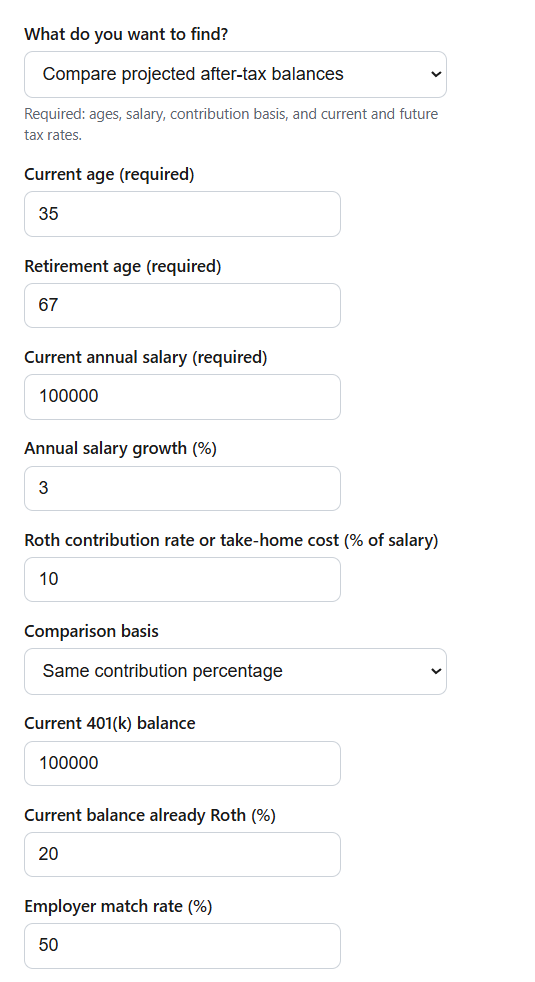
Compare Roth and traditional 401(k) contributions, employer match, and after-tax retirement balances or find the break-even future tax rate for your plan.
Roth vs Traditional 401(k) Formula
The calculator projects Roth, pre-tax, and employer-match balances separately, then applies retirement tax to the pre-tax portions.
For the Roth strategy:
AfterTax_{Roth}=RothBalance+(Pretax+Match)(1-T_f)
For the traditional strategy:
AfterTax_{Traditional}=ExistingRoth+(Traditional+Match)(1-T_f)
Equal take-home cost grosses up the traditional rate:
c_{traditional}=c_{Roth}/(1-T_c)
Variables:
- Tf is the retirement tax rate
- Tc is the current marginal tax rate
- employer matching is modeled as pre-tax
- salary growth raises dollar contributions over time
Same-contribution mode uses the same percentage for both choices. Same-take-home-cost mode allows a larger traditional contribution because of the current tax deduction.
Existing Roth and pre-tax balances retain their assumed tax character in both scenarios.
The model does not enforce annual limits, plan-specific matching provisions, or required distributions.
Comparison Basis Examples
Equal contribution and equal take-home cost answer different planning questions.
| Basis | Roth rate | Traditional rate at 24% tax | Take-home effect |
|---|---|---|---|
| Same contribution | 10% | 10% | Roth costs more today |
| Same take-home cost | 10% | 13.16% | Approximately equal |
| Same contribution | 6% | 6% | Roth costs more today |
| Same take-home cost | 6% | 7.89% | Approximately equal |
Example Problems
Example 1: Compare equal percentages.
At 10 percent, both choices deposit the same employee dollars, but only the traditional balance is reduced by future tax.
Example 2: Compare equal take-home cost.
At a 24 percent current rate, a 10 percent Roth cost corresponds to about a 13.16 percent traditional contribution before limits.
Frequently Asked Questions
How is employer match treated?
The match is modeled as pre-tax in both strategies and taxed at the assumed retirement rate.
Why enter the current Roth share?
It preserves the different tax treatment of dollars already accumulated.
Does the model calculate a full tax return?
No. It uses marginal-rate assumptions rather than brackets, deductions, credits, and state taxes.