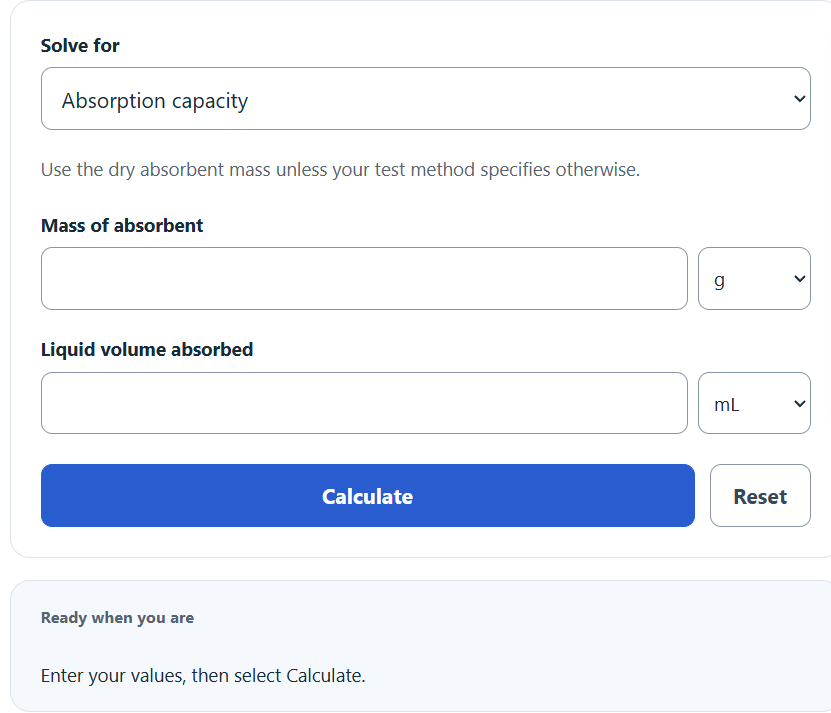
Calculate the missing value for absorbent mass, liquid volume, or absorption capacity using two inputs in g, kg, oz, lb, mL, L, or fl oz.
Related Calculators
- Iodine Value Calculator
- Solubility Constant Calculator
- Extinction Coefficient Calculator
- Absorbance to Transmittance Calculator
- All Chemistry Calculators
Absorption Capacity Formula
The absorption capacity calculator uses the relationship between the mass of an absorbent material, the volume of liquid it absorbs, and the absorption capacity of the material.
- AC = absorption capacity
- V = volume of liquid absorbed
- M = mass of absorbent
Choose the unknown under Solve for. Results include equivalent units. The calculator converts all entered values to base units before solving: grams for mass, milliliters for volume, and mL/g for absorption capacity.
- To calculate absorption capacity: enter mass and volume. The calculator divides liquid volume by absorbent mass.
- To calculate volume absorbed: enter mass and absorption capacity. The calculator multiplies capacity by mass.
- To calculate mass of absorbent: enter volume and absorption capacity. The calculator divides volume by capacity.
Unit Relationships Used for Absorption Capacity
These conversions show how the calculator standardizes values before applying the formula.
| Measurement | Unit | Base conversion |
|---|---|---|
| Mass | g | 1 g |
| Mass | kg | 1 kg = 1000 g |
| Mass | oz | 1 oz = 28.349523125 g |
| Mass | lb | 1 lb = 453.59237 g |
| Volume | mL | 1 mL |
| Volume | L | 1 L = 1000 mL |
| Volume | fl oz | 1 US fl oz = 29.5735295625 mL |
Common Capacity Unit Equivalents
| Capacity unit | Equivalent in mL/g | Note |
|---|---|---|
| mL/g | 1 mL/g | Base capacity unit |
| L/kg | 1 mL/g | Numerically equal to mL/g |
| fl oz/oz | approximately 1.04317556 mL/g | Uses US fluid ounces for volume and avoirdupois ounces for mass |
Example Calculations
Example 1: Calculate absorption capacity
You have 50 g of absorbent that absorbs 200 mL of liquid.
The absorption capacity is 4 mL/g.
Example 2: Calculate required mass of absorbent
You need to absorb 2 L of liquid using a material with an absorption capacity of 5 mL/g.
First convert 2 L to milliliters:
Then solve for mass:
You need 400 g of absorbent.
FAQ
What does absorption capacity mean?
Absorption capacity tells you how much liquid a material can absorb per unit of its own mass. For example, a capacity of 6 mL/g means each gram of absorbent can hold 6 milliliters of liquid.
Is mL/g the same as L/kg?
Yes. The numerical value is the same because 1 L equals 1000 mL and 1 kg equals 1000 g. For example, 5 mL/g is equal to 5 L/kg.
Should the mass be the dry mass or wet mass of the absorbent?
Use the dry mass of the absorbent unless your testing method says otherwise. Absorption capacity is normally based on how much liquid a known dry mass can take up.