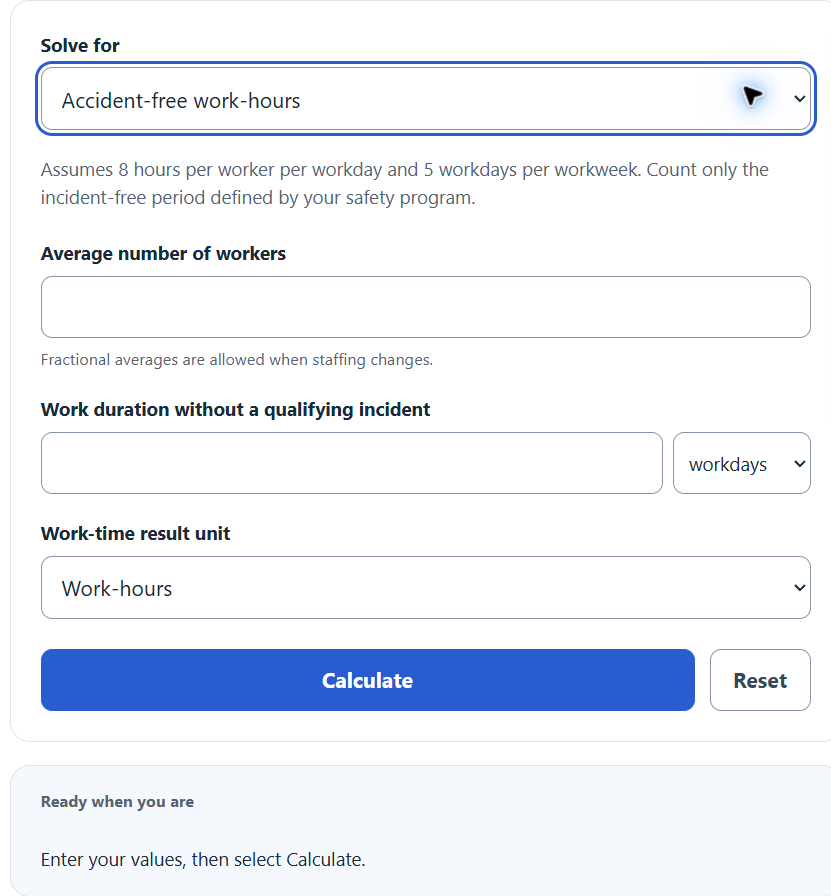
Choose Solve for, then enter the other two values to estimate accident-free work-hours, average workers, or workdays, assuming 8-hour workdays.
Related Calculators
- Accident Free Days Calculator
- Cumulative Safe Man Hours Calculator
- Lost Time Incident Rate Calculator
- Accident Frequency Rate Calculator
- Severity Rate Calculator
- Man Hours Calculator
- All Construction Calculators
Accident Free Man Hours Formula
The following formula estimates accident-free man hours for a constant crew size over a given number of accident-free workdays, assuming an 8-hour workday.
Variables:
- H = accident-free man hours (total work-hours logged without a recordable accident/incident)
- W = average number of workers on site
- D = number of workdays without a recordable accident/incident
This calculator fixes the shift length at 8 hours. If shift length varies or workers work overtime, use actual recorded hours outside this fixed-shift estimate. For project sites where headcount fluctuates, use a weighted average worker count over the period rather than a single snapshot.
What Are Accident Free Man Hours?
Accident-free man hours (also called safe man hours or safe work hours) represent the cumulative total of hours worked by all employees since the last recordable workplace accident or incident, as defined by your safety program or regulatory framework. The count resets to zero whenever a qualifying recordable incident occurs. The metric is a lagging safety indicator: it reflects past performance rather than predicting future risk, which means a large accumulation signals a strong safety track record but does not guarantee continued safety without active management.
The term “recordable incident” in the US context follows OSHA 29 CFR 1904 criteria. A work-related new injury or illness is generally recordable if it results in death, days away from work, restricted work or job transfer, medical treatment beyond first aid, loss of consciousness, or diagnosis of a significant injury or illness by a licensed healthcare professional. A near-miss without injury or illness is not an OSHA recordable case. First-aid-only cases are not recordable unless another recording criterion applies. Follow your program’s stated reset definition and track near-misses separately.
Milestone Thresholds and How Long They Take
Accident-free hour milestones function as formal recognition points in safety culture. The National Safety Council’s Million Work Hours Award specifically recognizes organizations that reach 1,000,000 work hours without a lost-time injury. The table below shows how long a crew of a given size must work continuously without a recordable incident to reach common milestones at an 8-hour/day, 5-day/week schedule.
| Crew Size (Workers) | 100K Hours | 500K Hours | 1 Million Hours |
|---|---|---|---|
| 25 workers | 100 weeks | 500 weeks | 1,000 weeks |
| 50 workers | 50 weeks | 250 weeks | 500 weeks |
| 100 workers | 25 weeks | 125 weeks | 250 weeks |
| 250 workers | 10 weeks | 50 weeks | 100 weeks |
| 500 workers | 5 weeks | 25 weeks | 50 weeks |
These figures assume a constant headcount and a strict 8-hour, 5-day schedule. For the same crew, 12-hour shifts on five days accumulate hours 50% faster; eight-hour shifts on seven days accumulate hours 40% faster. Both 12-hour shifts and seven-day weeks together accumulate hours 110% faster. Large construction megaprojects with 2,000+ workers on site can reach 1 million hours in a matter of months, which is why those projects often display ongoing counters on signs at the site.
Industry Benchmarks: TRIR and What Accident-Free Hours Imply
Accident-free man hours connect directly to the Total Recordable Incident Rate (TRIR), the most widely reported OSHA safety metric. TRIR is calculated as (number of recordable incidents x 200,000) divided by total hours worked in the period. The 200,000 constant normalizes the rate to 100 full-time equivalent workers working 2,000 hours per year.
The US Bureau of Labor Statistics reported 2023 total recordable case rates per 100 full-time workers of 2.4 for private industry overall, 2.3 for construction, 2.8 for manufacturing, and 3.6 for private health care and social assistance. Compare the same industry, reporting period and case definition. A long incident-free period alone does not establish statistically superior safety performance.
With zero recordable cases and a positive number of hours worked, the observed TRIR for that period is zero. For example, zero cases over 500,000 hours gives 0.0. This is an observed rate, not a risk floor or a guarantee about future incidents.
Lagging vs. Leading Indicators: Where Accident-Free Hours Fit
Accident-free man hours are a lagging indicator, meaning they measure outcomes that have already occurred (or, in this case, outcomes that have not occurred). OSHA and most safety researchers distinguish between lagging indicators like TRIR, DART rate, and accident-free hours, and leading indicators that measure proactive safety activities before incidents happen.
Leading indicators include completion rates for safety training, frequency of safety audits, number of near-miss reports filed, corrective action closure rates, and percentage of toolbox talks completed. OSHA guidance explicitly recommends using both types together: leading indicators identify where exposures and at-risk behaviors exist before an accident occurs, while lagging indicators like accident-free hours help monitor outcomes over time without proving that an intervention caused them.
A practical limitation of accident-free hours as a standalone metric is the incentive it can create against reporting. Workers or supervisors who are aware of a milestone may be reluctant to report first-aid or near-miss events out of concern for resetting the counter. This is one reason why leading indicators and anonymous reporting mechanisms are considered best practice supplements to accident-free hour tracking, particularly in high-hazard industries.
How Accident-Free Man Hours Are Used in Practice
Accident-free man hours serve several operational and commercial purposes beyond internal safety tracking. In contract prequalification, owners and general contractors routinely request 3-5 year safety records including TRIR, DART rates, and EMR (Experience Modification Rate). A high accumulated accident-free hour total strengthens a company’s bid position by demonstrating sustained safety performance. Some federal and state agency contracts require contractors to meet specific TRIR thresholds as a condition of award.
On active job sites, accident-free hour counts are often displayed on scoreboards at site entrances, updated daily or weekly. This visibility functions as a team motivator and reinforces that safety is a shared responsibility. Companies that reach major milestones (100,000, 500,000, or 1 million hours) frequently mark the achievement with team events, certificates, or formal awards. The National Safety Council’s Million Work Hours Award has been presented to organizations across construction, manufacturing, utilities, and healthcare.
The financial case for maintaining a strong accident-free record is well established. Research cited by the National Safety Council estimates that every $1 invested in an effective workplace safety program returns between $4 and $6 in avoided costs from workers’ compensation claims, lost productivity, equipment damage, regulatory fines, and insurance premiums. A company that tracks and communicates accident-free hours consistently is also signaling to its workforce that safety outcomes are valued and visible at the leadership level, which correlates with higher employee morale and lower voluntary turnover in high-hazard roles.