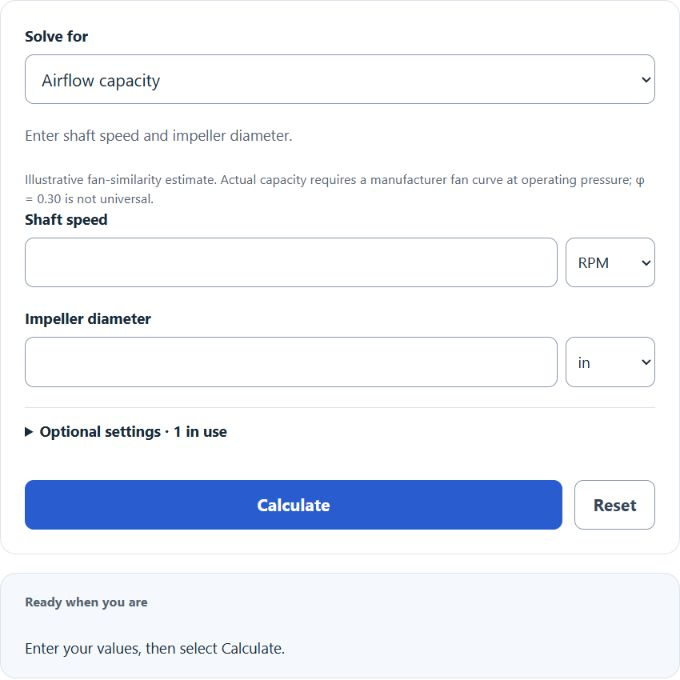
Estimate blower airflow, speed, or impeller diameter with an illustrative fan-similarity model, using CFM, cubic meters per hour, liters per second, RPM, and metric units. Actual capacity requires a manufacturer fan curve at the operating pressure.
Related Calculators
- Air Flow Calculator
- Volumetric Flow Rate Calculator
- Fan Velocity Calculator
- Exhaust Fan Calculator
- Loss Coefficient Calculator
- m3/h to CFM Calculator
- All Construction Calculators
Air Blower Capacity Formula
The following fan-similarity estimate assumes comparable geometry and operating conditions. The dimensionless coefficient is defined as φ = Q/(nD³), with Q in m³/s, n in revolutions per second, and D in meters. The default φ = 0.30 is illustrative, not a universal blower coefficient. With Q in CFM, N in RPM, and D in inches, this becomes:
Variables:
- Q is the flow rate (CFM)
- N is the blower speed (RPM)
- D is the blower/impeller diameter (inches)
What is an Air Blower?
An air blower is a device used to move air at a relatively high flow rate with a low to moderate pressure rise (generally higher pressure than a typical fan, but lower than a compressor). It is commonly used in various industrial and commercial applications, such as ventilation, cooling, and material handling. Air blowers can be powered by electric motors, gasoline engines, or other power sources, and they come in various designs, including centrifugal, axial, and positive displacement blowers. The performance of an air blower is typically characterized by its flow rate, pressure, and efficiency.
How to Calculate Air Blower Capacity?
The following steps outline how to calculate the Air Blower Capacity.
- First, determine the blower speed (N) in RPM.
- Next, determine the blower diameter (D) in inches.
- Finally, estimate the flow rate (Q) using: Q ≈ 1.74 × 10⁻⁴ · N · D3 (this corresponds to φ ≈ 0.30 and is an approximation).
- Select Airflow capacity, Blower speed, or Impeller diameter, enter the other two values, and optionally set a design-specific flow coefficient. Changing a unit converts the entered quantity.
- After inserting the values and calculating the result, check your answer with the calculator above.
Example Problem :
Use the following variables as an example problem to test your knowledge.
Blower speed (N) = 1500 RPM
Blower diameter (D) = 10 inches
Using φ = 0.30 gives Q ≈ 260.42 CFM (442.45 m³/h). This is an illustrative model result; verify actual performance against the manufacturer fan curve.