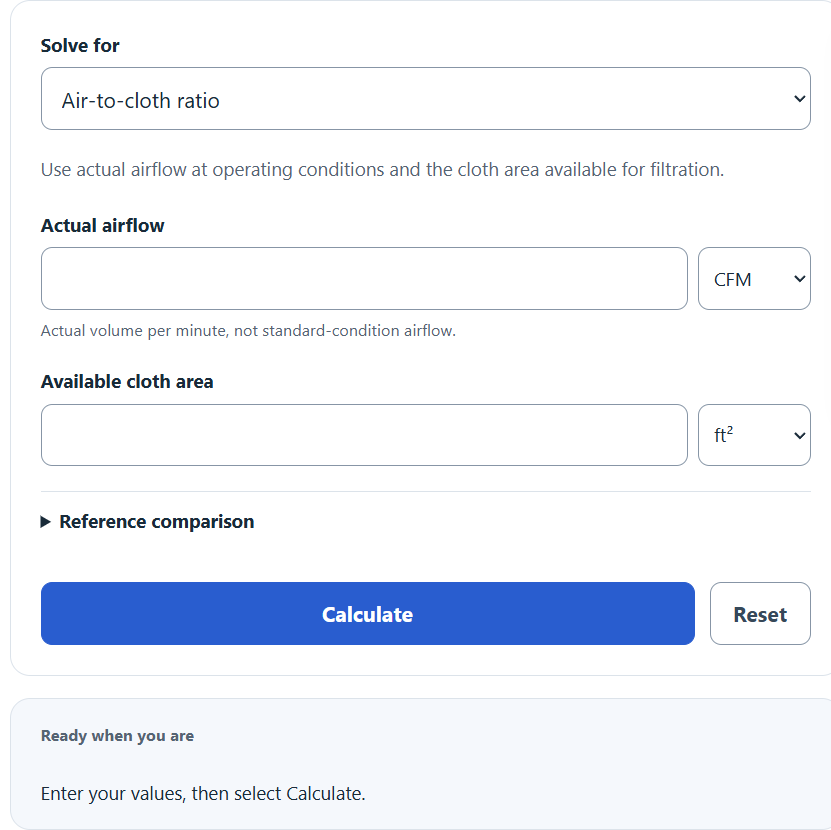
Calculate air-to-cloth ratio for dust collectors, find required filter cloth area, or estimate ratio from bag dimensions and airflow.
- All Construction Calculators
- CFM to FPS Calculator
- CFM to Static Pressure Calculator
- Air Volume Calculator
- Pneumatic Cylinder Airflow Calculator
Air to Cloth Ratio Formula
- A/C Ratio = air to cloth ratio, also called filtration velocity or face velocity (ft/min or m/min)
- Q = airflow rate through the collector (CFM or m³/min)
- A = total filter cloth area (sq ft or sq m)
Use consistent units. CFM ÷ sq ft gives ft/min directly. m³/min ÷ sq m gives m/min. To convert: 1 ft/min = 0.3048 m/min.
For the bag dimensions mode, cloth area per cylindrical bag is:
- D = bag diameter
- L = bag length
Total area is A_bag × number of bags. The calculation assumes clean cylindrical bags and ignores end caps. Cartridge media area is given by the manufacturer and should be used directly.
Illustrative A/C Ratios and Their Limits
The following bands are retained as illustrative values from the original article, not verified design limits. A suitable ratio depends on the dust, loading, filter media, cleaning system and operating conditions. Use a target confirmed by the equipment supplier; the optional comparison does not approve a design. Donaldson explains these application-specific sizing factors.
| Collector Type | A/C Range (ft/min) | A/C Range (m/min) |
|---|---|---|
| Pulse Jet | 3 – 8 | 0.9 – 2.4 |
| Reverse Air | 1.5 – 3.5 | 0.46 – 1.07 |
| Shaker | 1.5 – 4 | 0.46 – 1.22 |
| Cartridge | 1 – 4 | 0.30 – 1.22 |
| Dust Type | Examples | Illustrative Pulse Jet Values (ft/min) |
|---|---|---|
| Coarse | Sand, sawdust, grain | 6 – 8 |
| Average | Cement, clay, foundry | 4 – 6 |
| Fine | Carbon black, fume, lime | 3 – 4 |
| Sticky / Hygroscopic | Starch, sugar, soap | 2 – 3 |
Worked Example
A pulse jet baghouse handles 12,000 CFM with 96 bags, each 6 inches in diameter and 10 feet long.
Area per bag: π × (6/12 ft) × 10 ft = 15.71 sq ft. Total cloth area: 96 × 15.71 = 1,508 sq ft. A/C ratio: 12,000 ÷ 1,508 = 7.96 ft/min. That is near the top of the illustrative pulse jet band above. It does not establish suitability for a particular dust or collector. Compare it with the target specified for the application.
FAQ
Is a higher or lower A/C ratio better? A lower ratio means more filter area for the same airflow. Higher ratios can increase pressure drop and cleaning demand, but performance and bag life depend on the complete application.
What is net vs. gross A/C ratio? Gross uses total cloth area. Net excludes the area of compartments offline for cleaning. Gross and net are equal only when all counted area is available. Use net area when compartments are offline, regardless of cleaning method.
Does temperature change the ratio? The cloth area does not change, but airflow does. Use the actual volumetric flow at operating temperature (ACFM), not the standard flow (SCFM).
What if my result is below a reference band? This alone does not establish oversizing or predict bag life. Check the application-specific target and operating requirements with the equipment supplier.