Choose Solve for to calculate signed arc elasticity or any one price or quantity. All modes show midpoint changes and the resulting revenue comparison. Use consistent quantity units and currency.
- All Business Calculators
- Income Elasticity of Demand Calculator
- Economic Equilibrium Calculator
- Marginal Revenue Calculator
- Consumer Surplus Calculator
- Producer Surplus Calculator
Arc Elasticity Formula
The arc elasticity formula (also called the midpoint elasticity formula) measures the responsiveness of quantity demanded to a price change between two observed points on a demand curve:
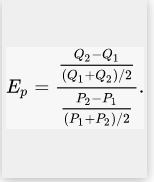
Where Ep is the arc elasticity coefficient, Q1 and Q2 are the quantities demanded at two observed points, and P1 and P2 are the corresponding prices. The denominator uses the average (midpoint) of both price and quantity rather than the initial value alone, which is the defining feature that separates this method from simple percentage change calculations.
What Is Arc Elasticity
Arc elasticity summarizes the price–quantity relationship between two observations. The midpoint method gives the same signed coefficient when the two observations are reversed and is independent of the measurement units. Equal revenue at two distinct positive-price observations corresponds to a signed coefficient of −1, not a guarantee of maximum revenue.
The practical significance of that symmetry property is substantial. Without it, measuring a price increase from $4 to $6 yields a different elasticity than measuring a price decrease from $6 to $4, even though the same two points are involved. The midpoint formula eliminates this inconsistency entirely, making arc elasticity the preferred tool when analyzing price changes that are not infinitesimally small.
Arc Elasticity vs. Point Elasticity
Point elasticity calculates demand responsiveness at a single exact point on a demand curve using the derivative of the demand function. It requires knowledge of the demand equation itself (for example, Qd = 200 – 5P) and computes elasticity as (dQ/dP) x (P/Q). Arc elasticity, by contrast, requires only two price-quantity observations and no underlying equation. This distinction matters in practice because real businesses rarely know their exact demand function but frequently observe sales data at two different price levels.
Point elasticity describes the local slope at a specific point; arc elasticity summarizes an interval. Their difference depends on the curve and interval. No universal 5% or 20% threshold establishes when they agree.
Interpreting Arc Elasticity Values
The absolute value of the arc elasticity coefficient determines the demand classification and its implications for pricing strategy and revenue:
|Ed| > 1 (Elastic magnitude): The midpoint quantity change has greater magnitude than the midpoint price change. For observations on a downward-sloping demand relationship, revenue moves opposite to price over the interval.
|Ed| = 1 (Unit magnitude): For negative elasticity, the two endpoint revenues are equal. Two equal endpoint revenues do not establish the revenue-maximizing price.
|Ed| < 1 (Inelastic magnitude): The midpoint quantity change has smaller magnitude than the midpoint price change. For a downward-sloping demand relationship, revenue moves with price over the interval.
|Ed| = 0 (Perfectly inelastic): Quantity demanded does not change at all when price changes. This is theoretically rare but approximated by goods with no substitutes in the short term, such as insulin for Type 1 diabetics or emergency epinephrine.
|Ed| approaching infinity (Perfectly elastic): Any price increase above the market price causes quantity demanded to drop to zero. This occurs in perfectly competitive markets where buyers can instantly switch to identical substitutes at the prevailing price, such as commodity wheat sold at a grain exchange.
Empirical Elasticity Values by Industry
Numerical elasticity estimates depend on the product definition, study, region and period. The calculator does not supply industry estimates; use observations relevant to the question being studied.
Highly inelastic (|Ed| below 0.5): A magnitude category, not a fixed attribute of any industry.
Moderately inelastic (|Ed| 0.5 to below 1): A magnitude category that must be calculated from relevant observations.
Elastic (|Ed| above 1): Quantity changes proportionally more than price under the midpoint calculation.
Time horizon can affect observed responsiveness; short- and long-run estimates should not be treated as interchangeable.
Arc Elasticity and Total Revenue
Revenue at each endpoint is TR = P × Q. The calculator reports both revenues, their difference and the percentage change relative to starting revenue. With a negative coefficient, elasticity magnitude above 1 corresponds to revenue moving opposite to price; below 1 it moves with price; exactly 1 gives equal endpoint revenues. A zero starting revenue makes the revenue percentage unavailable.
This framework is the basis for revenue-based pricing decisions in industries ranging from airlines (which segment elastic leisure travelers from inelastic business travelers using advance-purchase requirements) to pharmaceuticals (where inelastic demand for essential medications allows price increases without proportional volume loss) to e-commerce platforms (which use A/B pricing tests to empirically estimate arc elasticity across product categories).
Extending the Midpoint Method Beyond Price
The midpoint (arc) formula can be applied to any two-variable elasticity relationship, not just price and quantity demanded. Cross-price arc elasticity replaces P with the price of a related good to measure how demand for one product responds to price changes in another. A positive cross-price arc elasticity indicates substitutes (beef and chicken, Uber and taxi), while a negative value indicates complements (printers and ink, cars and gasoline). Income arc elasticity replaces P with consumer income to classify goods as normal (positive coefficient) or inferior (negative coefficient), with luxury goods typically showing income elasticity above 1.0 and necessities falling between 0 and 1.0.
Supply-side arc elasticity applies the same formula to the quantity supplied rather than quantity demanded, measuring how producer output responds to price changes. Agricultural products tend to have very low short-run supply elasticity because planting cycles are fixed, while manufactured goods with scalable production lines show higher values.
Limitations
Arc elasticity summarizes two observations without identifying the curve between them. It does not require a linear curve, but cannot describe variation in local elasticity within the interval. Changes in income, preferences or other prices can confound a causal interpretation. Two observations alone cannot identify a demand curve or its maximum revenue.
FAQ
Arc elasticity is a measure of the responsiveness of quantity demanded (or supplied) to a change in price, calculated between two distinct points on a demand or supply curve using the midpoint of both variables as the base for percentage changes. It was formalized by R.G.D. Allen in 1934 and is the standard method taught in introductory and intermediate economics courses for analyzing non-infinitesimal price changes.
Use arc elasticity when you have two observed price-quantity data points and do not know the underlying demand equation. The midpoint method gives the same coefficient when the two observations are reversed; there is no universal percentage threshold for choosing it. Use point elasticity when you have a known demand function and need precision at a specific price level.
Arc elasticity for demand is typically negative because of the law of demand: as price increases, quantity demanded decreases (and vice versa). The numerator and denominator of the formula carry opposite signs, producing a negative quotient. Many textbooks and calculators report the absolute value for convenience, but the sign itself carries information. A positive observed coefficient means price and quantity moved together; it does not by itself prove a Giffen or Veblen effect.
If |Ed| > 1 (elastic), a price decrease increases total revenue and a price increase decreases it. If |Ed| < 1 (inelastic), a price increase raises total revenue. For negative signed elasticity, |Ed| = 1 gives equal endpoint revenues. This does not locate a maximum. Usual demand revenue comparisons require a downward-sloping relationship.