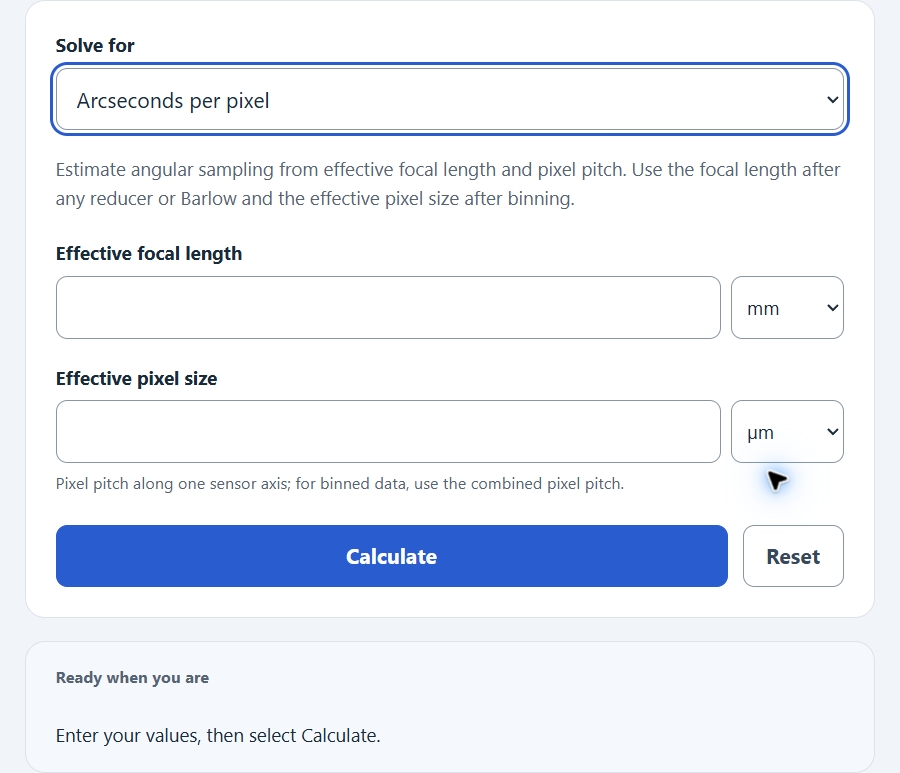
Select Solve for, enter the two displayed values and choose Calculate to estimate astronomy image scale, focal length or pixel size.
- All Physics Calculators
- Dawes Limit Calculator
- Field of View Calculator
- Pixels Per Degree to Resolution Calculator
- Angle of View Calculator
- Focal Ratio Calculator
Arc Seconds Per Pixel Formula
The arc seconds per pixel value, also called image scale, tells you how much sky each camera pixel covers. The calculator uses effective focal length in millimeters and effective pixel pitch in micrometers in a small-angle approximation near the optical axis. Account for reducers, Barlows and binning in these inputs. The rounded constant 206.265 makes the displayed formulas approximate.
- ASPP = arc seconds per pixel, in arc-sec/pixel
- PS = pixel size, in micrometers, µm
- FL = focal length, in millimeters, mm
- 206.265 = conversion constant based on the number of arc seconds in a radian and the µm to mm unit relationship
To solve for focal length, the formula is rearranged as:
- FL = focal length, in millimeters, mm
- PS = pixel size, in micrometers, µm
- ASPP = arc seconds per pixel
To solve for pixel size, the formula is rearranged as:
- PS = pixel size, in micrometers, µm
- ASPP = arc seconds per pixel
- FL = focal length, in millimeters, mm
Choose the unknown value in Solve for, enter the two displayed inputs, then select Calculate. If you enter focal length and pixel size, it calculates arc seconds per pixel. If you enter arc seconds per pixel and pixel size, it calculates the focal length needed. If you enter focal length and arc seconds per pixel, it calculates the pixel size that would produce that image scale.
Typical Image Scale Ranges
These ranges are illustrative sampling examples, not universal equipment recommendations. The best value depends on seeing conditions, tracking accuracy, optical quality, and the type of object you are imaging.
| Arc-sec/pixel | Typical use | General interpretation |
|---|---|---|
| Less than 0.5 | High-resolution planetary or very long focal length imaging | Very fine sampling. Often limited by seeing and tracking. |
| 0.5 to 1.0 | Small galaxies, planetary nebulae, detailed lunar work | Fine image scale. Requires good seeing and accurate guiding. |
| 1.0 to 2.0 | Many deep-sky imaging setups | Common balanced range for resolution and signal. |
| 2.0 to 4.0 | Wide-field nebulae, star fields, large galaxies | Coarser sampling; field of view also depends on the image dimensions in pixels. |
| More than 4.0 | Very wide-field imaging | Large sky coverage per pixel, but less fine detail. |
Common Unit Conversions
| Quantity | Conversion |
|---|---|
| Focal length | 1 cm = 10 mm |
| Focal length | 1 m = 1000 mm |
| Focal length | 1 in = 25.4 mm |
| Pixel size | 1 mm = 1000 µm |
| Pixel size | 1 in = 25,400 µm |
Example Calculations
Example 1: Calculate arc seconds per pixel
You have a telescope with a focal length of 800 mm and a camera with 3.76 µm pixels.
The image scale is about 0.97 arc-sec/pixel.
Example 2: Calculate focal length
You want an image scale of 1.5 arc-sec/pixel using a camera with 4.3 µm pixels.
The required focal length is about 591.3 mm.
FAQ
What does arc seconds per pixel mean?
Arc seconds per pixel tells you the angular size of the sky recorded by one pixel on your camera sensor. A smaller number means each pixel covers a smaller part of the sky, which gives finer sampling. A larger number means each pixel covers more sky, which gives coarser sampling. Total field of view also depends on the image dimensions in pixels.
Is a lower arc-sec/pixel value always better?
No. A lower value gives finer sampling, but it can also make the setup more sensitive to atmospheric seeing, tracking errors, focus problems, and optical imperfections. For many deep-sky setups, a value around 1 to 2 arc-sec/pixel is often practical, but the best value depends on your conditions and target.
Why does focal length affect arc seconds per pixel?
Longer focal length magnifies the image more, so each pixel covers a smaller angle of sky. That lowers the arc-sec/pixel value. Shorter focal length spreads a wider area of sky across the sensor, so each pixel covers a larger angle, increasing the arc-sec/pixel value.