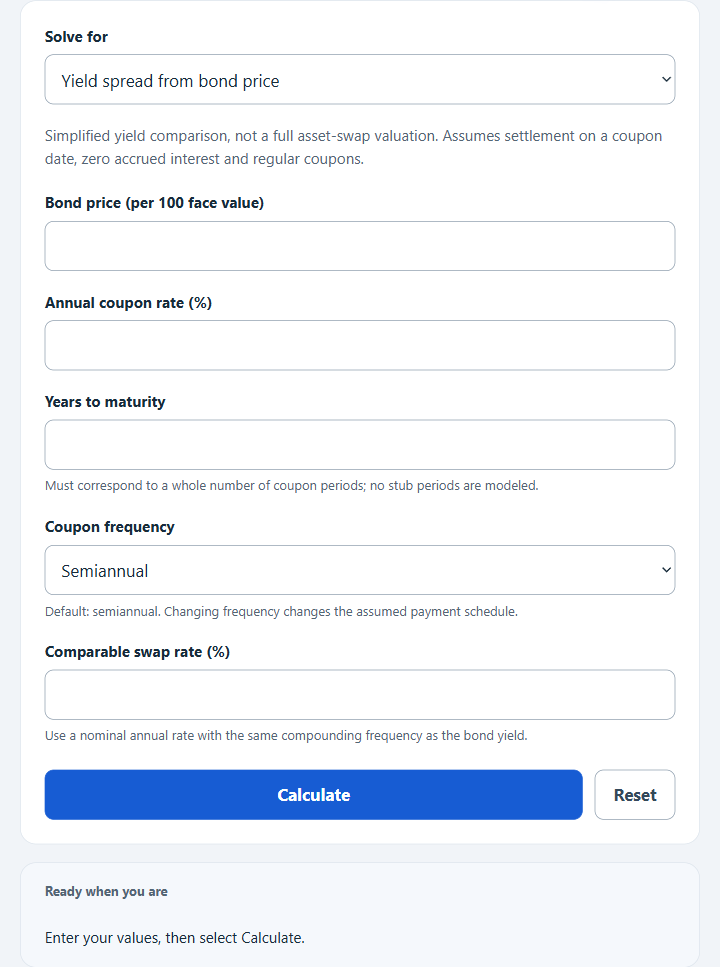
Estimate a simplified yield spread from bond price and a comparable swap rate, or estimate price from a target yield spread. This is a proxy, not a full asset-swap valuation.
Related Calculators
- Basis Points Difference Calculator
- BPS Calculator (Basis Points Calculator)
- Constant Yield Calculator
- Book Value Per Share Calculator
- All Business Calculators
Asset Swap Spread (ASW) Formula (Simplified)
The calculator above uses a simplified approximation for an asset swap spread by comparing a bond’s yield-to-maturity to the par swap rate of the same maturity.
- Where ASWbps is the (approximate) asset swap spread in basis points (bps)
- YTM% is the bond’s yield to maturity in percent (%) implied by the bond clean price (per 100)
- S% is the par swap rate (in %) for the same maturity
Note: A true asset-swap spread requires swap-curve valuation and market conventions. This yield-based proxy assumes settlement on a coupon date, zero accrued interest, redemption at 100, and a whole number of regular coupon periods. Bond yield and swap rate must use the same nominal annual compounding convention; stub periods and optionality are not modeled.
What is an Asset Swap?
Definition:
In fixed-income markets, an asset swap typically refers to combining a bond (the “asset”) with an interest rate swap so that the investor transforms the bond’s fixed cash flows into floating-rate cash flows (or vice versa). The asset swap spread (ASW) is commonly quoted in basis points and is often interpreted as the bond’s spread relative to the swap curve under the chosen market conventions.
How to Calculate Asset Swap Spread (ASW)?
Example Problem:
The following example outlines how to estimate ASW using the simplified approach implemented in the calculator.
Assume a bond has a clean price of 100.00 per 100 of face value, a 5.00% annual coupon paid semi-annually, and 5 years to maturity. The par swap rate for 5 years is 4.00%.
First, compute the bond’s yield to maturity (YTM). For a standard coupon bond priced at par (100.00), the YTM equals the coupon rate, so YTM = 5.00% (under the simplified assumptions of this calculator).
Next, compute the approximate ASW spread:
ASWbps ≈ (YTM% − S%) × 100
ASWbps ≈ (5.00% − 4.00%) × 100 = 100 bps
So the estimated asset swap spread is 100 bps.
FAQ
How can interest rate fluctuations affect an asset swap?
Interest rate changes affect both the bond’s price/yield and the swap curve. When rates move, the implied yield to maturity and the relevant par swap rate can change, which can widen or tighten the asset swap spread and change whether the position looks attractive under the chosen valuation assumptions.
What are the key risks associated with asset swaps?
Major risks include interest rate risk, credit/spread risk on the bond, and counterparty risk on the swap. Liquidity risk is also relevant, since either the bond or the swap may be costly to unwind in stressed markets.
When is swapping one asset for another most beneficial?
In fixed-income trading, asset swap packages are often used when an investor wants to isolate credit/spread exposure while hedging interest rate risk, or when relative-value opportunities appear between a bond’s yield and the swap curve. The attractiveness depends on swap levels, credit spreads, funding/financing, and market liquidity.