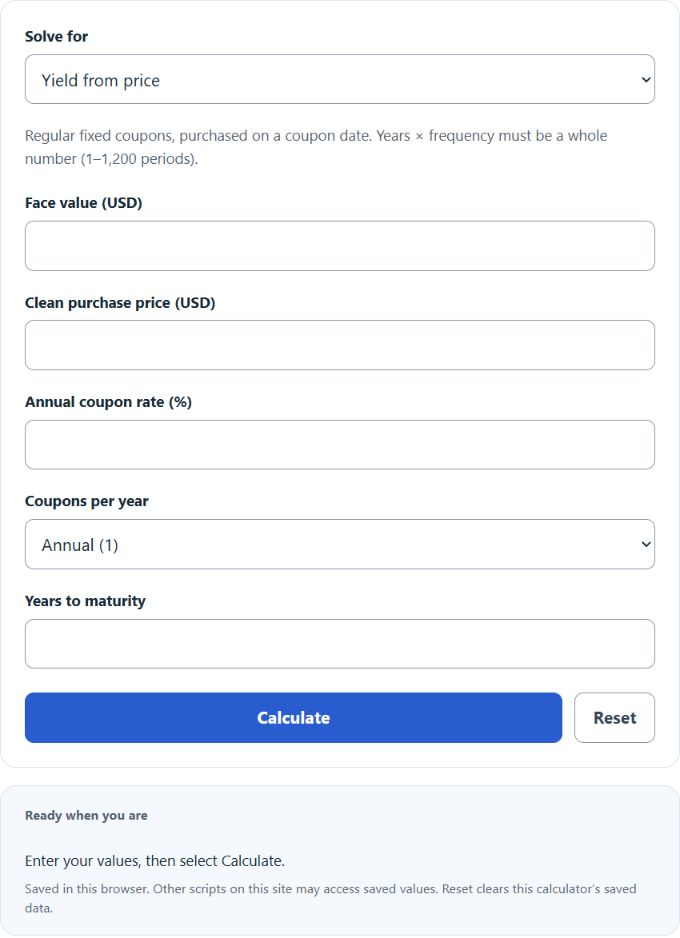
Calculate regular fixed-coupon bond yield to maturity, price from yield, and constant-yield amortization. Without dates, purchase is assumed to occur on a coupon date and years × coupon frequency must be a whole number (1–1,200 periods). In price mode, optional settlement and maturity dates replace years and determine the remaining coupon schedule. Discounting uses Actual/Actual coupon-period fractions; the selected day count applies to accrued interest. The model excludes calls, defaults, tax, fees, business-day adjustments and irregular coupons.
Related Calculators
- Yield To Maturity Calculator
- Discounted Value Calculator
- Days To Maturity Calculator
- Reverse ROI Calculator
- Capitalized Interest Calculator
- All Business Calculators
Approximate Constant Yield (Approximate YTM) Formula
The following formula is a common approximation for a bond’s yield to maturity (sometimes called the “approximate YTM”). The exact yield to maturity is the discount rate that solves the full bond pricing equation and typically must be found using iteration or a financial calculator (like the one above).
Variables:
- Yapprox is the approximate yield to maturity (constant yield), as a decimal per year
- C is the annual coupon payment (in dollars). If you have an annual coupon rate r, then C = r × F.
- F is the face (par) value of the bond
- P is the bond’s clean price; on a coupon date, accrued interest is zero and clean equals dirty price
- T is the years to maturity
To estimate the yield, add the annual coupon payment to the average annual price change toward par, (F − P) / T. Then divide by the average of the face value and the price, (F + P) / 2. This estimate is most accurate for bonds near par and with moderate maturities; for the stated regular-coupon assumptions, the calculator solves the full pricing equation numerically. Between coupon dates, discount the remaining cash flows from settlement to obtain dirty price, then subtract accrued interest to obtain clean price.
What is a Constant Yield?
In bond investing, yield to maturity (YTM) is the discount rate that equates the present value of promised coupons and principal to the purchase price. This calculator reports nominal annual yield (periodic yield × coupon frequency) separately from effective annual yield. In constant-yield/effective-interest amortization, interest equals beginning carrying value × periodic yield; the difference from the coupon changes carrying value toward face value. The schedule ends before principal redemption and uses unrounded balances. YTM assumes promised payments occur and does not guarantee realized return; reinvestment rates, calls, taxes and fees can change the outcome. This educational schedule does not determine tax treatment.
How to Calculate Constant Yield?
The following steps outline how to calculate the Constant Yield.
- First, determine the annual coupon payment (C) or the annual coupon rate and face value (so you can compute C).
- Next, determine the face value of the bond (F).
- Next, determine the bond’s clean price (P). Yield and amortization modes assume purchase on a coupon date, when accrued interest is zero.
- Next, determine years to maturity (T) and coupon frequency. Without dates, their product must be a whole number. For dated price calculations, enter both settlement and maturity dates instead; regular coupon dates are anchored to maturity, preserving month-end dates.
- To estimate the yield quickly, you can use the approximation: Yapprox = (C + (F − P) / T) / ((F + P) / 2). For the exact yield to maturity, solve for the yield rate that makes the present value of the bond’s future cash flows equal to its price (this generally requires iteration).
- After inserting the values and calculating the result, check your answer with the calculator above.
Example Problem :
Use the following variables as an example problem to test your knowledge.
Annual Coupon Payment (C) = 50
Face Value (F) = 1000
Purchase Price (P) = 950
Years to Maturity (T) = 10