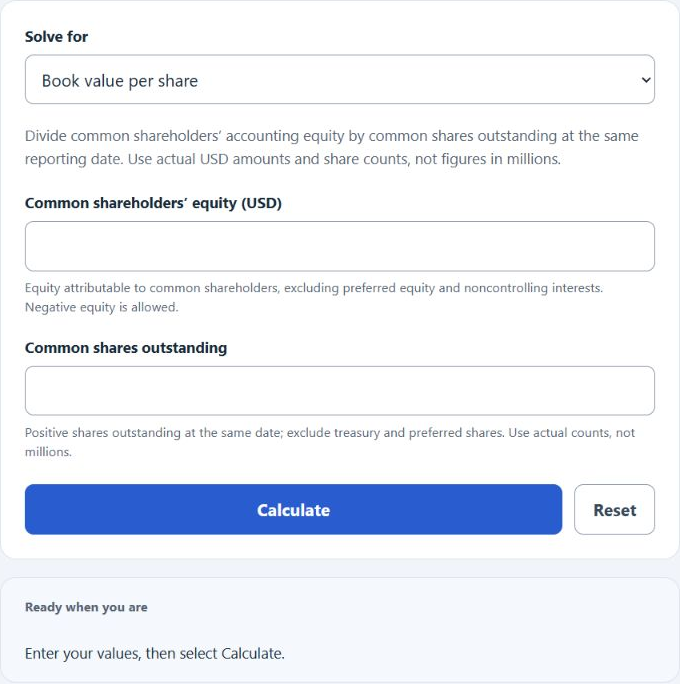
Select book value per share, common shareholders’ equity, or common shares outstanding, then enter the two requested values. Use common equity and actual outstanding share counts at the same reporting date.
- All Business Calculators
- Graham Number Calculator
- Stock Profit Calculator
- Par Value Per Share Calculator
- Cost Basis Per Share Calculator
- Shareholders’ Equity Calculator
- Share Price Calculator
Book Value Per Share Formula
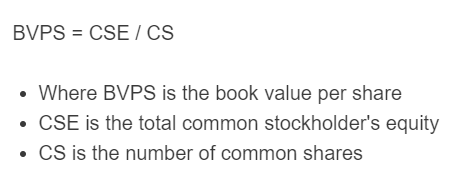
The primary formula for book value per share is:
- BVPS = book value per share, in dollars per share
- Equity = total common stockholder's equity, in dollars
- Shares = common shares outstanding at the same reporting date, excluding treasury and preferred shares
Select the quantity to solve for; the calculator shows the two required inputs and rearranges the formula:
- To calculate book value per share: enter total common stockholder's equity and number of common shares.
- To calculate total common stockholder's equity: enter book value per share and number of common shares.
- To calculate number of common shares: enter total common stockholder's equity and book value per share.
Book Value Per Share Inputs and Interpretation
| Input | Where it usually comes from | Notes |
|---|---|---|
| Total common stockholder's equity | Balance sheet, stockholders' equity section | Use equity attributable to common shareholders, excluding preferred equity and noncontrolling interests. Do not enter total assets or liabilities. |
| Number of common shares | Financial statements, share count disclosures, or company filings | Use common shares outstanding at the equity reporting date. Exclude preferred and treasury shares. Do not use weighted-average EPS shares or mix actual amounts with figures in millions. |
| Book value per share | Calculated from equity divided by common shares | Represents accounting value per common share, not the market price. |
| Result pattern | What it may suggest | Important limitation |
|---|---|---|
| Higher BVPS | More accounting equity supports each common share. | A high BVPS does not automatically mean the stock is undervalued. |
| Lower BVPS | Less accounting equity supports each common share. | Some companies have low book value because their value comes from intangible assets or future earnings. |
| Negative BVPS | Common stockholder's equity is negative. | This can indicate financial weakness, but you should review the full balance sheet and income statement. |
Example Problems
Example 1: Calculate book value per share
A company has total common stockholder's equity of $5,000,000 and 1,000,000 common shares.
The book value per share is $5.00.
Example 2: Calculate total common stockholder's equity
A company has a book value per share of $12.50 and 800,000 common shares.
The total common stockholder's equity is $10,000,000.
FAQ
Is book value per share the same as stock price?
No. Book value per share is based on accounting equity from the balance sheet. Stock price is the market price investors are currently willing to pay for one share. A stock can trade above or below its book value per share.
Should preferred stock be included in book value per share?
For common book value per share, use equity attributable to common shareholders. Exclude preferred equity and any noncontrolling interests from a broader total, following the issuer’s reported equity definition. Use a matching period-end common share count.
Why can book value per share be negative?
Book value per share can be negative when common stockholder's equity is negative. This means liabilities and other claims exceed the company's recorded assets available to common shareholders.