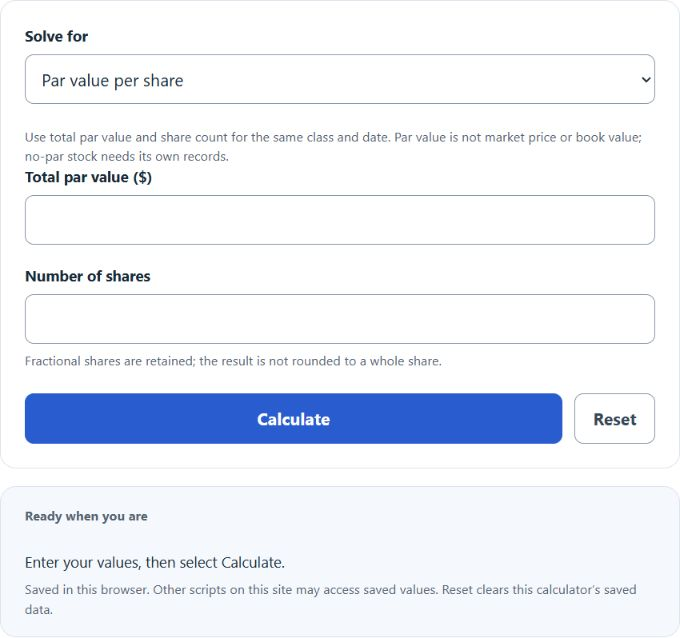
Select a solve direction and enter two known values for the same stock class and date to calculate par value per share, share count, or aggregate par value.
Related Calculators
- Cost of Preferred Stock Calculator
- Total Price Calculator
- Net Fixed Assets Calculator
- Net Loss Calculator
- All Business Calculators
Par Value Per Share Formula
The following formula is used to calculate the par value per share for a given total par value and total number of shares.
Variables:
- P is the par value per share
- T is the total par value of shares
- N is the total number of shares
To calculate the par value per share, divide the total par value of shares by the total number of shares.
What is Par Value Per Share?
Par value per share is the nominal or face value assigned to a share of stock by the issuing company. Its legal and accounting effects depend on the applicable law and company records; some stock is issued without par value. The par value is typically set at a very low amount, such as $0.01 per share, and is distinct from market price and book value per share. Instead, it serves as a baseline value for accounting purposes and helps to establish the company’s legal capital.
How to Calculate Par Value Per Share?
The following steps outline how to calculate the Par Value Per Share.
- First, determine the total par value of shares (T).
- Next, determine the total number of shares (N).
- Finally, calculate the par value per share using the formula P = T / N.
- After inserting the values and calculating the result, check your answer with the calculator above.
Example Problem :
Use the following variables as an example problem to test your knowledge.
Total Par Value of Shares (T) = $10,000
Total Number of Shares (N) = 1,000