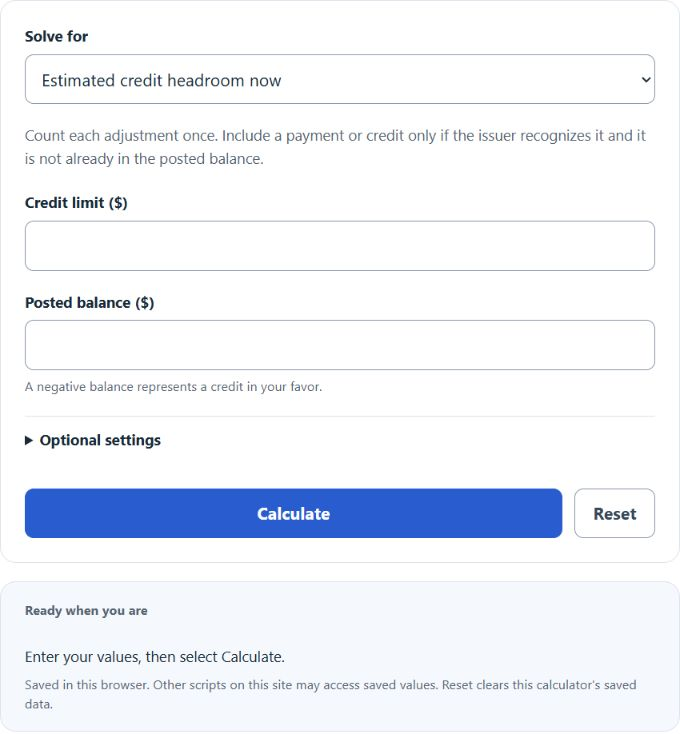
Estimate credit headroom, modeled utilization, purchase room at your chosen target, and an additional payment needed to reach it. Issuer approval and reported utilization can differ.
Available Credit Formula
Available credit is the credit limit minus the balance that is already using the account. Pending charges reduce available credit, while pending payments or credits can increase it once the issuer recognizes them.
E = B + P - C
 AC = L - E
Variables:
- E is net exposure, which can be negative for a credit balance
- B is the posted balance
- P is pending charges
- C is additional payments or credits recognized by the issuer and not already in the posted balance
- AC is mathematical credit headroom; the issuer determines usable available credit
- L is the credit limit
For a utilization target, the maximum target balance and the payment needed are:
TB = L * u
 Room = max(0, TB - E)
 Payment Needed = max(0, E - TB)
Here u is the target utilization written as a decimal. Purchase room rounds down to whole cents; payment needed rounds up. Negative net exposure is retained as a credit balance. Headroom above the limit does not guarantee extra spending capacity. Modeled utilization uses max(0, E)/L and may differ from credit-bureau reporting. Count each adjustment once.
Available Credit Examples by Exposure
The examples below use a $10,000 credit limit and show how pending activity changes both spendable credit and utilization.
| Posted balance | Pending charges | Pending credits | Available credit | Utilization |
|---|---|---|---|---|
| $2,000 | $0 | $0 | $8,000 | 20% |
| $2,000 | $500 | $0 | $7,500 | 25% |
| $2,000 | $500 | $300 | $7,800 | 22% |
| $8,500 | $750 | $0 | $750 | 92.5% |
Example Problems
Example 1: Find available credit now.
A card has a $10,000 limit, a $2,400 posted balance, $175 of additional pending charges, and a $300 payment recognized by the issuer but not yet reflected in that posted balance. Exposure is 2400 + 175 - 300 = $2,275. Available credit is 10000 - 2275 = $7,725.
Example 2: Find the payment needed for a target.
The same $10,000 card has $4,100 of exposure and you want 30% utilization. The target balance is 10000 * 0.30 = $3,000. The estimated payment needed is 4100 - 3000 = $1,100.
Frequently Asked Questions
Why is my available credit different from limit minus posted balance?
Pending card authorizations, holds, recent payments, credits, disputes, and issuer availability rules can all affect the number. Enter known pending items for an estimate, then use the issuer's displayed available credit before making a transaction.
Can available credit be negative?
Yes. A balance plus pending charges can exceed the limit, especially after fees, interest, a lowered limit, or a large hold. A negative estimate shows the amount by which exposure exceeds the limit.
Does a payment restore available credit immediately?
Not always. Some issuers release credit as soon as a payment posts, while others hold availability until the payment clears. Include a payment or credit in this estimate only when the issuer recognizes it and it is not already reflected in the posted balance. Dollar inputs use whole cents and are limited to one trillion dollars per field.